Many cross-chain products now promise the same thing: one click, no bridge screens, no chain switching, no gas-token juggling. The interface is cleaner. The harder question is whether the risk is actually lower.
Usually, it is not. At least not automatically.
A lot of the confusion comes from three terms getting blended together: account abstraction, intents, and chain abstraction. They are related, and modern wallets often combine all three. But they solve different problems at different layers. Once those layers blur, it becomes much harder to judge whether a product is truly reducing bridge risk or simply hiding it behind better design.
Chain Abstraction vs Intents vs Account Abstraction: Start With the Right Mental Model
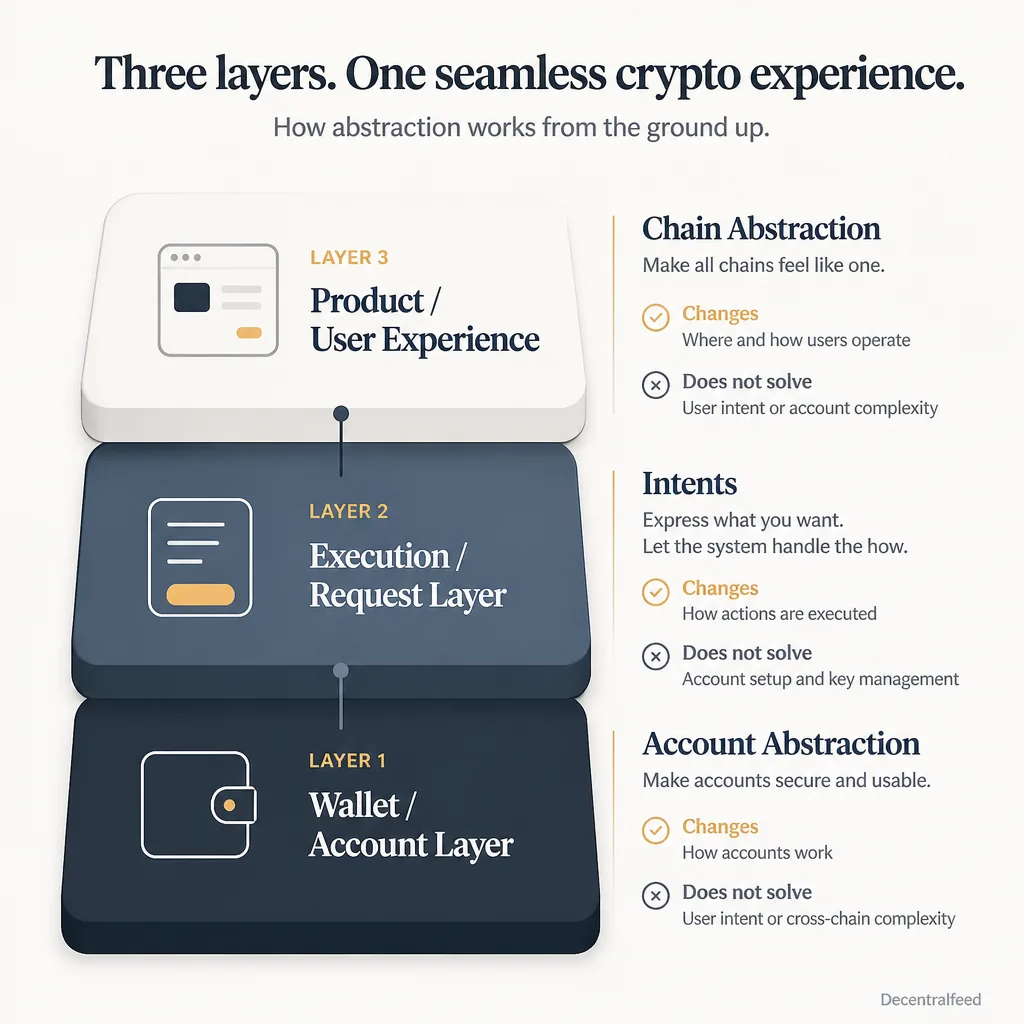
The simplest way to make sense of the terminology is to stop treating these as competing buzzwords.
They are better understood as layers of the stack:
- Account abstraction changes the wallet/account layer
- Intents change the request/execution layer
- Chain abstraction changes the product/UX layer
Why these terms get blurred together
Because real products bundle them.
A wallet might use a smart account built around ERC-4337, let you pay gas with a non-native token, route your request through an intent-based solver network, and present the whole experience as “chain abstraction.” That is not necessarily misleading. But it does make the architecture harder to inspect.[^1]
For users, the problem is simple: the smoother the flow looks, the easier it is to miss where the real trust assumptions live.
The simple distinction: wallets, execution, and user experience are different layers
A practical way to remember it:
| Concept | Layer | What it helps | What it does not solve | Main risk or limitation |
|---|---|---|---|---|
| Account abstraction | Wallet/account | Signing UX, gas sponsorship, batching, session keys | Cross-chain settlement, bridge security, destination execution risk | Better UX can hide unchanged settlement risk |
| Intents | Execution/request | Lets users ask for an outcome instead of choosing the route | Does not remove trust assumptions by default | Solver trust, opaque routing, censorship, bad execution |
| Chain abstraction | Product/UX | Hides chain-level complexity from the user | Not a safety property on its own | May simply conceal bridge usage and intermediate dependencies |
That distinction matters because bridge risk falls because of architecture, not terminology.
Account Abstraction Changes the Wallet Layer, Not Cross-Chain Settlement
If your question is narrowly, “Will this protect me from bridge-related risk?” account abstraction is the least relevant of the three.
Not because it is unimportant. It is. But it solves a different problem.
What account abstraction usually means in practice: smart wallets, gas sponsorship, session keys
On Ethereum and Ethereum-compatible systems, account abstraction usually refers to smart-account-based improvements such as:
- batched transactions
- sponsored gas through paymasters
- custom spending rules
- session keys
- recoverability
- paying gas with tokens other than the chain’s native asset, depending on implementation[^1]
That is the world of ERC-4337, smart account infrastructure, and wallet designs that move beyond the old “one key, one externally owned account” model. Newer proposals like EIP-7702 are also part of the broader wallet-evolution conversation.[^2]
What it improves for users
This can improve safety at the margins.
A smart wallet can reduce clumsy multi-step flows. It can lower the chance of user error around repeated approvals, chain-specific gas preparation, or awkward signing sequences. A user who can batch actions or rely on session permissions may make fewer operational mistakes.
That is real progress.
A concrete example: a wallet might let you sign once to swap and send USDC while sponsoring gas and handling approvals in the background. That is a better experience than manually topping up gas, switching chains, and signing three or four separate transactions.
What it does not solve: bridge security, liquidity fragmentation, and destination-chain execution risk
What it does not solve is the hard part of moving value across chains.
If your smart wallet lets you pay gas in USDC while sending funds from Arbitrum to Base, the wallet may feel much better. But under the hood, the system still needs a route for value transfer or fulfillment. That route could involve a bridge, a liquidity network, a solver using inventory, or some hybrid model.
Account abstraction does not remove:
- bridge contract risk
- multisig or governance risk in cross-chain systems
- liquidity fragmentation
- destination-chain smart contract risk
- bad routing
- slippage on the final swap
- delayed or failed settlement
The right summary is simple: account abstraction improves usability, not cross-chain settlement by itself.
Intents Change How Execution Is Requested
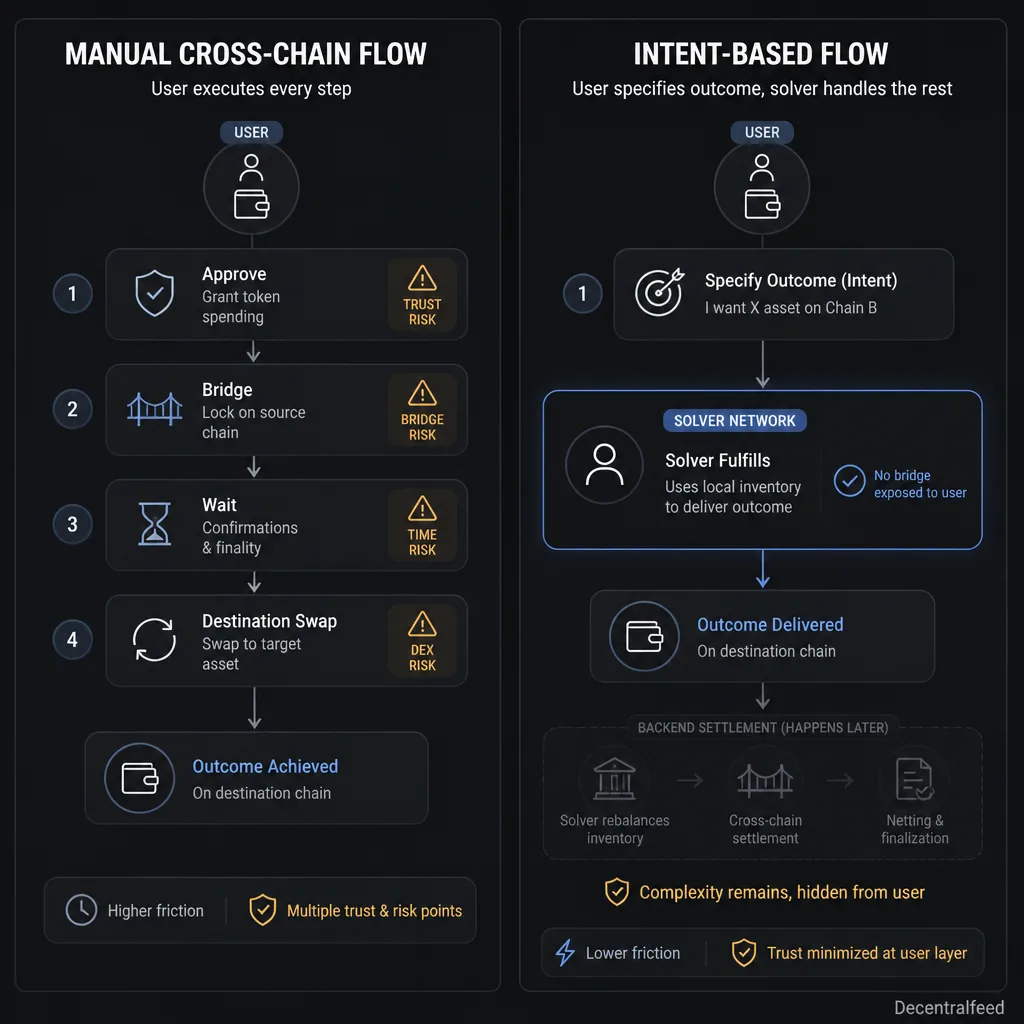
Intents matter more directly to the bridge-risk conversation because they change how the user expresses what they want.
What an intent is: the user specifies an outcome, not the exact path
An intent is an outcome-based request.
Instead of specifying exact calldata and route, the user says something closer to: I want to end up with 1,000 USDC on Base.
Then someone else figures out how to make that happen.
This design shows up in different forms across crypto. UniswapX uses offchain orders with third-party fillers in a trading context.[^3] Across uses relayers and a separate settlement mechanism in a cross-chain context.[^4] The details differ, but the pattern is similar: the user specifies the destination outcome, and specialized actors compete or coordinate to fulfill it.
How solvers, fillers, or relayers complete the request
The terminology varies, and the differences can matter.
- A solver may compute and execute the route
- A filler may fill the order
- A relayer may transport messages or front gas
- A market maker or liquidity provider may supply inventory
In practice, these roles often overlap.
Consider a user moving USDC from Arbitrum to Base. In a manual flow, the user picks the bridge, approves the token, waits for settlement, then may need another swap on the destination chain.
In an intent-based flow, a solver might simply deliver USDC on Base immediately from its own inventory, then rebalance later through a separate venue or settlement layer.
From the user’s perspective, that can feel “bridge-less.”
Why intents can reduce direct user interaction with bridges
This is where intent systems can genuinely help.
They can reduce direct user exposure to:
- choosing a weak route
- forgetting destination gas
- making timing mistakes
- waiting through long canonical settlement windows
- manually handling multi-step bridge-plus-swap flows
Professional solvers may also route better than retail users in some conditions. That is not guaranteed, but it is a real possibility.
The new risks: solver trust, censorship, opaque routing, poor execution, private orderflow concerns
The hidden issue is that the bridge step may be removed for you, not necessarily from the system.
That means new trust assumptions appear:
- solver or filler concentration risk if only a few parties can execute reliably
- censorship or liveness risk if fulfillment depends on a narrow network
- opaque routing if the product does not disclose how your order is completed
- poor execution quality if the solver wins by giving you a worse fill than you realize
- private orderflow concerns if offchain requests expose useful information to counterparties or intermediaries[^5]
- unclear recourse if execution fails halfway through
This is the tradeoff many marketing pages skip. Intents can reduce the need for users to touch a bridge interface. They do not automatically remove cross-chain trust assumptions.
Chain Abstraction Is the Product Layer That Hides the Plumbing
“Chain abstraction” is best understood as a user-facing design goal, not a single primitive.
What chain abstraction is trying to do from the user’s perspective
The promise is straightforward: the user should not need to care which chain they are on, what gas token is required, which bridge to use, or how the assets arrive.
That framing is explicit in resources like NEAR’s chain abstraction documentation, which describes abstracting chains away from the user experience.[^6]
This is why chain abstraction is compelling. It aims to make crypto feel less like operating infrastructure and more like using software.
Why chain abstraction often depends on account abstraction, intents, bridges, or all three
Most chain abstraction products are built from some mix of:
- smart wallet infrastructure
- gas abstraction
- intent-based execution
- bridge or liquidity routing
- backend rebalancing
- cross-chain messaging
That is why chain abstraction should not be treated as a direct answer to the question, “Is this safer?”
It might be. But only because of what sits underneath it.
When chain abstraction genuinely reduces bridge exposure
It can genuinely help when the underlying system:
- reduces how often users need to move value across chains at all
- uses local liquidity or inventory-based fulfillment where that is safer and more resilient
- avoids unnecessary hops through multiple bridges
- makes route selection transparent
- keeps custody handoffs minimal
- makes recovery paths explicit
If a product consistently helps users avoid brittle, manual bridge flows and replaces them with well-capitalized, transparent, audited execution paths, that can be a meaningful improvement.
When it only makes bridge usage less visible
The opposite case is common too.
A wallet may advertise instant chain abstraction while still routing through one or more third-party bridges, suppressing route details, adding opaque fees, and giving the user no clear answer to basic questions like:
- Where are my funds if this stalls?
- Who had temporary control during execution?
- What bridge or liquidity network was actually used?
- What happens if the filler disappears?
A clean interface is not the same thing as a clean risk profile.
What Actually Reduces Bridge Risk for Real Users
If you strip away the language, a few factors do most of the work.
Reducing the number of times value must cross chains
The first and most underrated improvement is simple: move value across trust boundaries less often.
If a product architecture reduces unnecessary re-bridging, avoids fragmented multi-hop paths, or keeps activity local where possible, risk often drops immediately.
Every extra cross-chain dependency is another place where timing, verification, governance, or contract assumptions can fail.
Using local liquidity or solver inventory instead of canonical bridging when appropriate
Sometimes the safest user experience is not waiting for a direct canonical bridge transfer.
A solver with local Base inventory can, in some cases, fulfill a request faster and spare the user from direct interaction with a bridge contract. That can reduce exposure to one category of failure.
But “when appropriate” matters. If the replacement is a weakly disclosed, centralized inventory provider with unclear solvency, the improvement may be mostly cosmetic.
Limiting user custody handoffs and opaque intermediate steps
The more places funds, permissions, or control pass through, the more questions the user should ask.
Good systems minimize unnecessary handoffs. Great systems explain them.
That matters because many losses do not come from bridging as an abstract concept. They come from specific weak points: compromised validator sets, bad message verification, governance failures, liquidity insolvency, or destination execution problems.
Making failure handling explicit instead of invisible
A lot of products optimize the happy path.
Real safety shows up in the unhappy path.
If a route breaks halfway through, users should be able to learn:
- where the funds are
- whether the transfer is pending, reversible, or claimable
- what the timeout logic is
- who bears settlement risk
- what support or self-service recovery exists
Invisible complexity is tolerable only when failure handling is visible.
The Tradeoff Most Marketing Skips: Risk Is Usually Moved, Not Deleted
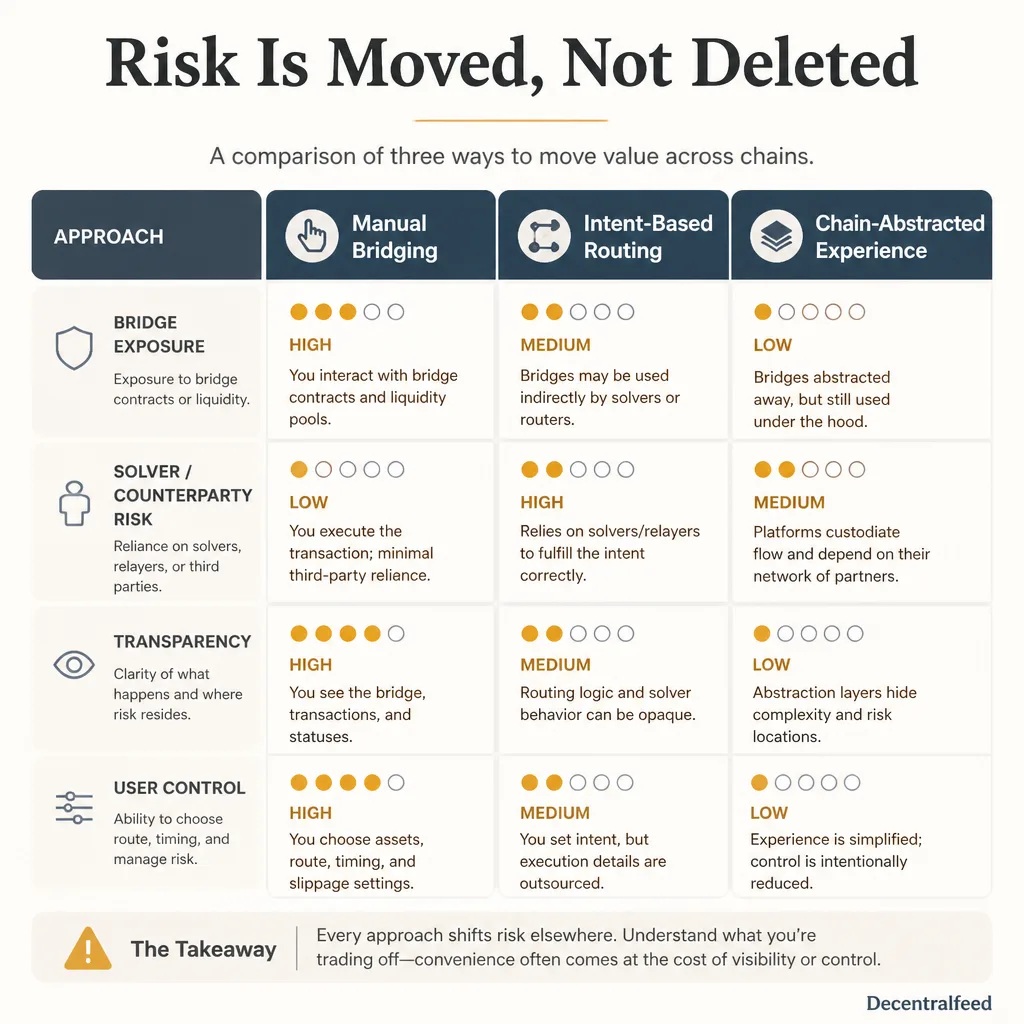
This is the central idea.
Bridge risk vs counterparty and solver risk
You can reduce dependence on a bridge contract and still increase dependence on a solver network, market maker, operator treasury, or backend settlement process.
That does not make the design bad. It means the risk has moved.
Execution simplicity vs transparency
Manual bridge flows are often ugly but legible.
Abstracted flows are often elegant but harder to inspect.
For most users, the sweet spot is not maximum abstraction. It is abstraction with enough transparency that you still know what system you are trusting.
Convenience vs user control
Every one-click design makes choices on the user’s behalf.
Sometimes that is a feature. Sometimes it quietly gives up route selection, timing, privacy, and execution visibility.
Why the safest-looking UX can still hide the most assumptions
The cleanest interface can sit on top of the messiest architecture if it conceals where funds actually travel and who gets temporary control over the process.
That is the practical warning.
How to Evaluate a Router or Wallet Before You Trust It
You do not need to read every contract to get a much better signal.
Custody model: who controls funds during routing
Ask:
- Do funds stay in user-controlled contracts until fulfillment?
- Do they pass through escrow contracts, relayers, market makers, or protocol pools?
- Is the system “non-custodial” only at signing time, or throughout execution?
That distinction matters more than branding.
Failure handling: what happens if a step breaks midway
Look for clear answers to:
- What happens if the destination fill is delayed?
- Is there a timeout?
- Can you reclaim funds?
- Is the route atomic, partially recoverable, or manually recoverable?
- Does the app explain this before execution?
If those answers are missing, assume the product is optimized more for conversion than for user safety.
Quote transparency: fees, slippage, bridge path, and destination assumptions
Before you approve anything, check whether the app shows:
- total fees
- spread
- expected destination amount
- slippage assumptions
- selected route
- bridge or liquidity source
- whether the route may change mid-execution
If the quote looks magical, it may simply be incomplete.
Private orderflow and MEV handling options
If the system takes requests offchain, ask:
- Who can see the order before execution?
- Is it broadcast publicly?
- Are there protections against harmful information leakage?
- Can you choose private orderflow options?
This is especially relevant in intent-based systems where third parties compete to fill user requests.[^5]
Security posture: audits, bug bounties, open-source components, and incident history
Check for:
- recent audits from recognized firms
- public bug bounty programs
- open-source core contracts or repos
- disclosed incident history
- evidence of production use under stress
No audit makes a protocol safe. But no transparency at all is a bad sign.
What to test first with small transactions
Before trusting meaningful size, do a low-value trial.
A good first test looks like this:
- Send a small amount of a common asset such as USDC from one L2 to another.
- Compare the quoted output with what you actually receive.
- Measure time to completion.
- Inspect the route details if available.
- Note whether the app explains delays clearly.
- Check what support or recovery options exist if the flow stalls.
If the small transaction feels opaque, the large one will not feel better.
A Practical Rule of Thumb
Here is the clean version.
Account abstraction improves usability
It can reduce friction, improve wallet safety at the edges, and make multichain apps less annoying to use. But it does not directly solve bridge security.
Intents can reduce direct bridge handling but add execution-layer trust assumptions
They can be genuinely useful. In some cases, they may produce better routing and less user error than manual bridging. But they shift power toward solvers, fillers, and routing infrastructure, which makes transparency especially important.
Chain abstraction is only safer when the hidden system underneath is safer
Chain abstraction describes the experience, not the guarantee.
If the routing, liquidity, settlement, and recovery design are stronger, then the abstracted experience may reduce user risk. If not, all you got was a nicer screen between you and the same old fragility.
The right question is never “Does this remove bridges?”
It is: Where does cross-chain settlement happen, who absorbs the risk, and what happens when the happy path fails?
Conclusion
Account abstraction, intents, and chain abstraction are not competing synonyms. They are different layers solving different problems.
Account abstraction makes wallets more capable. Intents let users ask for outcomes instead of hand-building routes. Chain abstraction tries to hide the chain map entirely. None of that, by itself, eliminates bridge risk.
What reduces bridge risk is more concrete than the marketing language: fewer cross-chain transfers, better route design, less opaque custody handoff, stronger recovery logic, and trust assumptions that are visible rather than buried.
For real users, that is the test worth keeping. Do not ask whether the product feels bridge-less. Ask whether the architecture is legible, the routing is defensible, and the failure modes are survivable.
FAQ
What is the difference between chain abstraction, intents, and account abstraction?
They operate at different layers. Account abstraction changes the wallet or account layer, usually through smart accounts, gas sponsorship, batching, or session keys. Intents change the execution layer by letting users specify the desired outcome rather than the exact route. Chain abstraction is the product layer that hides chain-level complexity behind a unified experience.
Does account abstraction reduce bridge risk?
Not directly. Account abstraction can improve wallet usability and reduce operational friction, but it does not solve cross-chain settlement risk, bridge smart contract risk, liquidity fragmentation, or destination-chain execution risk.
Do intents remove the need for bridges?
Sometimes they reduce direct user interaction with a bridge, but they do not automatically remove cross-chain trust assumptions. A solver may use local inventory, delayed settlement, or a separate bridge or liquidity network underneath. The bridge step may be hidden from the user rather than eliminated.
Is chain abstraction safer than bridging manually?
It can be, but only when the underlying routing and settlement architecture is genuinely safer. A cleaner interface does not guarantee lower risk. Some products reduce exposure by minimizing cross-chain transfers or using stronger routing logic. Others simply make bridge usage less visible while adding new trust assumptions.
What actually reduces bridge risk for real users?
The biggest improvements usually come from reducing how often value must cross chains, using transparent routing, limiting custody handoffs, making failure handling clear, and avoiding unnecessary dependence on opaque intermediaries. Terminology alone does not reduce risk.
What risks do solver-based or intent-based systems introduce?
They can introduce solver or filler concentration risk, censorship risk, opaque routing, weaker quote transparency, private orderflow concerns, liveness dependency, and uncertainty about what happens if execution fails midway.
How can I evaluate a cross-chain wallet or router before using it?
Check who controls funds during routing, whether the route and fees are disclosed clearly, how failure recovery works, whether there are private orderflow protections, and whether the product has audits, bug bounties, open-source components, and a credible incident history. Start with small test transactions before trusting larger amounts.
Does bridge-less UX mean there is no bridge risk?
No. Bridge-less often means bridge-less for the user interface, not necessarily for the system. The product may still rely on backend settlement, rebalancing, liquidity providers, or bridges that remain relevant to user risk.