Introduction: Why wallet choice is really infrastructure choice
ERC-4337 wallets can feel like a real step forward the first time you use one. No awkward native-gas top-up before a first transaction. Better recovery flows. Batching. Session keys. Onboarding that feels closer to a modern consumer app than a 2018 crypto wallet.
That improvement is real. But it can also blur the actual buying decision.
When you choose a smart-account wallet in 2026, you are not just choosing a UI or even a contract standard. You are choosing an infrastructure stack: a bundler path, a paymaster policy, a recovery design, an upgrade model, and often a vendor-operated service layer between user intent and on-chain execution. ERC-4337 was designed to enable permissionless smart-account flows without changing Ethereum’s base protocol, using UserOperations, bundlers, and an EntryPoint contract.[^1][^2]
So the better question is not, “Which wallet has the smoothest gasless demo?” It is: What still works when the convenience layer stops working? If the sponsor turns off, the bundler degrades, the recovery backend disappears, or the upgrade authority changes the rules, can you still transact, recover, export, and exit? That is the lens that matters.
What buyers need to understand about the ERC-4337 stack
A practical mental model: smart accounts, UserOperations, and EntryPoint
You do not need protocol-level mastery to evaluate an ERC-4337 wallet. You need a usable mental model.
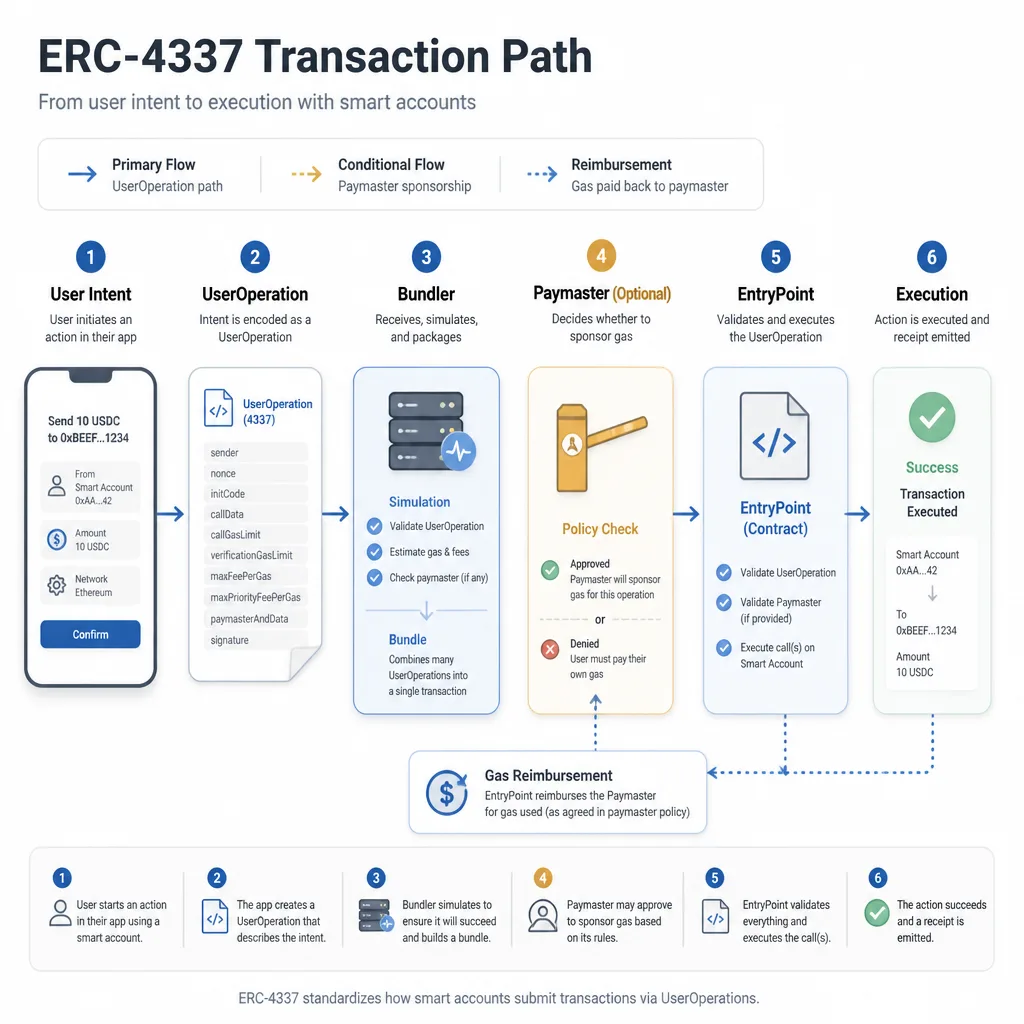
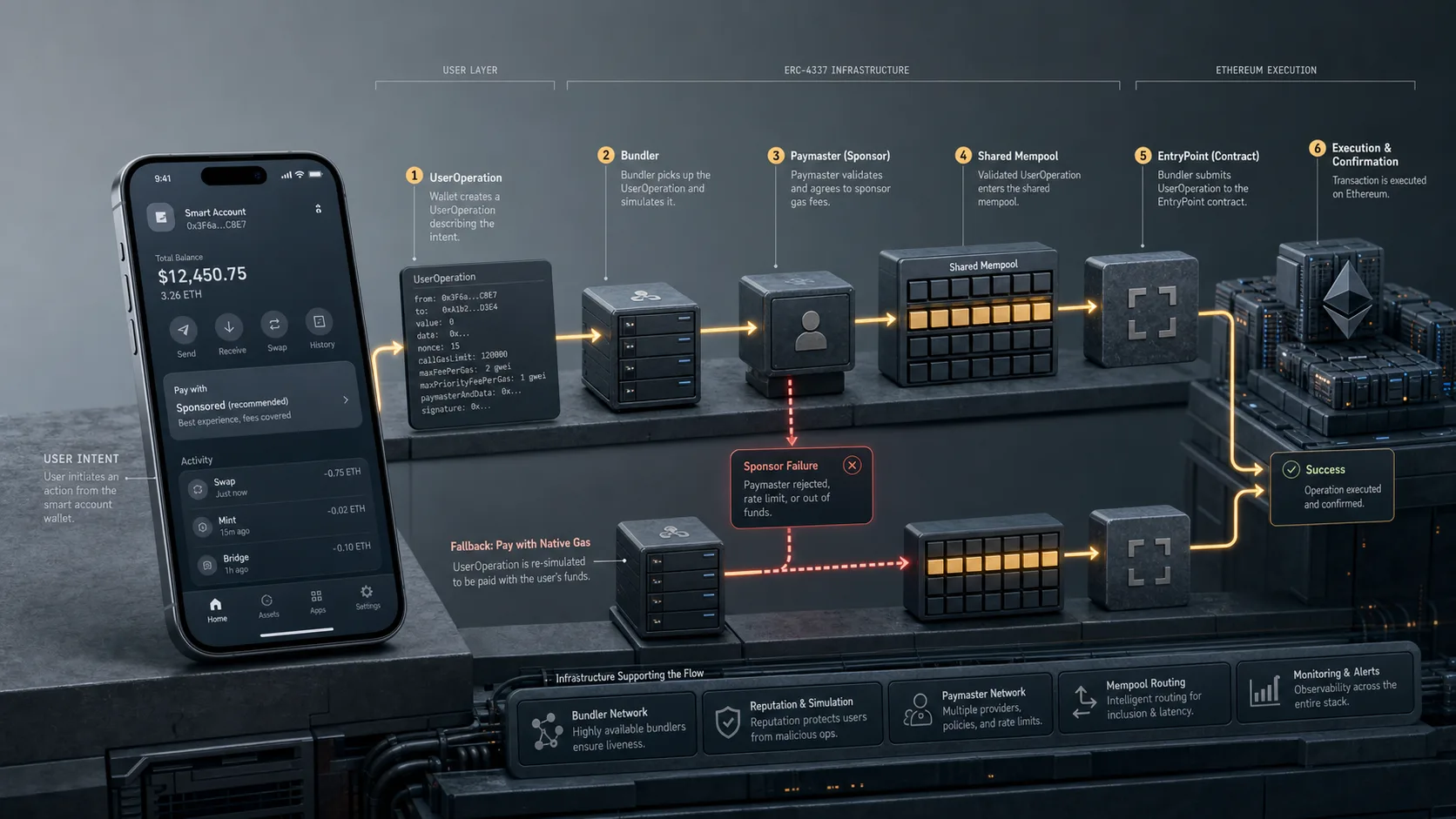
Under ERC-4337, the user usually does not send a normal Ethereum transaction directly. Instead, the wallet creates a UserOperation describing the intended action and how the account should validate it. That operation is picked up by a bundler, routed through the EntryPoint contract, validated by the smart account and, if applicable, a paymaster, then executed on-chain.[^1][^3]
A simple way to picture the flow is:
user intent → UserOperation → bundler simulation and submission → EntryPoint validation and execution → gas reimbursement
That sequence matters because every step can introduce dependencies that wallet marketing often glosses over.
What a bundler actually does
A bundler is more than a relay. It watches the ERC-4337 mempool, receives UserOperations, simulates whether they will validate, rejects those that fail, and packages valid operations into bundles for on-chain execution through EntryPoint.[^3][^4]
For buyers, the takeaway is straightforward: the bundler is part of the wallet’s reliability path. If your wallet depends on a single hosted bundler route, bundler downtime or policy changes can feel like wallet failure even if the smart account contract itself is fine.
What a paymaster actually does
A paymaster is a smart contract that can sponsor gas for a UserOperation if the operation satisfies the paymaster’s rules.[^5] Those rules might allow onboarding transactions, specific in-app actions, token-based reimbursement, backend-approved actions, or quota-limited campaigns.
The key correction is simple: paymasters do not make gas disappear. They remove the need for the user to hold native gas at that moment. Someone still pays for execution.[^5][^6]
Gasless UX is usually sponsored UX
The three common models
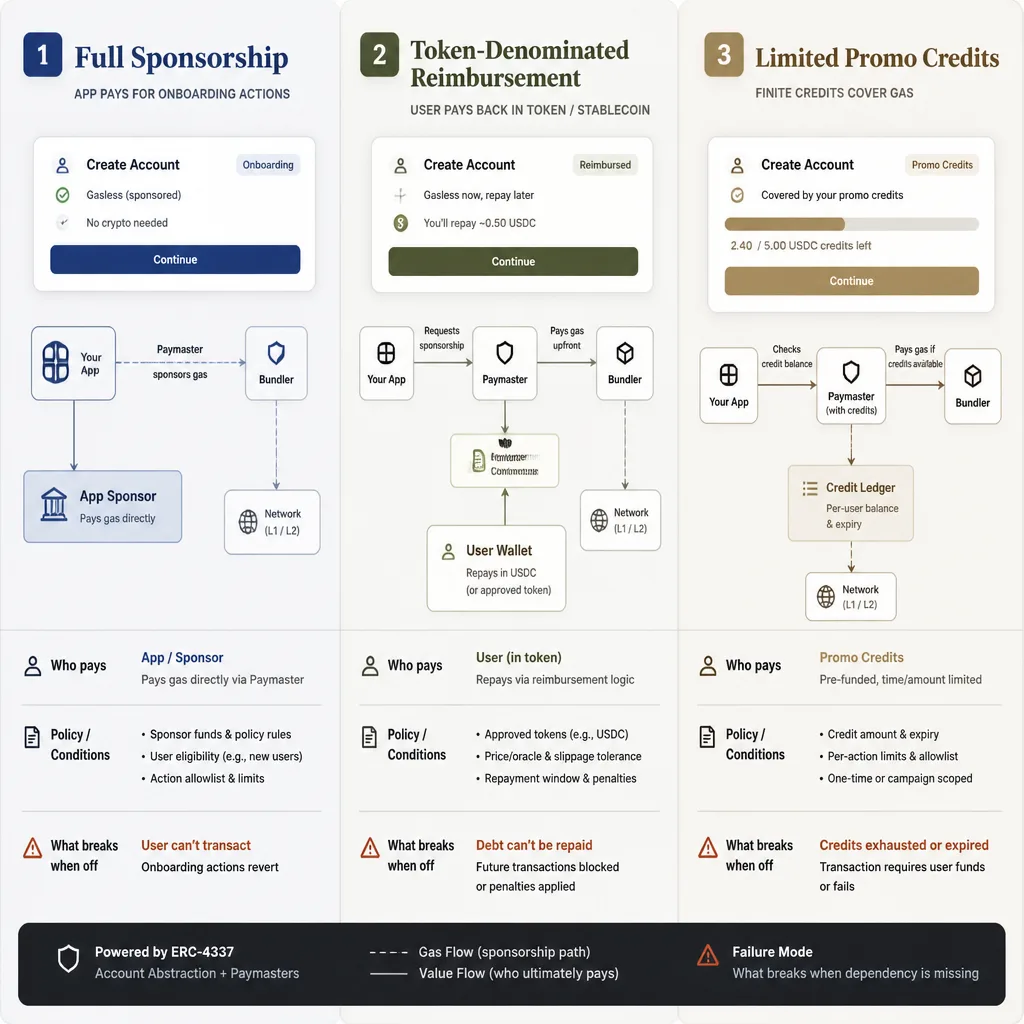
Most “gasless” ERC-4337 experiences fall into three buckets.
Full sponsorship is the cleanest onboarding model. The app or wallet provider pays for selected actions so the user can start without bridging or buying native gas. This is common in gaming, social, and embedded-wallet flows.
Token-denominated reimbursement means the user is still paying, just not in native gas at the moment of action. Fees may be settled in a stablecoin or another supported token, often through paymaster logic or a tightly coupled off-chain pricing flow.
Limited promo credits are the Web2 growth-hack version of gas abstraction. The first few actions are subsidized. After that, the user either pays directly or drops off.
All three can be useful. None make execution free.
Why “no gas required” can still mean heavy provider dependence
This is where buyers often get misled.
A wallet can honestly advertise “no gas required” for onboarding while still relying on one paymaster, one bundler route, one SDK backend, and one policy engine deciding which actions qualify for sponsorship. That is a UX improvement, but it is also a control surface.
Sponsorship can be app-scoped, quota-limited, abuse-limited, geo-restricted, or disabled for certain contract interactions. Paymasters operate under explicit ERC-4337 security rules, including simulation, deposits, and staking-related protections meant to reduce griefing and denial-of-service risk.[^5][^6][^7] In practice, “gasless” is often conditional service, not a permanent property of the wallet.
What breaks when the sponsor turns off
The obvious failure is a reverted transaction. The less obvious failure is a broken product flow.
If a sponsor turns off, onboarding can stall immediately. Reward claims may stop working. Session-based in-app actions can fail mid-experience. Users who never acquired native gas may discover they still own the assets, but cannot easily move them.
A familiar pattern is an app wallet that sponsors swaps, claims, and profile actions during growth mode. It works beautifully until the budget tightens or abuse controls harden. The wallet still exists on-chain, but the experience that made it usable for non-technical users is gone. The assets are not lost. The practical path to using them may be.
The new centralization risks buyers tend to miss
Bundler concentration and routing dependence
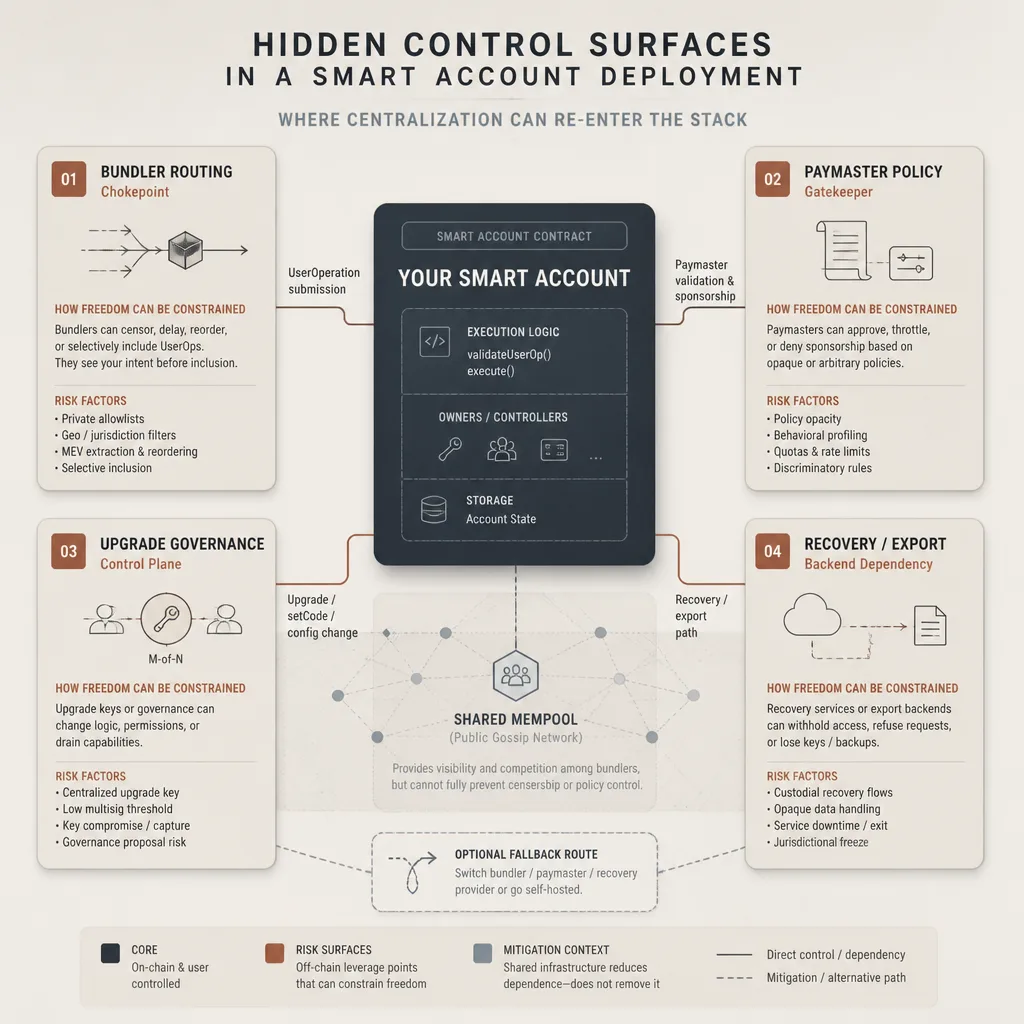
ERC-4337 is designed for permissionless participation, but product deployments are often less decentralized than the protocol ideal.[^2][^8] If a wallet routes all UserOperations through a single provider, that provider becomes a chokepoint for reliability, support, rate limiting, and sometimes policy enforcement.
This is not just theoretical. Official ERC-4337 documentation notes that fragmented private bundler flows historically weakened inclusion guarantees because bundlers could ignore or drop UserOperations.[^8]
Paymaster policy as a censorship surface
Paymasters are usually discussed as fee-abstraction tools. Buyers should also treat them as policy engines.
A paymaster decides which actions it will fund and under what conditions.[^5] That makes it a potential censorship surface, even if the account itself remains under user control. A politically sensitive donation, a high-risk DeFi interaction, or a contract call outside an app’s comfort zone may simply stop qualifying for sponsorship.
That does not mean paymasters are inherently bad. It means they are conditional infrastructure, not neutral plumbing.
Upgrade keys, mutability, and governance risk
Many smart accounts are upgradeable. Sometimes that is a feature. It can allow vulnerability patches, improved validation logic, or new UX capabilities.
But upgradeability changes the trust model. If someone can change the account logic quickly, they have meaningful power over wallet behavior. The real question is governance: Is the account immutable? Is it upgradeable through a multisig? Is there a timelock? Can users see upgrades coming and exit first? Or can a vendor push unilateral changes immediately?
Upgradeable does not automatically mean unsafe. Unconstrained upgrade power is the real problem.
Recovery and exportability that depend on vendor cooperation
“Self-custody” can be technically true and still operationally fragile.
A wallet may give users control over funds through a smart account while still depending on a vendor’s recovery backend, passkey service, signer orchestration, or migration tooling to remain practical. If exporting signer material, recovery configuration, or account metadata requires a support ticket, portability is weak.
This is one of the most important distinctions in the category: on-chain ownership is not the same as off-chain independence.
Shared mempools help, but they do not remove app-layer dependence
There has been real progress here. The ERC-4337 Shared Mempool is live on Ethereum, Arbitrum, and Optimism as of November 2024, improving propagation and making it harder for any one bundler to act as the sole gatekeeper.[^8]
That matters. Shared propagation reduces one major centralization risk.
But it does not make the full wallet stack permissionless. A wallet can still recentralize the experience through a hosted SDK, a default bundler route, a vendor-controlled recovery flow, or a policy-heavy paymaster. Protocol progress is real. Product dependence can still be real at the same time.
A buyer’s framework: evaluate survivability, not just features
The most useful way to compare smart-account wallets is to ask four survivability questions.
1. Transaction survivability: can you still send if the sponsor disappears?
This is the first test because it affects daily usability.
A strong implementation supports multiple bundler paths, participates in the shared mempool where relevant, and lets users continue by supplying native gas if sponsorship disappears.[^8] A weak implementation assumes one default route and offers little visibility into simulation failures, retries, or fallback behavior.
If a provider goes down on a volatile market day, can the user still act? That is the real benchmark.
2. Asset survivability: can you move assets without the vendor?
This is the escape-hatch test.
Strong implementations use documented account patterns, publish contract details, and let users operate the account from another interface or migration path if the original app disappears. Weak ones keep the account technically on-chain but practically stranded behind proprietary tooling.
If the front end shuts down tomorrow, how do you move funds?
3. Identity survivability: can you rotate keys, recover access, or leave?
Recovery is where many wallets sound stronger than they are.
Good designs let users rotate keys or authenticators without vendor permission. Better ones document exactly how recovery works, what delays exist, who can intervene, and how a user exits the recovery system entirely. Weak designs hide critical identity functions behind opaque backend coordination.
You are not just checking whether recovery exists. You are checking whether it still works under conflict or vendor failure.
4. Contract survivability: who can upgrade the account, and under what constraints?
This is the governance test.
Strong implementations either minimize upgradeability or constrain it with multisigs, timelocks, public documentation, and narrow upgrade powers. Weak implementations retain broad unilateral control while still marketing themselves as non-custodial.
For meaningful balances, governance often matters more than feature count.
The due-diligence checklist
Bundler and mempool questions
Ask these before trusting the stack:
- Does the wallet rely on one default bundler?
- Can you bring your own bundler or configure multiple endpoints?
- Does the provider participate in the shared mempool?[^8]
- What happens if the primary bundler times out, rejects, or censors a
UserOperation? - Can you see simulation failures and retry behavior?
If a provider cannot answer these clearly, that is a warning sign.
Paymaster and fee-model questions
Translate “gasless” into operational terms:
- Who pays for each major user flow?
- Which actions are sponsored, and which are not?
- Are sponsorship rules app-specific, temporary, or geography-dependent?
- What happens after promo credits run out?
- If token-denominated gas is offered, is that enforced on-chain through paymaster logic or handled by off-chain reimbursement promises?
The more conditional the answer, the less gasless the wallet really is.
Recovery, export, and fallback questions
This is where hidden lock-in usually appears:
- Can you export signer material or equivalent control state?
- Can you migrate to another interface or provider?
- If the sponsor disappears, can you continue by funding native gas directly?
- If the app shuts down, what exact steps let you recover or move assets?
- Does any critical step require vendor approval?
Good answers are specific. Bad answers are branding.
Upgradeability and security-review questions
You want both code quality and governance quality:
- Are the account contracts audited?
- Are the reports public and recent?
- Is the deployed code materially the same as the audited code?
- Who controls upgrades?
- Are upgrades protected by a multisig or timelock?
- Can emergency pauses occur, and who can trigger them?
Audits matter, but a wallet with clean audits and reckless upgrade authority can still be a bad fit.
Operational trust questions for teams integrating wallets
For founders and PMs, the key issue is vendor replaceability:
- Can you swap providers without forcing users into new accounts?
- What SLAs exist for bundling and sponsorship?
- How are abuse controls enforced?
- What monitoring exists for sponsorship denials and submission failures?
- What is the migration plan if the vendor relationship ends?
If vendor replacement is impossible, you are not integrating a wallet feature. You are adopting a platform dependency.
When the convenience tradeoff is worth it
Good fit: onboarding-heavy apps, gaming, social, and low-friction consumer flows
ERC-4337 shines when reducing friction creates real product value. Games, social apps, loyalty systems, and consumer onboarding flows benefit from sponsored transactions, batched actions, and more flexible recovery. In these contexts, the convenience tradeoff is often rational.
Use caution: treasury, long-term storage, or politically sensitive use
The picture changes for larger balances or adversarial use cases.
If funds are strategic, dormant for long periods, or likely to be used in contentious contexts, hidden service dependencies matter more. In those cases, censorship resistance, exportability, and governance constraints should matter more than sleek onboarding.
A practical split strategy
For many users, the best answer is neither ideological purity nor full convenience. It is separation.
Use a smart-account wallet for active app flows, routine interactions, and low-friction participation. Keep reserves in a harder setup, often built around simpler self-custody assumptions or hardware-backed controls. The best wallet for activation is often not the best wallet for durable storage.
How to read vendor claims without getting fooled
Red-flag marketing phrases
Treat these claims as prompts for verification, not conclusions:
- “No gas ever”
- “Fully decentralized”
- “Self-custody” with vague recovery details
- “Non-custodial” alongside instant upgrade authority
- “Permissionless” when only one hosted route is documented
None of these phrases are automatically false. They are often incomplete.
Signals of stronger architecture and governance
The strongest signals are usually boring.
Public contract addresses. Open-source code. Clear EntryPoint compatibility documentation. Multi-bundler support. Explicit fallback behavior. Transparent sponsorship rules. Public audits. Timelocked or multisig-governed upgrades. Migration instructions that do not require human approval.
These are not flashy features. They are what matter when something breaks.
How to weigh audits, open source, and fallback paths
Audits and open source are useful trust signals, but neither is enough on its own.
An open-source wallet can still depend on a fragile hosted stack. An audited account can still be trapped behind weak migration design. The strongest signal is not documentation alone. It is a documented fallback path that a technical user could realistically use under stress.
Conclusion
The core ERC-4337 buying mistake is simple: judging a wallet by the smoothness of its happy path instead of the strength of its failure path.
Bundlers and paymasters do improve wallet UX. Shared mempool progress has also made ERC-4337 more resilient than it was in its early private-queue phase.[^8] But “gasless” usually means sponsored, conditional, or shifted costs, and every convenience layer introduces new control points.[^3][^5]
So evaluate smart-account wallets like infrastructure, not magic. Ask whether transactions survive sponsor loss, whether assets remain movable without the vendor, whether identity can be recovered or rotated independently, and whether upgrade power is constrained. The right wallet is the one that still works when the demo stops working.
FAQ
What is a bundler in ERC-4337, and why should buyers care?
A bundler receives UserOperations, simulates whether they will validate, packages valid ones, and submits them through EntryPoint for on-chain execution.[^3][^4] In practice, that makes the bundler part of the wallet’s reliability path, not just a passive relay. If a wallet depends on one hosted bundler route, failures or policy decisions there can feel like wallet failure even when the smart account contract still works.
What does a paymaster do in an account abstraction wallet?
A paymaster is a smart contract that can sponsor gas for a UserOperation if that operation passes the paymaster’s rules.[^5] Those rules may be simple, like a whitelist, or restrictive, like app-specific quotas, backend approvals, or token-based reimbursement logic. The main takeaway is that paymasters change who pays and under what conditions; they do not eliminate transaction costs.
Does gasless UX mean transactions are actually free?
Usually not. In most ERC-4337 products, gasless means sponsored, prepaid, reimbursed, or charged in another asset or business model. Someone still pays execution costs.[^5] The real question is who pays, for which actions, for how long, and what happens when that sponsorship policy changes.
What breaks if the sponsor turns off gas sponsorship?
Common failures include stalled onboarding, failed reward claims, broken session flows, and users realizing they cannot move assets because they never acquired native gas. A strong smart-account wallet should make the fallback path clear, such as allowing the user to fund native gas and continue without the sponsor.
Are ERC-4337 wallets decentralized by default?
Not necessarily. ERC-4337 is designed to support permissionless participation through bundlers, EntryPoint, and a shared UserOperation mempool.[^1][^8] Official ERC-4337 documentation says the shared mempool is live on Ethereum, Arbitrum, and Optimism as of November 2024.[^8] But product-level UX can still depend on a single SDK vendor, bundler route, recovery backend, or paymaster policy. Protocol design and product survivability are not the same thing.
What should I verify before trusting a smart-account wallet with meaningful funds?
Check whether you can use multiple bundlers, whether there is a native-gas fallback if sponsorship disappears, whether signer and recovery state are exportable, whether account contracts are audited and open source, and who controls upgrades. Also verify whether recovery or migration requires vendor cooperation, because the most important survivability properties are often operational, not just on-chain.
Why do shared mempools matter for wallet resilience?
Shared mempools improve propagation and reduce dependence on isolated private queues. Official ERC-4337 documentation says fragmented bundler flows weaken inclusion guarantees because a single bundler can ignore UserOperations, while shared propagation lets more participating bundlers see them.[^8] That said, shared mempools reduce one centralization vector; they do not remove dependence on a wallet’s broader hosted stack.
Are upgradeable smart accounts always a red flag?
No. Upgradeability can be useful for patching vulnerabilities and improving wallet logic. The real question is governance: who can upgrade, how fast, under what review process, and whether users get meaningful notice or exit time. Timelocks, multisig control, public documentation, and constrained upgrade scopes are much stronger signals than unilateral instant upgrade authority.