Most Bitcoin L2 discussions start in the wrong place.
They begin with speed, fees, programmability, or yield. Those things matter, but they are not the first question a careful BTC holder should ask. The first question is simpler, and less flattering to marketing: if you move BTC into this system, what exactly do you own on the other side, and how do you get back out?
That is the part many users cannot answer clearly. They may know a system is “Bitcoin-aligned,” “secured by Bitcoin,” or offers a BTC-denominated return. Under stress, those labels do not redeem anything. Withdrawal rights do. Finality assumptions do. Peg control does.
A useful way to evaluate Bitcoin L2s is to borrow a concept from finance: convertibility. In crypto, the real issue is the redemption path. A yield figure tells you what you might earn. A redemption path tells you what you actually own.
Bitcoin L2s are easier to misunderstand than to compare
Why the market leads with speed, fees, and yield
Part of this is a product problem, and part is a language problem.
Teams naturally lead with what feels tangible: faster transactions, lower fees, EVM compatibility, DeFi access, BTC-backed apps. Those are easy to demo. Redemption mechanics are harder. They live in bridge docs, custody models, signer assumptions, and withdrawal rules.
The language makes this worse. “Bitcoin L2” now covers a messy range of designs: sidechains, federated systems, rollup-like architectures, bridge-based execution layers, and synthetic BTC environments. Some use Bitcoin for settlement anchoring. Some use BTC as the main asset. Some borrow Bitcoin branding more than Bitcoin security.
So two projects can both call themselves Bitcoin L2s while giving users very different things.
The better question: what are you redeeming, and how?
The first distinction is between BTC exposure and a credible claim on native BTC.
Native BTC is controlled by Bitcoin keys on Bitcoin itself.
Wrapped or bridged BTC is a claim on BTC held somewhere else.
Synthetic BTC usually gives you price exposure or notional value without a one-to-one claim on specific BTC reserves.
That sounds basic, but it is where many risk models fail. In normal markets, these assets can trade close enough to feel interchangeable. Under stress, the differences stop being theoretical.
The core lens: what is a redemption guarantee?
Redemption as the crypto version of convertibility
“Redemption guarantee” is not a legal guarantee in the strict sense. It is a practical one.
The question is: how credible, enforceable, timely, and censorship-resistant is your path from an L2 BTC representation back to native BTC?
That framing matters because a peg is not just a price relationship. It is a withdrawal relationship. A token can trade near 1:1 with BTC for long periods and still have weak redemption rights.
The five questions that define a BTC exit path
Before depositing BTC into any BTC-linked system, ask five things:
Who controls the peg or custody path?
Is BTC locked under a federation, a multisig, a custodian, a validator set, or some hybrid design?Who can authorize, censor, delay, or refuse withdrawals?
A system may look automated until something goes wrong. Then the real control surface becomes visible.What assumptions make redemption possible?
Do exits depend on cryptographic proofs, honest signers, governance action, offchain operators, or market liquidity?What kind of finality matters?
Is the relevant finality Bitcoin settlement, sequencer inclusion, bridge checkpoint acceptance, or actual BTC redemption on-chain?What happens under stress?
If operators go offline, collude, pause the bridge, or liquidity dries up, what is your fallback?
Why BTC yield means little until the exit path is clear
This is where a lot of analysis goes soft.
BTC yield is often discussed as if it were separate from bridge design. It is not. Yield usually compensates users for some mix of lending risk, counterparty exposure, rehypothecation, governance risk, liquidity risk, or operator risk.
If a system offers a generous BTC-denominated return, the important question is not “how high is the APY?” It is “what extra assumptions am I being paid to accept?”
A yield figure tells you what you might earn. A redemption path tells you what you actually own.
A trust-model matrix for Bitcoin L2s
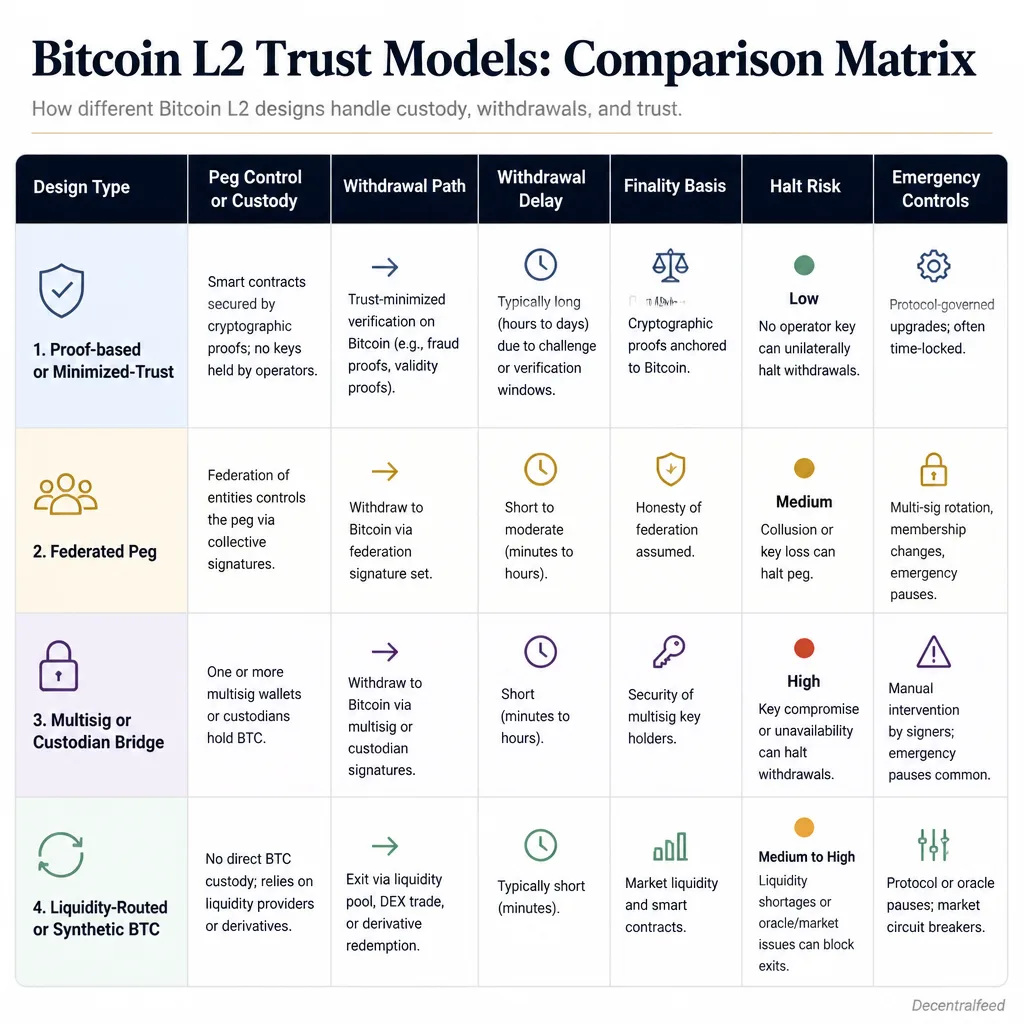
Matrix dimensions: peg control, withdrawal mechanism, finality basis, halt risk, withdrawal delay, emergency controls
The matrix below stays at the design-pattern level on purpose. This category changes quickly, and project branding often moves faster than the underlying trust model.
| Design type | Who controls peg / custody | Withdrawal path | Withdrawal delay | Finality basis | What can halt exits | Emergency controls | Best fit |
|---|---|---|---|---|---|---|---|
| Proof-based / minimized-trust | Ideally constrained by proofs and protocol rules, though often still dependent on operators for some bridge functions | User exits through a proof-backed process or protocol-defined withdrawal route | Often medium to long; may include proving or challenge windows | Cryptographic proof plus underlying settlement assumptions | Proof bottlenecks, operator liveness failures, bridge implementation limits, DA issues where relevant | Often some admin, upgrade, or guardian layer in early systems | Users who want the strongest possible exit assumptions and can tolerate complexity |
| Federated peg | Defined federation or signer set | Withdrawal approved and executed by threshold signers | Usually medium; batching and operator processing are common | Federation attestation plus Bitcoin settlement of released BTC | Signer refusal, threshold failure, governance disputes, outage | Federation governance, emergency pause, signer rotation | Users comfortable with a known operator model |
| Multisig / custodian bridge | Multisig operators or a legal custodian | Redemption request processed by signers or custodian | Medium to variable; may involve manual review or operational windows | Custody integrity, governance, and actual BTC release | Custodian freeze, legal action, insolvency, key compromise, operator refusal | Admin controls, compliance procedures, freeze authority | Institutions or users prioritizing familiarity over trust minimization |
| Liquidity-routed / synthetic BTC | Often no direct one-to-one BTC custody claim; depends on LPs, collateral, or market makers | Exit via swap, LP routing, secondary-market redemption, or synthetic unwind | Fast in calm markets, unreliable in stress | Market liquidity, collateral health, arbitrage, protocol incentives | Liquidity shortages, depeg, collateral stress, route failure | Pauses, parameter changes, liquidation rules, caps | Traders who knowingly accept market-function risk |
How to read the matrix without flattening important differences
This is not a moral ranking. It is a map of what has to go right.
A proof-based design may offer stronger theoretical exit guarantees than a federation while still carrying meaningful implementation and liveness risk. A federated peg may be much easier to understand operationally, even if it asks users to trust a signer set. A liquidity-routed system may work well for active trading until the moment liquidity matters most.
Security here is not one-dimensional. A system can be strong on execution and weak on redemption, or strong in normal use and fragile during a forced exit.
Trust models, from strongest exits to weakest guarantees
Proof-based or minimized-trust designs: best when the exit path is enforceable, not merely promised
This category most closely matches what sophisticated users want to hear: rules over discretion.
In the best version of this design, a user’s right to exit is constrained by proofs and protocol rules rather than by a committee deciding whether to honor withdrawals. In principle, that is the cleanest model.
But this is also where marketing often outruns reality. A system may use the language of proofs while still depending on external operators for bridge execution, data availability, or withdrawal handling. If so, the execution model may be stronger than the redemption model.
That does not make the design bad. It means the user should ask where proof ends and operator discretion begins.
Federated pegs: practical, but redemption depends on a defined operator set
Federated systems are easier to reason about than many critics admit.
The model is usually clear: BTC is controlled by a federation, withdrawals require a threshold of signers, and governance determines signer rotation and emergency procedures. The tradeoff is obvious. If enough signers refuse, fail, or coordinate badly, redemption can stall.
That trust is concentrated, but it is also legible. For some users, especially those who value predictable operations over ideological purity, that may be an acceptable bargain.
The real mistake is not using a federation. It is pretending you are not.
Multisig or custodian-style bridges: simple to understand, but trust sits in key control and governance
This is the cleanest category in plain English.
Your BTC is held by a multisig or custodian. You receive a representation elsewhere. Redemption depends on those parties releasing BTC when requested.
The benefit is clarity. The downside is that custody risk is doing most of the work. That includes signer compromise, governance capture, legal intervention, insolvency, compliance freezes, and ordinary operational delay.
For institutions, this model may actually be easier to diligence because the counterparties and procedures are explicit. But it is still a different asset profile from native BTC.
Liquidity-routed or synthetic BTC systems: redemption may depend more on market function than protocol guarantees
This is where users often confuse usability with safety.
A liquidity-routed system can feel excellent in normal conditions. Exits can be fast because you are not waiting for a canonical redemption flow; you are swapping through available liquidity. A synthetic BTC design can also look efficient if collateral is healthy and markets are liquid.
But the redemption model here is usually weakest. Your exit may depend less on protocol-enforced convertibility and more on whether counterparties, LPs, or arbitrageurs are still willing and able to make the market.
In calm periods, that can be enough. In stress periods, it can vanish quickly.
What finality means in practice
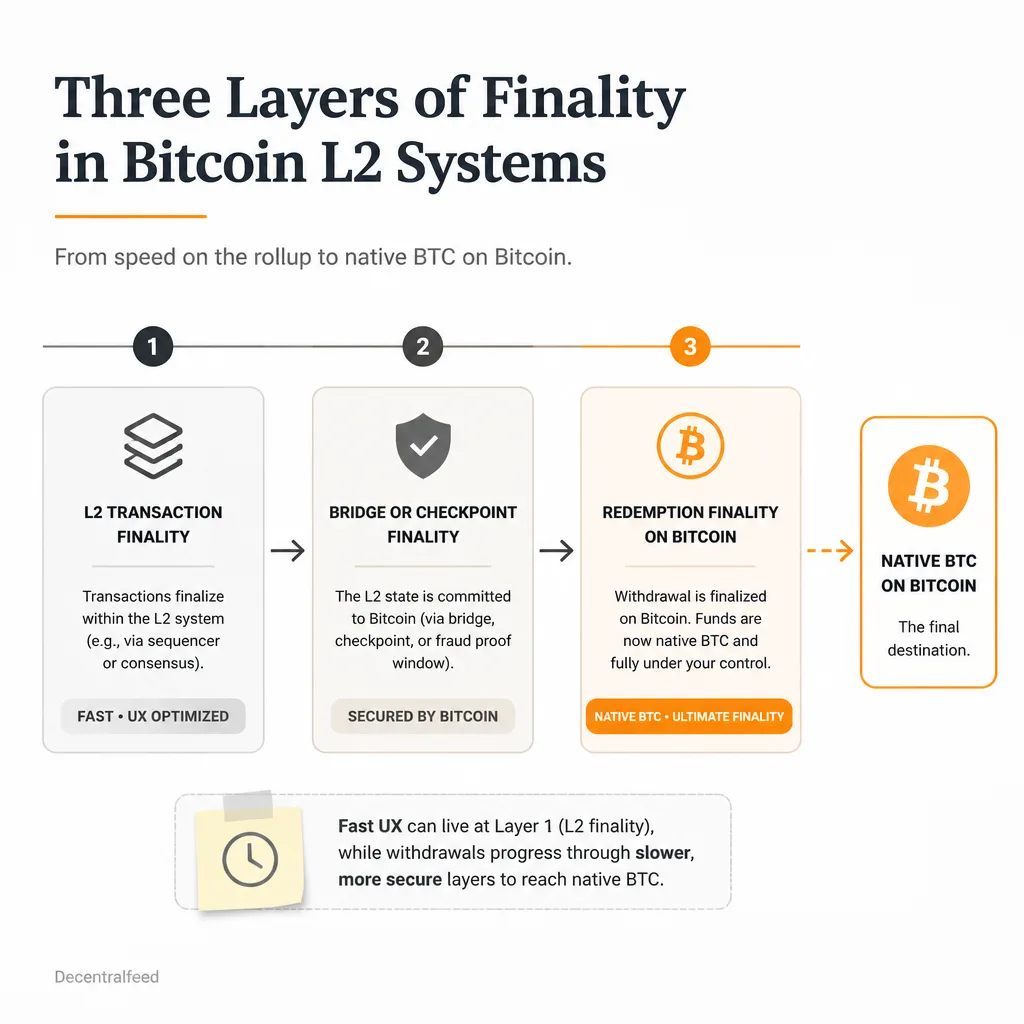
Bitcoin settlement finality versus L2 transaction finality
Many users hear “finality” and assume it refers to one thing. Usually, it refers to three.
The first is transaction finality on the L2. Your transfer is included. The app updates. The interface says confirmed.
The second is bridge or checkpoint finality. Some state transition is accepted by the system’s bridge, signers, or proof process.
The third is redemption finality. You actually hold native BTC back on Bitcoin.
Only the third answers the custody question.
Sequencer finality, bridge finality, and redemption finality are not the same
A fast sequencer gives fast UX. It does not automatically give a strong exit path.
That matters because many rollup-like or execution-heavy systems optimize for immediate usability. That is real value. But a smooth interface can hide a slower and more conditional withdrawal path underneath.
What looks final to a trader may still be provisional to a long-term holder.
Why a fast UX can hide a slow or discretionary exit
A system can settle user expectations long before it settles withdrawal rights.
That gap is where much of the confusion lives. If your main use case is trading, maybe that is acceptable. If your main use case is preserving BTC optionality, it is not.
What can halt withdrawals under stress
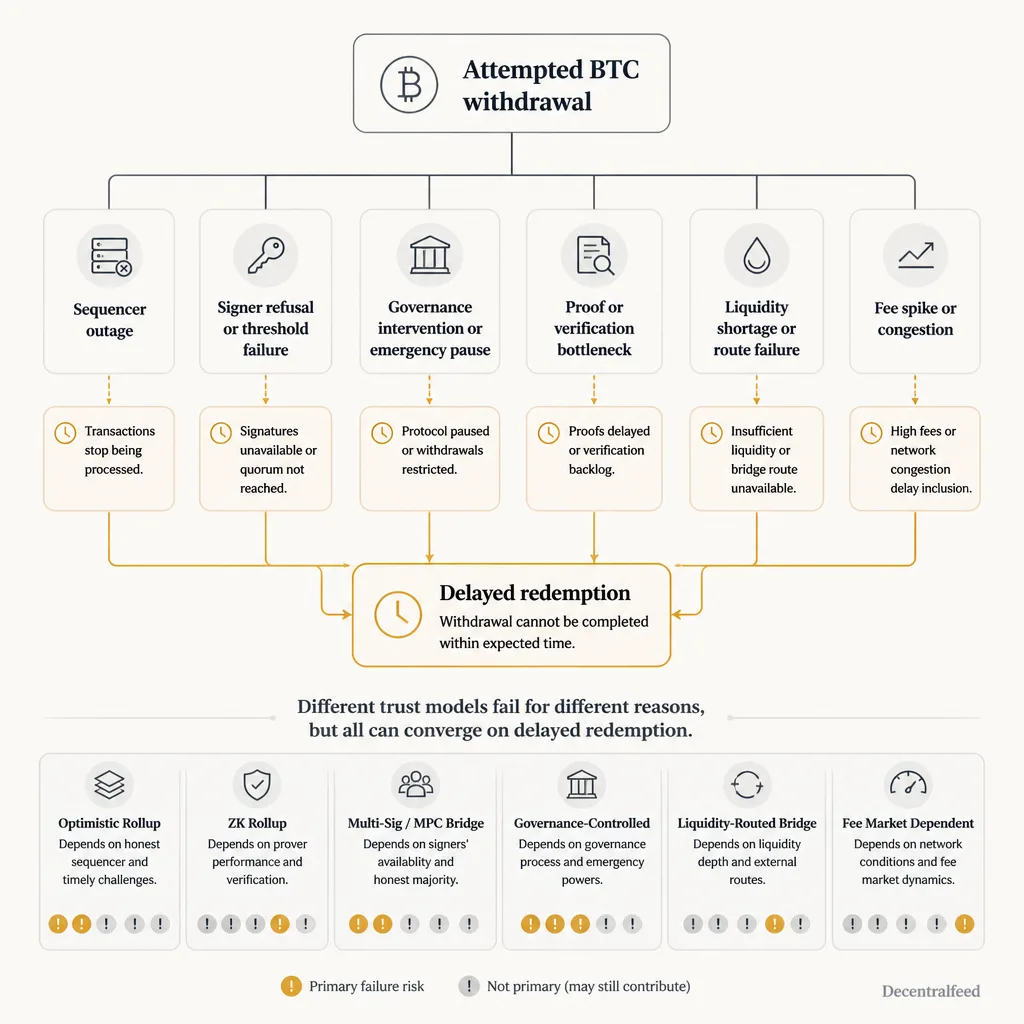
Sequencer outages, operator refusal, signer collusion, governance intervention
Withdrawals can fail in more ways than theft.
Sometimes the problem is a sequencer outage. Sometimes signers are offline. Sometimes the operator set refuses withdrawals. Sometimes governance pauses the system because it believes that is safer than letting a possible exploit continue.
Different failure modes, same practical result: you do not have BTC back yet.
Fraud-proof or proof-verification bottlenecks, where relevant
In more proof-oriented systems, the weak point may not be custody alone. It may be liveness.
If a proof system is delayed, if verification paths are immature, or if the data required to validate exits is unavailable, a theoretically strong design can still produce a messy real-world withdrawal experience.
Stronger trust assumptions on paper do not eliminate operational dependency.
Liquidity crises, fee spikes, congestion, and emergency pause mechanisms
The softer failures are often the easiest to ignore.
Queue congestion, withdrawal caps, limited processing windows, Bitcoin fee spikes, and liquidity shortages can all turn a nominally redeemable asset into a temporarily trapped one. Emergency pause mechanisms add another layer. They may reduce catastrophic damage in a crisis, but they also show that redemption is not unconditional.
Under stress, markets reprice these details very quickly.
How to use the matrix as an investor or operator
For conservative BTC holders: prioritize redeemability over feature depth
If your goal is to keep BTC with a high-confidence path back to native Bitcoin, feature richness should come second.
You are not really comparing APYs. You are comparing exit rights.
That usually means preferring the design with the clearest redemption path, even if it is slower, narrower, or less exciting.
For active users: decide which assumptions you are actually being paid to take
Traders and power users do not need the same threshold.
It can be rational to accept federation risk, operator risk, or liquidity risk in exchange for composability, leverage, speed, or better execution. But that should be a priced decision, not an accidental one.
Know whether the yield is compensating you for real bridge and exit risk, or merely dressing it up.
For institutions and treasuries: treat withdrawal rights as part of asset due diligence
Institutions should treat redemption mechanics as part of the asset itself.
That means looking at signer concentration, custody structure, legal jurisdiction, pause rights, withdrawal SLAs, governance powers, and failure procedures. A BTC-denominated balance on a dashboard is not enough.
If the withdrawal path is discretionary, your asset is discretionary too.
The right takeaway
A BTC representation is only as strong as its path back to Bitcoin.
That does not mean every system with heavier trust assumptions should be dismissed. Some users genuinely want speed, features, or yield more than the strongest possible redemption model. Some institutions may even prefer known counterparties to experimental designs. The point is not to moralize the tradeoff. It is to see it clearly.
The useful question is not “is this a Bitcoin L2?” It is “what has to go right for redemption to work?”
Ask that before you deposit. Ask who controls custody, who can interrupt exits, how long withdrawal can take, and what your BTC claim becomes if the system is stressed. Once you do, most of the category becomes much easier to understand.
FAQ
What is a redemption guarantee in a Bitcoin L2?
A redemption guarantee is the practical credibility of turning an L2 BTC representation back into native BTC. It depends on who controls the peg, who can authorize or block withdrawals, how long exits take, and what happens if operators fail or pause the system.
Why is BTC yield meaningless without understanding the exit path?
Because yield tells you what you might earn, not what you actually own. If the BTC representation depends on a federation, custodian, sequencer, or liquidity network for redemption, the real risk sits in the withdrawal path, not the headline APY.
Are all Bitcoin L2s secured by Bitcoin in the same way?
No. “Secured by Bitcoin” can mean settlement anchoring, asset denomination, checkpointing, or simply Bitcoin branding. Those are not equivalent when the real question is whether you can redeem back into native BTC under stress.
What is the difference between transaction finality and redemption finality?
Transaction finality means your action appears settled on the L2. Redemption finality means you have actually completed the withdrawal and regained native BTC on Bitcoin. A system can offer fast L2 confirmations while still having slow, delayed, or discretionary exits.
What can halt withdrawals from a Bitcoin L2?
Withdrawals can be delayed or stopped by sequencer outages, signer downtime, federation refusal, multisig collusion, governance pauses, proof bottlenecks, queue congestion, liquidity shortages, or high Bitcoin fees during stress.
Which design is best for conservative BTC holders?
In general, conservative holders should prefer designs with the clearest and most enforceable redemption path, even if they offer less yield or slower withdrawals. The key is not feature depth but confidence that BTC can be recovered without discretionary approval.
Are federated pegs always a bad choice?
No. Federated pegs can be a rational tradeoff when users knowingly accept the operator model and value predictable operations or ecosystem utility. The issue is not that they exist. The issue is whether the trust assumptions are understood and priced correctly.
What is the main question to ask before depositing BTC into an L2?
Ask what has to go right for redemption to work. More specifically: who controls custody, who can interrupt exits, what delay applies, what finality assumptions matter, and what your BTC claim becomes if the system comes under stress.