Privacy in Crypto Is Becoming Modular: ZK Proofs, TEEs, and Selective Disclosure Tradeoffs
Public blockchains were built around transparency. That made verification easier, but it also narrowed how people talked about privacy. For years, “crypto privacy” was often treated as shorthand for privacy coins and anonymous transfers.
That view is now too narrow.
Privacy in crypto is splitting into distinct jobs: private payments, identity checks, confidential computation, private governance, compliance proofs, and more. Those jobs do not need the same tools. A system that hides transaction amounts solves a different problem from one that proves a user is over 18 without exposing a passport.
A better mental model is a modular toolkit. Zero-knowledge proofs, trusted execution environments, and selective disclosure credentials each hide different things, depend on different trust assumptions, and fail in different ways. The real question is not which one is “most private.” It is what should be hidden, from whom, at what cost, and under which constraints.
Privacy in crypto is no longer a coin category
Why the old “privacy coin” framing is too narrow
The old framing was not wrong. It was incomplete.
Early privacy systems in crypto focused on transfer privacy: can you send value without exposing the sender, receiver, or amount? That is still important, and projects like Zcash remain a canonical example of strong cryptographic privacy.[^1]
But transfer privacy is only one target.
A DeFi app may want to hide trading intent before execution. A wallet may want to prove KYC completion without sharing raw personal data. A DAO voting system may want ballot secrecy and tally integrity while also preventing duplicate votes. These problems are related, but they are not interchangeable.
Treating all of them as “privacy coin” questions leads to bad comparisons and weak design choices.
A better mental model: privacy as a toolkit
A more useful model is to treat privacy in crypto as a stack of primitives:
- ZK proofs prove something is valid without revealing the underlying data.
- TEEs keep computation confidential inside isolated hardware.
- Selective disclosure credentials reveal only specific facts from a credential.
These categories overlap. A credential system may use zero-knowledge proofs. A private app may use a TEE for fast execution and ZK for public settlement. The point is not to sort projects into camps. It is to match the tool to the job.
The three main privacy primitives
Zero-knowledge proofs: less trust, stronger cryptographic assurance
Zero-knowledge proofs let one party prove a statement without revealing the witness behind it. In crypto, that can mean proving a transaction is valid, a user belongs to a set, or a reserve ratio holds without exposing the sensitive inputs.[^1]
That is why ZK works so well for private transfers on public chains. The network can verify that no coins were created from nothing and that the spender had authority to spend them, without seeing every transaction detail.
That is the appeal of shielded transfers in Zcash. It is also why systems like Aztec are pushing beyond coin-style privacy toward programmable privacy.[^2]
But “ZK” is not one thing. Some zk-SNARK systems require a trusted setup; some do not. zk-STARKs avoid trusted setup, but they often come with larger proofs and different performance tradeoffs. So “just use ZK” is usually a slogan, not a design answer.
Trusted execution environments: privacy through isolated hardware
TEEs provide confidentiality by running code inside protected hardware regions. Instead of proving every step cryptographically, the system relies on hardware isolation, remote attestation, and careful implementation.[^3]
That matters because TEEs can support flexible, stateful, lower-latency private computation that would be expensive or awkward to prove in ZK today. This makes them attractive for private order flow, hidden mempools, confidential off-chain logic, and coprocessor-style designs.
Examples in the broader confidential computing world include Intel SGX and AWS Nitro Enclaves.[^3][^4]
TEE privacy is not fake privacy. It is a different bargain. You reduce exposure to the outside world, but you accept hardware vendor trust, attestation dependencies, patching burdens, and a long history of side-channel research against enclave systems.
Selective disclosure credentials: reveal only what matters
Selective disclosure credentials solve a different problem. The goal is not to hide a transfer. It is to prove a narrow fact without oversharing.
For example:
- prove you are over 18
- prove you passed KYC
- prove you live in an allowed jurisdiction
- prove you hold an accreditation or membership credential
The W3C Verifiable Credentials Data Model is a major standard in this area, though its privacy properties depend heavily on how credentials are issued, presented, and revoked.[^5]
This is where categories often get blurred. Selective disclosure does not automatically mean full anonymity. Some systems support unlinkable presentations and zero-knowledge predicates. Others simply redact fields while still leaking issuer identity, verifier correlation, or stable identifiers. Systems using BBS+ signatures or anonymous credential models like Idemix aim for stronger privacy than simple claims-sharing workflows.
A crypto-native example is Polygon ID, which uses ZK techniques for identity claim verification.[^6] That overlap matters: selective disclosure is often a use case category, not a proof-system category.
The real comparison is not ideology. It is tradeoffs
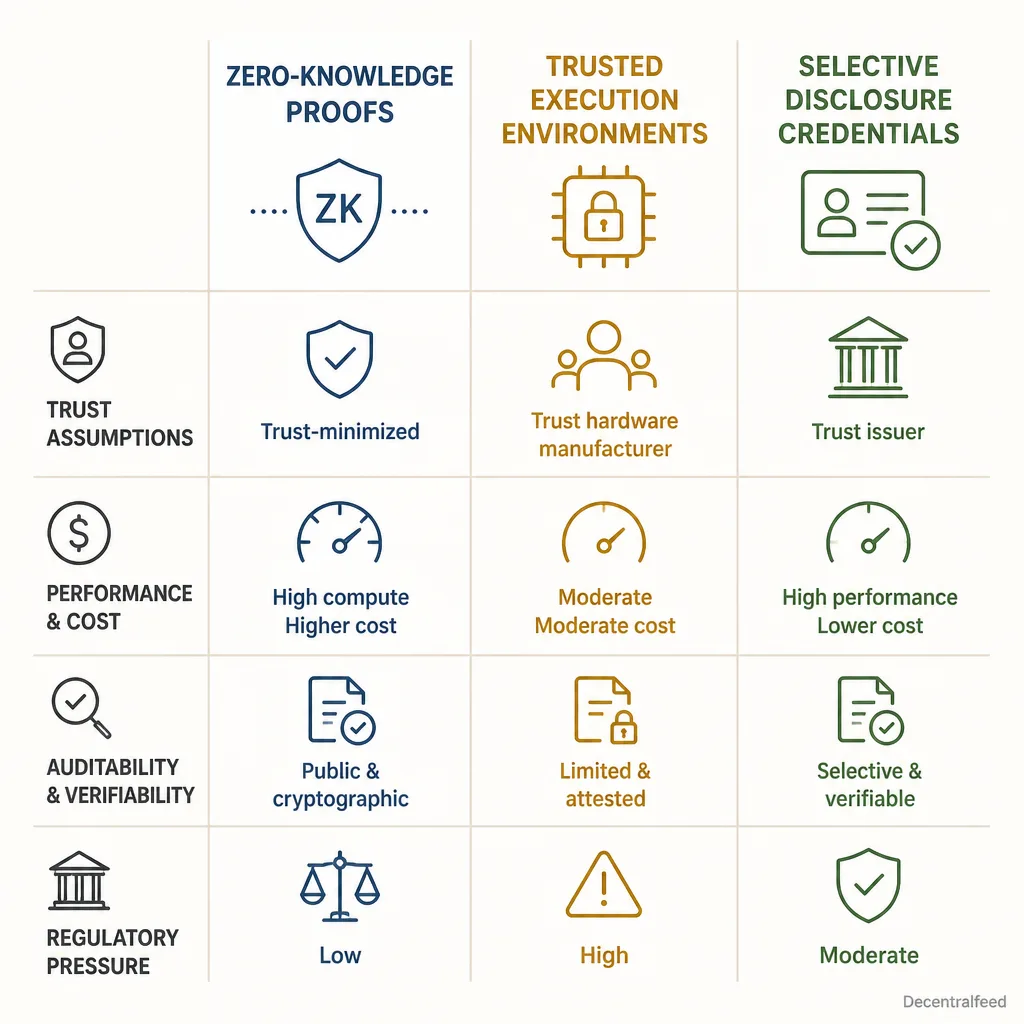
Trust assumptions: math, hardware, issuers, and operators
This is the real dividing line.
With ZK systems, trust centers mostly on cryptographic soundness and implementation quality. With TEEs, trust shifts toward hardware vendors, firmware, attestation services, and enclave operators. With credentials, trust sits heavily with issuers, wallet security, revocation systems, and verifier behavior.
There is no trust-free option. There are only different trust surfaces.
And the visible primitive is only part of the story. Relayers, sequencers, RPC providers, upgrade keys, multisigs, and admin controls can all weaken an otherwise private design.
Performance and cost: proving time, latency, throughput, and UX
ZK often wins on verifiability and loses on convenience. Proof generation can be computationally heavy. Tooling can be complex. User experience can degrade if proving takes too long or depends on specialized infrastructure.
TEEs often look better here. They can execute private logic with lower latency and more flexibility. That is one reason builders keep returning to them, even when they would prefer a more trust-minimized architecture.
Credential systems move complexity elsewhere: issuer onboarding, wallet support, revocation, standards compatibility, and verifier workflows. The hard part is less about proving every transaction and more about making identity infrastructure usable without making it linkable.
Auditability and verifiability: what outsiders can check
ZK’s biggest advantage is public verifiability. Outsiders can often verify correctness without seeing the hidden data.
TEEs are different. A user or chain usually cannot independently inspect the hidden computation. They rely on remote attestation and the credibility of the hardware security model. That can still be auditable in a practical sense, but it is not the same thing as broad public verification.
Credential systems usually sit somewhere else again: a verifier checks a presentation, but the whole network does not necessarily re-verify every identity fact.
Regulatory pressure: why these tools are treated differently
Regulators do not treat all privacy tools the same.
Systems designed for private movement of value often draw the most scrutiny, especially when counterparties and transaction flows become hard to inspect. Privacy-preserving identity tools may face fewer direct objections when they support data minimization while still allowing eligibility checks, sanctions screening outcomes, or compliance attestations.
That does not make credentials “safe” in every jurisdiction, and it does not make private transfer systems unlawful by default. It means the compliance posture is use-case dependent. Hiding payments and minimizing identity disclosure are politically and legally different activities.
Three use cases show why one privacy tool does not fit everything
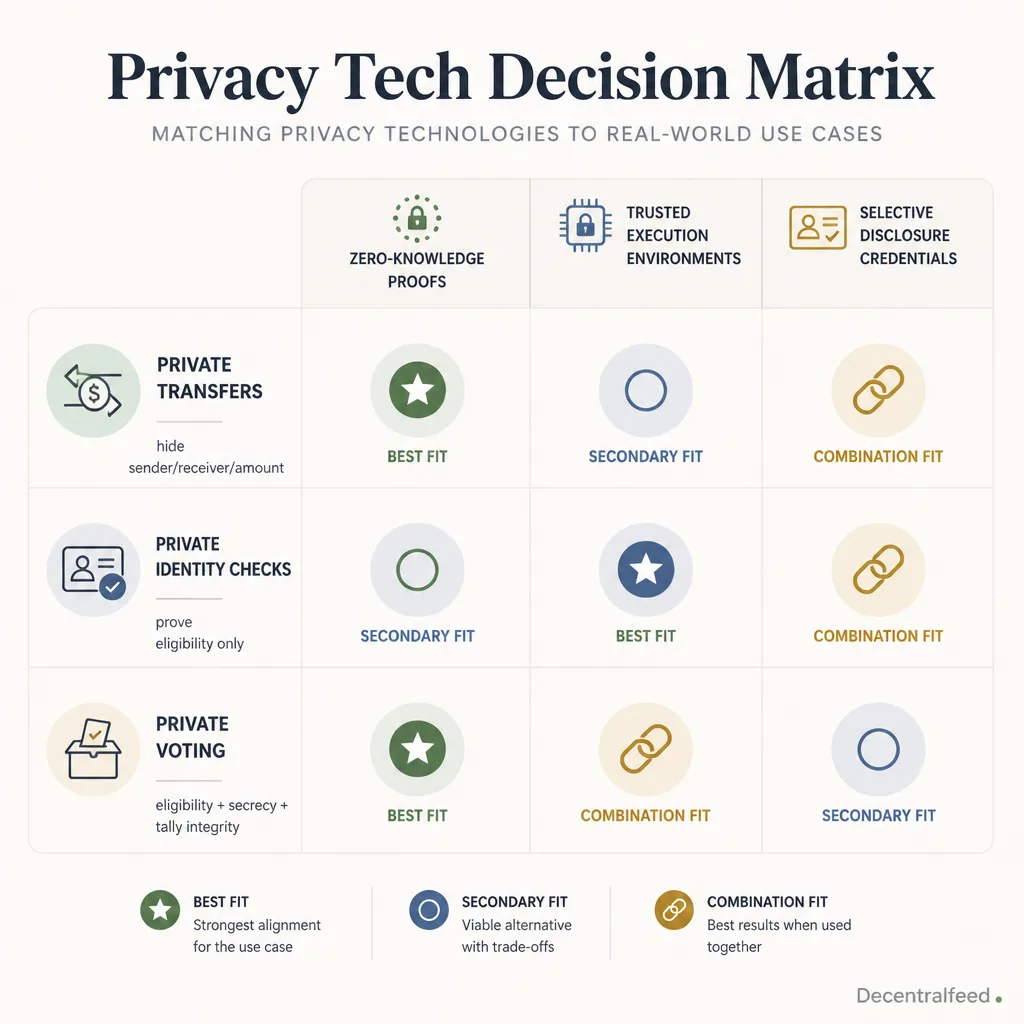
Private transfers: hiding sender, receiver, amount, or all three
This is the classic case for ZK-based systems.
If the chain itself must verify valid private state transitions, ZK is usually the cleanest fit. Shielded transfers in Zcash are the reference example, and features like viewing keys show an important nuance: privacy can still support selective auditability when needed.[^1]
That is more subtle than the usual “privacy versus compliance” framing. Often the real design question is not whether disclosure exists, but who controls it.
Private identity checks: proving eligibility without exposing full identity
This is where selective disclosure usually makes more sense than anonymous transfer machinery.
If the goal is to prove age, residency, accredited investor status, or completed KYC, the task is to reveal a fact, not to hide the movement of assets. A credential-based approach can reduce unnecessary data collection while preserving the ability to verify eligibility.[^5][^6]
This is one of the clearest examples of modular privacy. Good privacy is not always about saying less to everyone. Sometimes it is about saying exactly enough to the right verifier.
Private voting: privacy, coercion resistance, and tally integrity are separate problems
Voting is where sloppy privacy thinking breaks down quickly.
A private voting system needs at least three things:
- voter eligibility
- ballot secrecy
- tally correctness
And even that is not enough, because coercion resistance is its own problem. A system may hide votes from the public and still fail if voters can prove how they voted to a buyer or coercer.
ZK can help with ballot validity and tally integrity. Credentials can help with voter eligibility. But private voting is not solved by adding one privacy primitive and calling it done.
What actually breaks privacy systems in practice
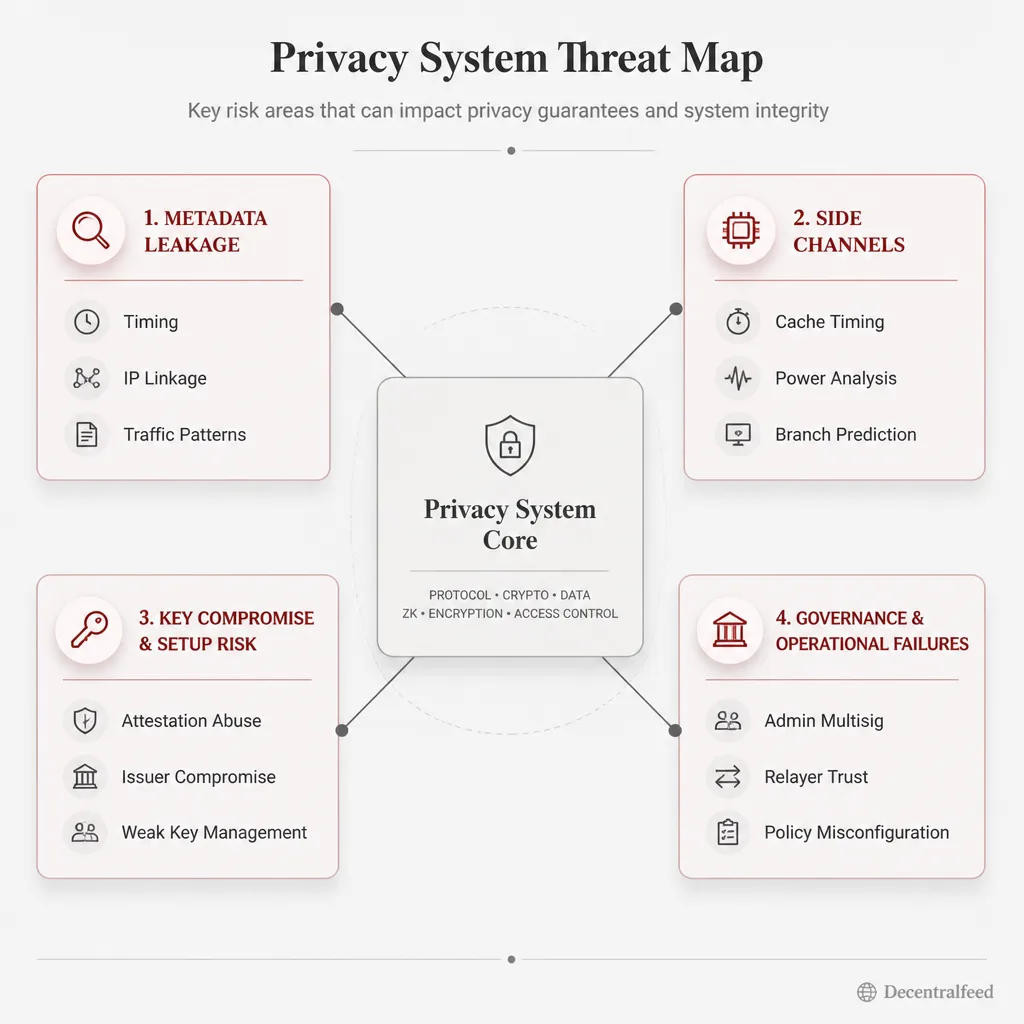
Metadata leakage: timing, network patterns, and linkability
This is one of the most underplayed failure modes.
A system can hide content well and still leak context. Timing, IP addresses, wallet reuse, gas patterns, relayer choice, graph structure, and amount heuristics can make users linkable even when payload data is shielded.
Private in content is not the same as private in behavior.
Side channels: where TEEs become vulnerable
TEE systems live or die on implementation reality. Cache timing, page-fault observation, speculative execution issues, and other side-channel classes have all been studied extensively in enclave environments.
The lesson is not “never use TEEs.” It is that enclave-based privacy depends on a long operational chain: vendor security, patching, attestation, state continuity, and side-channel resilience.
Key compromise and setup risk
Each model has its own catastrophic failure mode.
In a private transfer system, compromised keys may expose spend authority or viewing access. In some ZK constructions, setup compromise matters; in others, it does not. That distinction is important, because trusted setup risk is real but not universal.
In credential systems, issuer compromise can mint false credentials or undermine revocation. In TEE systems, key misuse or attestation abuse can weaken confidence in the entire confidential execution model.
Governance and operational failures
A surprising number of privacy systems fail at the boring layer.
Upgrade keys, admin multisigs, centralized relayers, issuer registries, wallet bugs, and weak operational controls can create trust dependencies far larger than the cryptography suggests on paper.
The hidden cost is rarely setup alone. It is maintenance.
A practical decision guide
Use ZK proofs when cryptographic verifiability matters most
Choose ZK when the network, or a wide set of outsiders, must verify correctness without seeing the inputs.
This is usually the best fit for:
- shielded transfers
- solvency proofs
- private state transitions on public chains
- policy proofs where trust minimization matters more than raw speed
Use TEEs when performance or flexible private computation matters most
Choose TEEs when you need confidential execution for logic that is too costly, too dynamic, or too latency-sensitive for a pure ZK approach.
This often fits:
- private order flow
- hidden mempools
- confidential off-chain computation
- systems that need fast iteration and broad programmability
The tradeoff is simple: more flexibility, more trust.
Use selective disclosure when the job is proving facts, not hiding transfers
Choose credentials when the problem is eligibility, not asset privacy.
This usually fits:
- age checks
- residency proofs
- KYC completion attestations
- membership and sybil-resistance claims
- accreditation and access control
The challenge is less “can I prove this fact?” and more “can I do it without creating correlation and revocation problems?”
Use combinations when the product needs both privacy and operational realism
This is where the ecosystem appears to be heading.
A practical stack might use credentials for identity, a TEE for fast confidential execution, and ZK proofs for settlement or auditability. These approaches are not mutually exclusive. In many serious products, they are complementary.
The important shift
The future is probably not a contest over which privacy coin wins.
The more useful question is narrower: what exactly needs to stay hidden, from whom, who still needs to verify correctness, and which failure mode is least acceptable?
That is the shift. Privacy in crypto is becoming modular because the problems are becoming more specific. The mature approach is not to choose a camp. It is to choose the right tool, understand its trust costs, and be honest about how it can fail.
FAQ
What does it mean that crypto privacy is becoming modular?
It means privacy is no longer best understood as a single category of privacy coins. Different tools now serve different jobs: ZK proofs for verifiable private state changes, TEEs for confidential computation, and selective disclosure credentials for proving facts without revealing full identity data.
Are zero-knowledge proofs the best privacy solution in crypto?
Not automatically. ZK proofs are often strongest when public verifiability matters and you want to minimize trust in operators or hardware. But they can be expensive to generate, harder to implement, and not always the best fit for identity checks or fast confidential computation.
How are TEEs different from zero-knowledge proofs?
TEEs protect data by isolating code and computation inside trusted hardware, while ZK proofs rely on cryptographic proofs that outsiders can verify. TEEs can be faster and more flexible, but they introduce hardware vendor trust, attestation dependencies, and side-channel risk.
What is selective disclosure in crypto?
Selective disclosure lets a user prove a specific fact without revealing the full underlying credential. For example, someone can prove they are over 18 or passed a KYC check without exposing a full identity record.
Which privacy primitive fits private payments best?
For private payments on public blockchains, ZK-based systems are often the strongest fit when the network needs to verify validity without seeing amounts or counterparties. TEEs can help in adjacent private execution contexts, but they do not offer the same public cryptographic verifiability.
Which privacy primitive fits identity verification best?
Selective disclosure credentials are usually the best conceptual fit for identity checks, age gating, residency proofs, accreditation, or KYC completion attestations. The goal is to prove a narrow claim, not to hide asset transfers.
Can ZK proofs, TEEs, and selective disclosure be combined?
Yes. In practice, they often are. A system might use credentials for identity, TEEs for fast private execution, and ZK proofs for settlement or auditability.
What are the biggest privacy risks in practice?
The main risks are metadata leakage, side-channel attacks, key compromise, verifier or issuer collusion, poor revocation design, and governance or admin-key failures. A system can hide content well but still leak context through timing, network patterns, or operational dependencies.
Why is metadata leakage such a big deal?
Because hiding payload data does not automatically hide behavior. Timing, IP addresses, wallet reuse, relayer choice, transaction graph patterns, and amount heuristics can still make users linkable even when transaction details are shielded.
How does regulation affect these privacy tools differently?
Regulatory pressure is not uniform. Tools designed for private money movement often face more scrutiny than systems built for privacy-preserving identity or compliance attestations. The difference usually turns on what is being hidden, who can audit it, and whether the system supports lawful verification.