Is Blockchain Future-Proof? A Framework to Separate Durable Tech From Hype (2026)
Most people ask the wrong question.
“Is blockchain future-proof?” sounds useful, but it treats every network as if it shared the same strengths, risks, and failure modes. That is not how this space works. Investors, builders, and serious users do not need a verdict on blockchain as a category. They need a way to judge whether a specific chain can stay secure, credible, and useful once easy growth disappears.
That is the point where marketing stops helping. A chain can look strong in a bull market and still be structurally weak if its security depends on heavy emissions, its validators are tightly concentrated, or too much of the stack runs through a few hidden choke points.
The better way to think about it is simple: blockchain is not future-proof by default. Durability is chain-specific. It depends on security, decentralization under stress, governance resilience, and how many external systems the network relies on.
So instead of trying to predict winners, this article offers a framework for separating durable networks from those being carried by narrative, subsidies, or convenience.
The wrong question is whether “blockchain” survives
Blockchain will almost certainly survive in some form. That is no longer the interesting debate.
The harder question is whether a given network can keep working credibly under pressure. Pressure can mean lower issuance, weak token prices, validator concentration, software bugs, governance conflict, or infrastructure that turns out to be less decentralized than advertised.
That is why both blanket optimism and blanket skepticism miss the point. Some chains are built for long-term neutrality and conservative operation. Others prioritize speed, flexibility, or app-specific performance. Those can be rational tradeoffs, but they create different kinds of fragility.
A useful framework starts there: durability is not a sector-wide trait. It is a property of individual chains.
What “future-proof” actually means in blockchain
Durability is not permanence
In crypto, “future-proof” often gets used to mean permanent, dominant, and unchanged. That is not realistic.
A future-proof chain is one that can remain credible as conditions change. It can handle lower subsidies, adversarial pressure, infrastructure failures, governance disputes, and shifts in where users and apps operate.
A blockchain does not fail only when it disappears. It can also fail by becoming too centralized to trust, too dependent to operate independently, or too subsidized to defend itself honestly.
Survival does not always mean dominance
A chain does not need to win everything to survive.
Bitcoin can matter as a conservative settlement asset. Ethereum can matter as a programmable base layer and coordination hub for a larger modular stack. An app-chain might survive by serving one durable use case extremely well. A niche network can succeed if it has coherent economics and a role it can defend.
That distinction matters because many arguments about blockchain’s future are really arguments about status. Survival is about staying useful and credible, not necessarily about becoming the global default.
A simple framework: five tests of blockchain durability
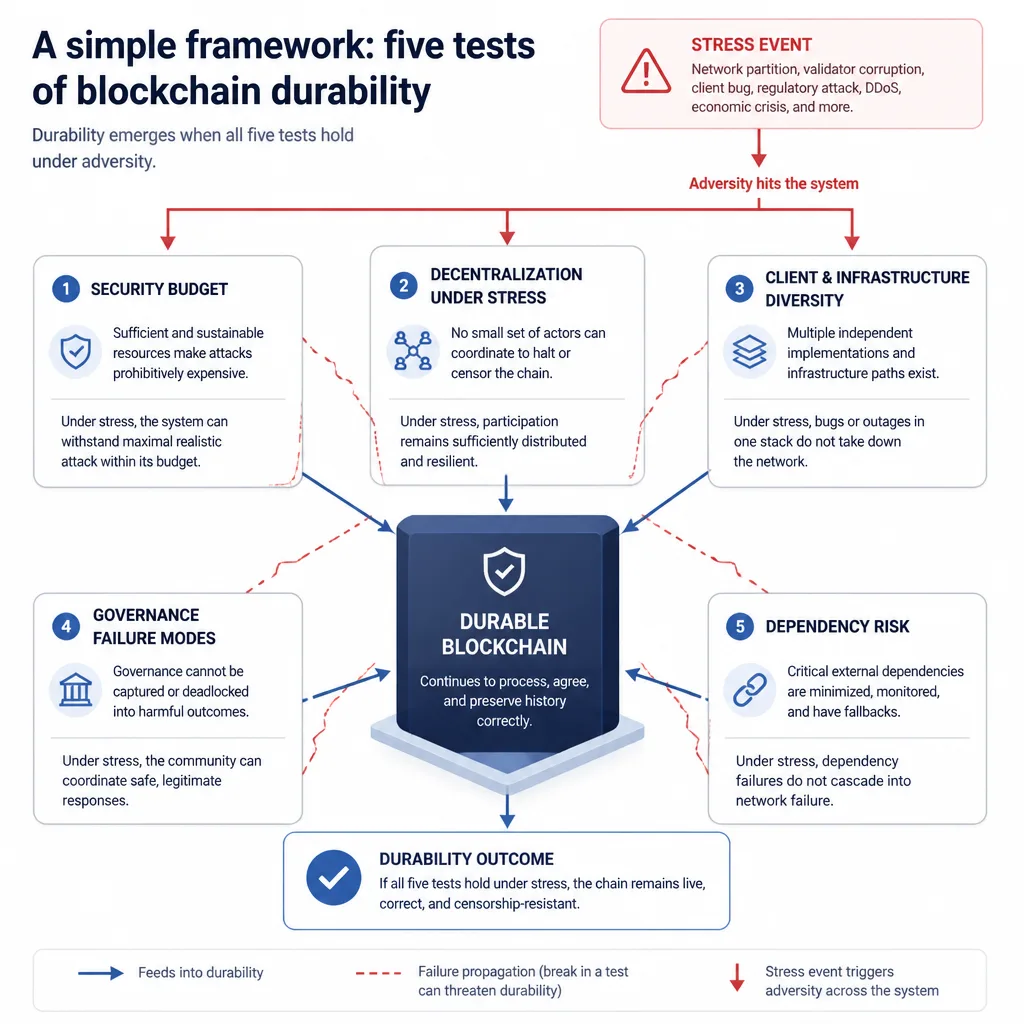
The clearest way to judge whether a blockchain is future-proof is to ask five questions.
1. Can the chain keep paying for its own security?
This is usually where hype breaks first.
Every blockchain needs miners or validators to keep defending the network. If it looks secure only because inflation is still generous, that is not durability. It is a subsidy.
The key question is what happens if token incentives weaken. If security becomes much easier to attack or much less attractive to provide, the chain has a structural problem.
2. Who actually controls block production under stress?
Validator counts can be misleading.
A network may show thousands of validators while effective control sits with a few custodians, staking providers, mining pools, or data centers. What matters is not how decentralized the chain looks on a dashboard. It is who can censor transactions, coordinate halts, shape upgrades, or dominate MEV extraction when things go wrong.
Decentralization matters most during conflict, not during routine uptime.
3. Can one bug or provider disrupt the system?
A chain can be decentralized in theory and brittle in practice.
If most validators run the same client, one critical bug can cause correlated failure. If users depend on a small number of RPC providers, cloud vendors, relays, or wallet gateways, the chain may stay technically live while practical access breaks down.
Durable systems degrade gracefully. Fragile ones seize up around single points of failure.
4. What happens when participants disagree?
Governance is not mainly about normal upgrades. It is about conflict.
Can the chain absorb disagreement without losing legitimacy? Is crisis management controlled by a small inner circle? Are emergency powers limited and trusted? Does token voting drift toward plutocracy because turnout is low and ownership is concentrated?
No chain has perfect governance. The real test is whether governance remains credible when stakes are high.
5. What else has to stay healthy for the chain to work?
This matters more now than it did a few years ago.
A chain may depend on a parent chain, bridges, sequencers, multisigs, oracle networks, or data availability layers. An L2 may inherit settlement security from Ethereum while still relying on its own upgrade path, proof system, sequencer design, and bridge architecture.
That does not make L2s weak by definition. It just means “inherits security” is only part of the story.
Security budget is often the first real stress test
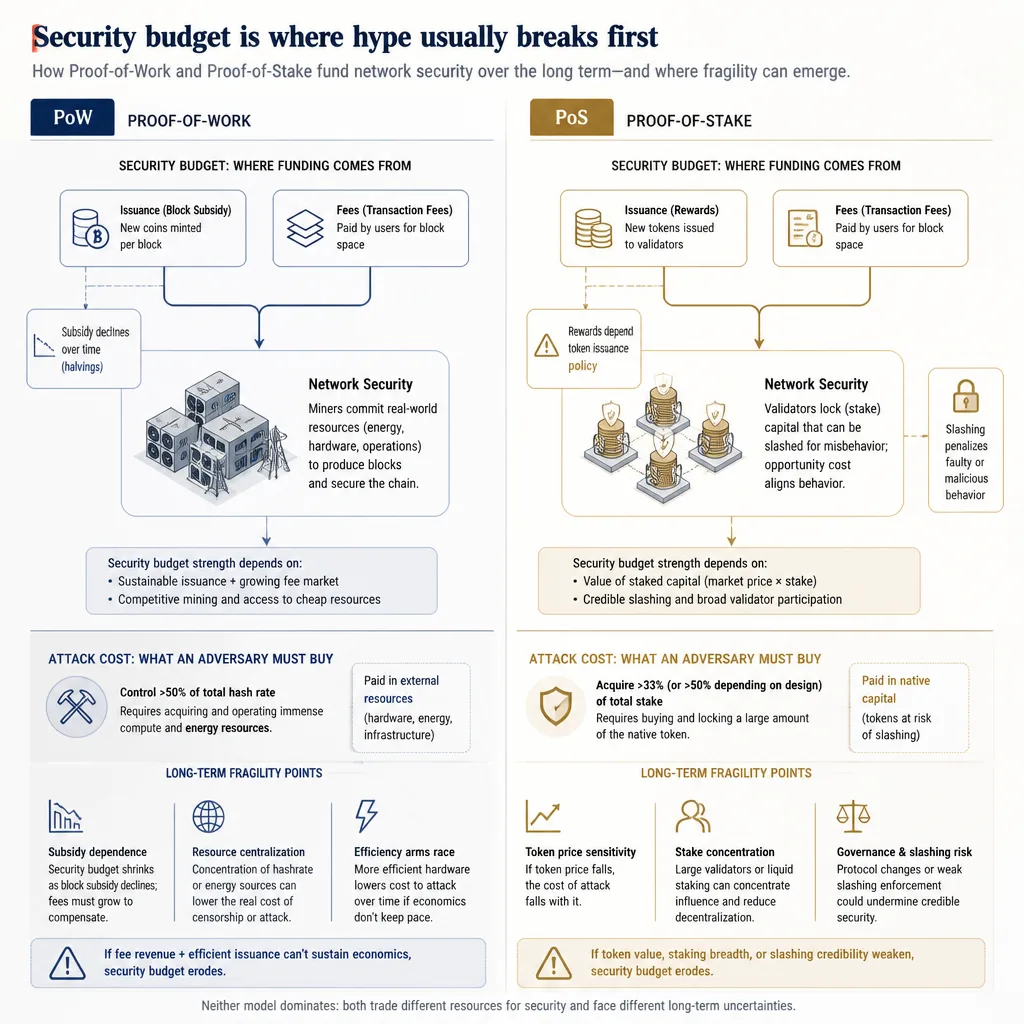
Long-term blockchain security is fundamentally an economic question.
PoW: simple security model, open fee-market question
Proof of Work has a clear strength: attacking the network requires real-world resources. Bitcoin’s durability case rests heavily on that simplicity, along with a conservative social contract and resistance to unnecessary change.
The open question is familiar: as block subsidies decline, can fees provide enough security over the long run? No one knows with certainty. Bitcoin’s fee market has shown bursts of strength, but long-term sufficiency is still an unresolved issue, not a solved one.
That does not make PoW weak. It means part of its durability depends on sustained demand for blockspace.
PoS: efficient, but only if incentives remain credible
Proof of Stake approaches security differently. Instead of external energy cost, it relies on economic stake, validator incentives, and penalties such as slashing.
Its advantage is efficiency. It can support broad smart contract ecosystems without the operating model of PoW. Ethereum after the Merge is the clearest large-scale example.
But PoS can look safer than it is if token price is doing most of the work, rewards are mostly subsidy-driven, or stake is concentrated through a few major intermediaries. Slashing is powerful in theory, but its real strength depends on whether penalties can and will be enforced under stress.
Subsidized activity can hide weak foundations
This is where many alt-L1 stories start to weaken.
A chain can show high activity, low fees, and an apparently healthy validator set while still being economically thin underneath. If usage depends on token emissions, user incentives, and foundation spending, demand may not be strong enough to support security once those supports fade.
A useful rule of thumb: if inflation is masking weak organic demand, the chain may be popular without being durable.
Decentralization matters most when things go wrong
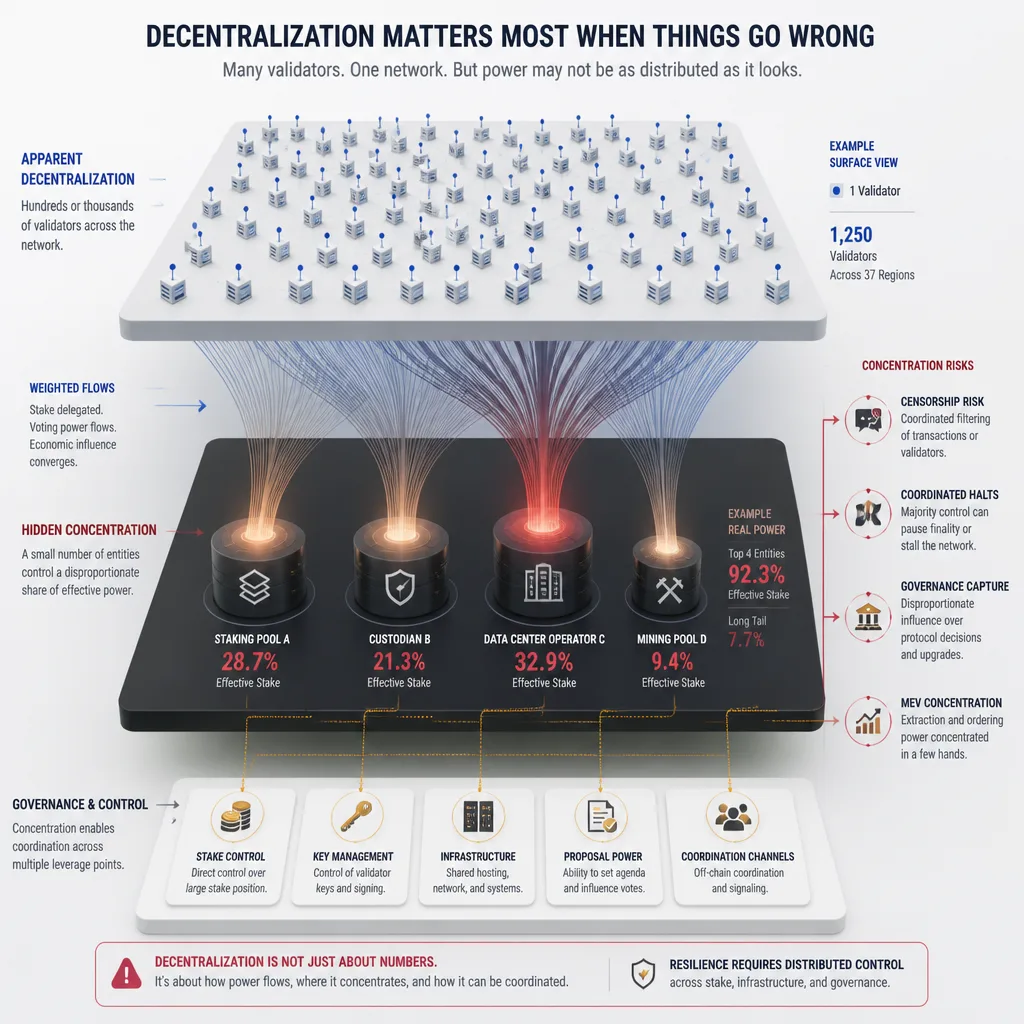
Concentration matters more than headline validator counts
A blockchain does not need perfect decentralization to be useful. It does need enough distribution of power that no small group can easily dominate outcomes.
For PoS chains, that means looking beyond raw validator numbers to effective stake control. If a few staking providers or custodians hold a large share of stake, the network may be less neutral than it appears.
For PoW chains, the same logic applies to mining pools. Hashrate can be broadly distributed at the hardware level while block construction and pool governance remain concentrated.
Capture is social as well as technical
The risk is not just technical control. It is political and institutional control too.
If a handful of actors can coordinate around censorship, preferred forks, or emergency interventions, neutrality weakens. A fast, cheap chain can look much less durable once users believe the rules may bend under pressure from insiders.
Fast finality is not the same as credible neutrality
This is easy to miss because fast finality is visible and neutrality is not.
Users notice low fees immediately. They notice weak neutrality only when a transaction is censored, a chain is halted, or governance pressure shows up. But that is exactly when decentralization becomes the product.
A chain’s behavior under stress tells you more than its peak TPS ever will.
Blockchains rarely fail only at the consensus layer
Client monoculture
If most of a network depends on one software client, one serious bug can become a systemic event. That is why client diversity matters more than many people assume, especially in complex smart contract ecosystems where the software surface area is larger.[^1]
Ethereum has long treated client diversity as strategically important, which is a real durability advantage. But no network gets to declare this permanently solved.
RPC and provider centralization
Even if consensus is decentralized, user access may not be.
If wallets, apps, and traders all route through a small number of RPC providers or cloud regions, outages or policy decisions at those providers can create effective centralization. Users experience a chain through infrastructure, not just protocol rules.
Bridges, sequencers, and Layer 2 dependencies
L2s deserve more careful analysis than either promoters or skeptics usually give them.
A mature rollup can inherit meaningful security properties from a base chain, especially around settlement and dispute resolution.[^2] But it also introduces new dependencies. If the sequencer is centralized, the bridge is brittle, or upgrade keys sit behind a small multisig, trust remains concentrated.
So the better question is not “Are L2s secure?” It is “Secure against which failures, and dependent on whom?”
PoW, PoS, and L2s: different paths, different failure modes
Bitcoin-style durability
Bitcoin’s strongest durability trait is restraint. Its design is relatively narrow, its governance culture is conservative, and its neutrality is unusually credible. That gives it a strong case for long-term settlement relevance.[^3]
Its tradeoff is adaptability. Its unresolved issue is still long-term security funding as issuance declines.
Ethereum-style durability
Ethereum’s strength is breadth. It has deep developer mindshare, broad application utility, and a scaling model that expands through L2s rather than forcing all activity onto one base layer.[^4]
Its tradeoff is complexity. More layers create more dependencies. More functionality creates more governance surface. Ethereum may be durable partly because it is adaptable, but that adaptability also widens the set of things that must keep working.
Alt-L1 and app-chain durability
A specialized chain is not automatically weaker than a general-purpose L1. In some cases, specialization is the advantage.
An app-chain with real usage, coherent economics, and honest dependency management may be more durable than a “universal” chain whose main pitch is being faster and cheaper than Ethereum. But specialization becomes fragility if demand is narrow, security is rented without a durable economic base, or the ecosystem exists mostly because incentives are still flowing.
A practical scorecard
Before calling a chain future-proof, ask:
- Who pays for security if token incentives weaken?
- How concentrated is effective control over block production?
- How much client and infrastructure diversity exists in practice?
- What happens during a contentious upgrade or emergency?
- What external systems must remain trusted for the chain to stay usable?
- Is demand organic, or mostly bought through incentives?
For investors, the key is separating real usage from subsidized activity.
For builders, the key is matching architecture to the kind of durability they need. If neutrality and settlement matter most, a conservative L1 may be the right fit. If cost and distribution matter more, an L2 may be the better choice. If the app needs custom economics or execution, an app-chain can make sense, but only if its security and dependency tradeoffs are understood clearly.
Common red flags
These warning signs tend to show up repeatedly:
- chronic reliance on inflationary rewards
- concentrated staking or mining intermediaries
- client monoculture
- foundation-controlled upgrade keys
- centralized sequencers with weak exit paths
- bridge-heavy usage
- repeated halts or emergency restarts
- activity that appears heavily incentive-driven rather than organic
None of these guarantees failure on its own. Several together usually mean the chain is less durable than its narrative suggests.
Conclusion
The useful answer to “is blockchain future-proof?” is no, not by default.
Some blockchains may prove highly durable. Others may survive in narrower roles. Many will struggle once subsidies shrink, power concentrates, or dependencies become too heavy to ignore.
The important shift is to stop treating blockchain as a single bet. Durable chains earn survival through credible security, decentralization under stress, operational resilience, governance legitimacy, and manageable dependencies. They do not get there just because they are fast, cheap, or currently popular.
If you want one line to keep in mind, use this: a blockchain is not future-proof because it is popular. It is future-proof only if it stays credible when popularity stops doing the work.
FAQ
Is blockchain future-proof as a technology category?
Not in any blanket sense. The better question is which specific networks can remain secure, credible, and relevant as market conditions change and subsidies shrink.
What does future-proof mean for a blockchain in 2026?
Here, it means a chain can keep functioning credibly under stress. That includes maintaining security, resisting capture, surviving software or governance failures, and staying useful as incentives and usage patterns evolve.
What are the main tests of blockchain durability?
A practical framework includes five tests: security budget, decentralization under stress, client and infrastructure diversity, governance under conflict, and dependency risk.
Why is the security budget so important?
Because blockchains do not defend themselves for free. Miners or validators need incentives, and attackers must face meaningful economic cost. A chain that relies heavily on emissions or subsidies may look healthy while hiding weak long-term security.
Is Proof of Work or Proof of Stake more future-proof?
Neither is universally superior. Proof of Work offers a simpler model with external attack costs, but it faces long-term questions around declining issuance and fees. Proof of Stake can be more efficient and flexible, but it becomes fragile if stake concentrates, slashing is weak in practice, or governance capture emerges.
Does decentralization still matter if a chain is fast and cheap?
Yes. Decentralization matters most when things go wrong. Low fees and fast finality do not help much if a small group can censor transactions, coordinate halts, or dominate upgrades.
Can a blockchain be decentralized in theory but fragile in practice?
Absolutely. A chain may have distributed validators on paper while depending on one dominant client, a few RPC providers, limited cloud regions, or foundation-run infrastructure.
Are Layer 2 networks future-proof?
Some may be durable, but they should not be treated as independent by default. Many L2s inherit security from a parent chain while also introducing sequencer risk, bridge risk, upgrade key risk, and other dependencies.
What are common signs that a blockchain is fragile?
Common red flags include chronic dependence on inflationary rewards, concentrated validator or staking control, client monoculture, foundation-controlled upgrade keys, bridge-heavy usage, centralized sequencers with weak exit paths, repeated halts, and demand that appears mostly incentive-driven.
Does a blockchain need to become a dominant global network to survive?
No. A chain can be durable as a settlement layer, an execution environment, an app-chain, or a niche network with a defensible role and coherent economics.
How should investors evaluate whether a chain is durable?
Look beyond market cap, TPS, and token price. Better questions are who pays for security if incentives weaken, how concentrated block production is, what dependencies exist, how governance behaves during conflict, and whether demand is real or subsidized.
How should builders choose between an L1, an L2, or an app-chain?
They should match the choice to the kind of durability they need. If neutrality and settlement are the priority, a strong L1 may make sense. If lower costs and distribution matter more, an L2 may be better. If specialization is core to the product, an app-chain can work, but only if its security model and dependencies are sustainable.