What Actually Secures a Blockchain? A Threat-Model Guide to PoW, PoS, and L2s
“Security” is one of the most abused words in crypto. A chain gets called secure because it has a large market cap, a strong brand, a lot of total value locked, or simply a loyal community.
That is not a serious standard.
A blockchain is not secure in the abstract. It is secure against specific attacks, under specific assumptions, with specific recovery paths. The useful question is never “Is this blockchain secure?” It is: secure against what, against whom, for how long, and what happens if something goes wrong?
That lens matters whether you are comparing Bitcoin and Ethereum, evaluating a newer Proof of Stake chain, or trying to understand what it really means when a rollup claims to “inherit Ethereum security.”
Security Is Not a Badge. It Is a Threat Model.
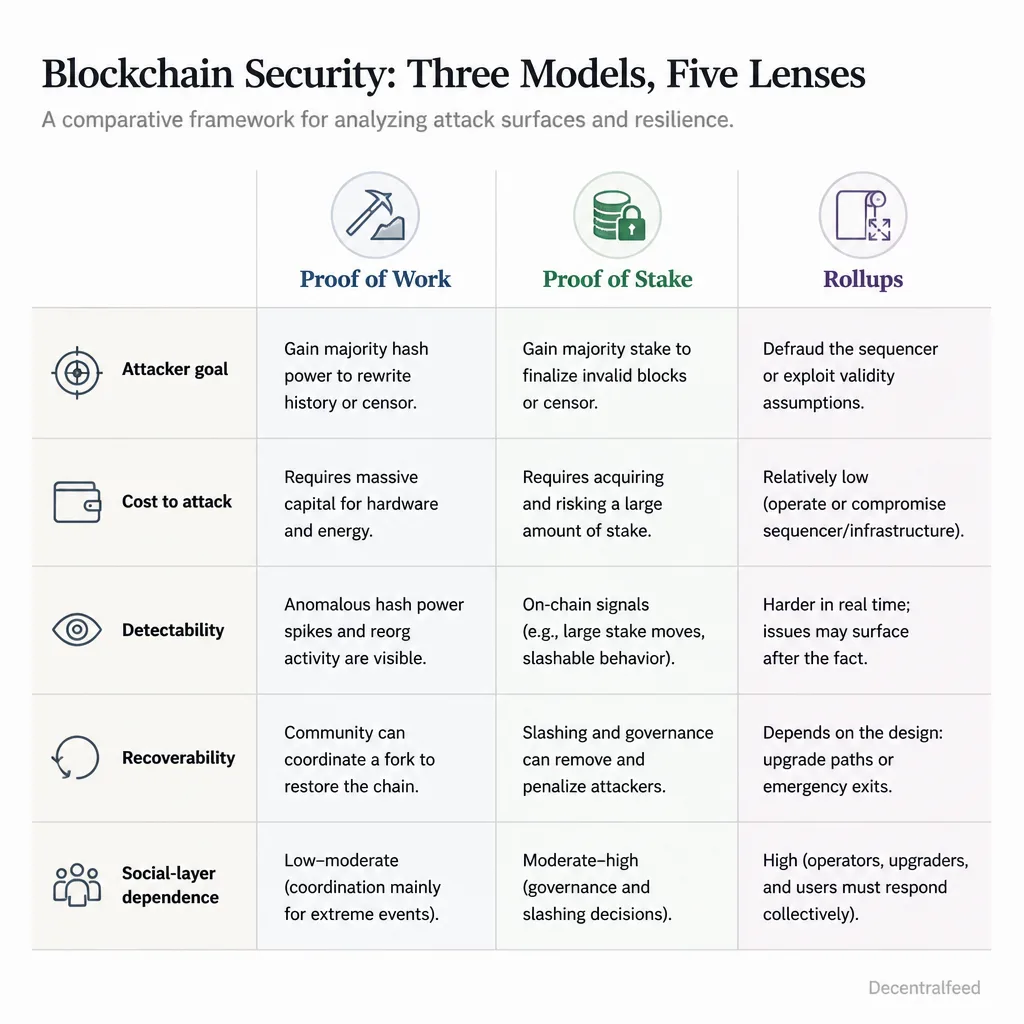
Security is not a trophy. It is a set of assumptions that holds until an attacker tests it.
Secure against what, exactly?
Different attackers want different things.
Some want to reverse transactions and double-spend. Some want to censor users. Some want to halt the network at a bad moment. Others want to influence upgrades, extract MEV, or pressure operators into filtering transactions without ever “breaking” the protocol.
Those are different failure modes. Lumping them together under one word hides more than it explains.
It helps to separate at least five properties:
- Safety: does the system avoid invalid or conflicting state?
- Liveness: does it keep making progress?
- Censorship resistance: can users get transactions included?
- Finality confidence: how hard is it to reverse history?
- Recoverability: what happens if something fails?
A chain can be strong on one and weak on another. An L2 may keep funds safe while remaining easy to censor for a period. A PoW chain may strongly resist invalid state changes but still be vulnerable to deep reorgs if users treat low-confirmation transactions as final.
The questions that matter
A usable threat model does not need to be complicated. Start here:
- What is the attacker trying to do?
- What does it cost?
- How quickly would anyone notice?
- What can users or the community do to recover?
- How much of that recovery depends on the social layer rather than automatic protocol rules?
One more question usually matters in practice: who controls the relevant surface area? Depending on the system, that may mean miners, validators, sequencers, bridge operators, multisigs, or client maintainers.
That framework is more useful than market cap, TVL, or brand reputation. Those metrics can matter, but only as inputs. They are not conclusions.
What Actually Secures Proof of Work
Proof of Work secures block production by making chain extension expensive in the real world. Miners spend electricity and hardware resources to produce blocks, and nodes follow the chain with the most accumulated work.
Why hashpower matters, and why it is not the whole story
Hashrate matters because it is the resource an attacker must overcome. If you want to replace recent blocks, you generally need enough hashpower to build an alternative chain that overtakes the honest one.
But “high hashrate” is not a complete security claim.
You also need to ask:
- How concentrated are mining pools?
- Is hashpower rentable?
- Does the chain share its mining algorithm with a much larger network?
- Is hardware production concentrated?
- Are major pools clustered in a few jurisdictions?
A small PoW chain can look secure until someone rents enough hashpower to attack it. That has happened more than once. The issue was not PoW as a concept. The issue was that the real attack cost was lower than people assumed.
Main PoW failure modes: reorgs, 51% attacks, and censorship
A reorg happens when nodes abandon one chain tip for another with more accumulated work. Small reorgs can happen naturally. Deep reorgs are different. They can reverse transactions users thought were settled.
A familiar example is a merchant accepting a low-confirmation payment for a high-value purchase. If an attacker can briefly marshal enough hashpower, they may mine an alternative chain and reverse that payment. The chain was not insecure in general. The settlement assumption was weak relative to the attacker.
A 51% attack in PoW is also widely misunderstood. Majority hashpower can enable:
- reordering recent blocks
- censoring transactions
- attempting double-spends
It does not usually let an attacker mint coins from nowhere, rewrite protocol rules, or spend coins without the private keys.
Censorship is often the quieter risk. A majority miner, or a coordinated group of large pools, can refuse to include certain transactions. That pressure may come from regulation, politics, or profit.
Where PoW is stronger than critics admit, and weaker than fans admit
PoW’s strongest feature is that attacks usually require external resources. Electricity, hardware, and infrastructure are real-world constraints. That cost is often visible, and it can make attacks genuinely painful.
That matters.
But external cost does not eliminate concentration. If a small number of pools controls most block production, practical power may be narrower than the headline hashrate suggests.
So PoW is stronger than critics admit because it imposes hard real-world costs. It is weaker than fans admit because mining concentration, bribery, and censorship pressure are not edge cases.
What Actually Secures Proof of Stake
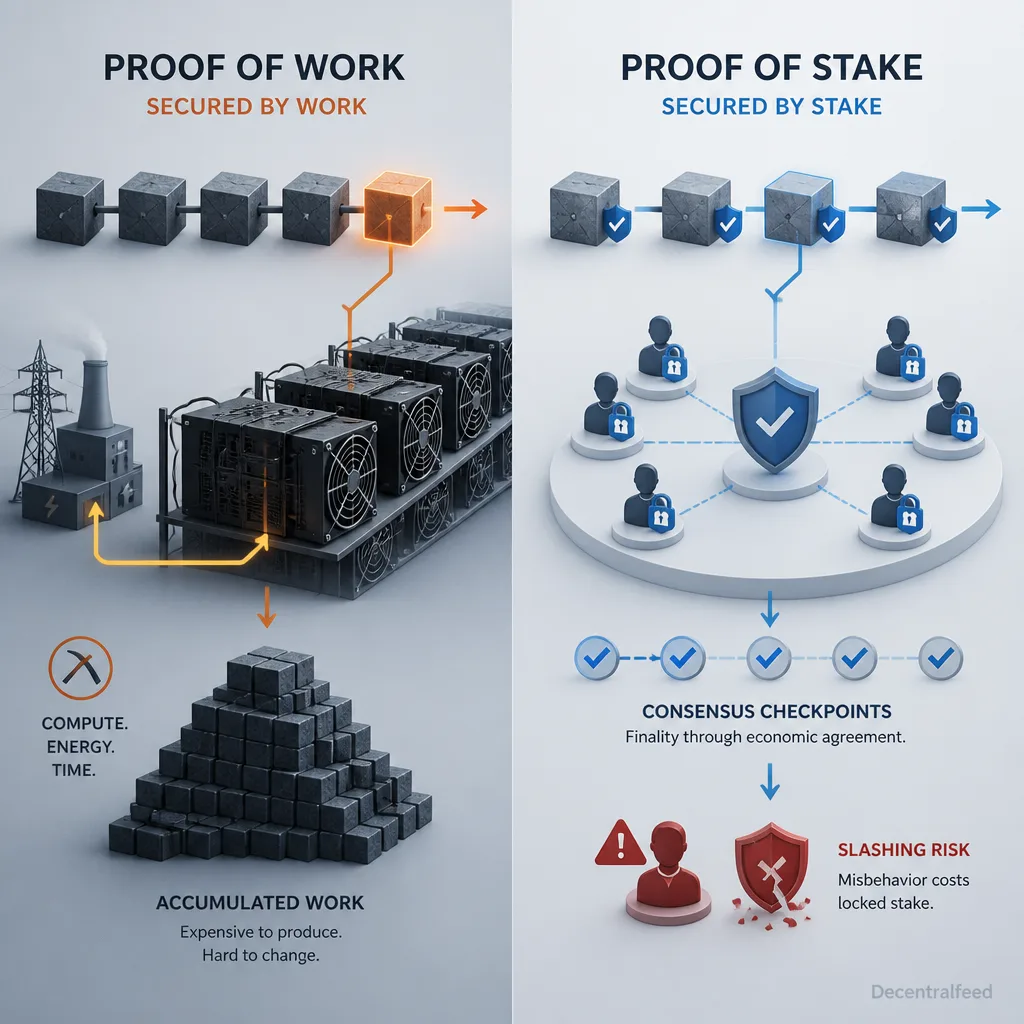
Proof of Stake replaces external work with bonded capital. Validators lock stake, follow consensus rules, and can be penalized or slashed for certain forms of misbehavior.
Stake is collateral, not magic
Stake is best understood as collateral.
That sounds obvious, but it corrects a common mistake. People talk about a chain having “$X billion of economic security” as if that number settles the question. It does not.
The real questions are:
- What behavior is actually slashable?
- How quickly can it be detected?
- Who holds the stake?
- Could that stake be borrowed, coordinated, or pressured?
- Would the community actually agree on the punishment path?
If a validator equivocates or violates finality rules, slashable collateral can make the attack self-destructive. That is a real strength of PoS. But not every harmful action is that clean. Soft censorship, cartel behavior, governance capture, or operational concentration can weaken a network without triggering an obvious slash-and-recover mechanism.
Main PoS failure modes: long-range attacks, cartelization, and censorship
A long-range attack is a class of PoS attack in which an adversary uses old validator keys or outdated stake assumptions to fabricate an alternative history far back in time. Mitigations usually depend on checkpointing and recent trusted views of the chain, not blind replay of protocol rules.
Then there is validator cartelization. If a large share of stake sits with a few custodians, exchanges, or staking providers, concentration risk rises even if the protocol still appears to be functioning normally.
Censorship is often the more realistic concern. A concentrated validator set, especially one exposed to the same legal or operational pressures, can make transaction inclusion less neutral. No dramatic protocol break is required. The system simply becomes less permissionless in practice.
Weak subjectivity and the social layer
This is where PoS makes something unusually explicit: the social layer is part of the security model.
Many PoS systems require weak subjectivity. In plain English, a node that has been offline for a long time may need a recent trusted checkpoint or social reference point to know which chain history to accept.
That is not a footnote. It is a design assumption.
To be fair, PoW also depends on humans in catastrophic scenarios. Major chains of any kind rely on client software, governance norms, and off-chain coordination when things go badly enough. But PoS tends to make that dependence more visible.
Where PoS is stronger than critics admit, and weaker than fans admit
PoS is stronger than critics admit because slashable attackers can be punished in-protocol, and finality can be firmer than ordinary probabilistic settlement. Reverting finalized state is meant to be socially obvious and economically severe.
But PoS is weaker than fans admit when stake is concentrated, client diversity is thin, or governance and validation become entangled. Economic deterrence is real. So is social dependence.
The clean version is simple: PoS can be very strong, but its strength lives in validator distribution, slashing design, checkpoint assumptions, and recovery norms. Not in the abstract size of staked capital.
Rollups Change the Security Question
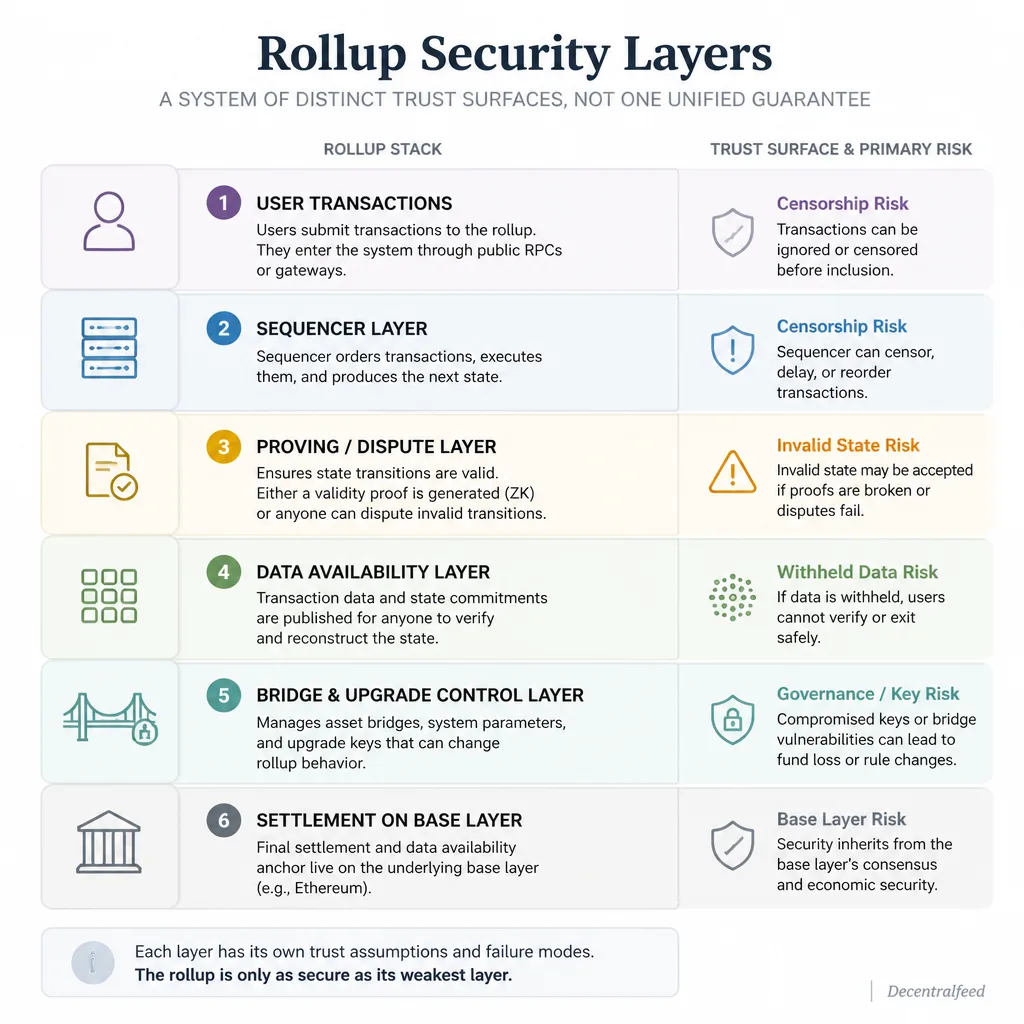
When people say an L2 “inherits Ethereum security,” they are compressing too much.
That phrase is partly true, but only if you unpack it.
Sequencing, proving, and data availability are separate trust surfaces
A rollup does not have one security assumption. It has several.
At minimum, separate these:
- Sequencing: who orders transactions?
- Proving or dispute resolution: how is correct state enforced?
- Data availability: where is the data posted, and can users reconstruct state?
You should also ask about bridge contracts, upgrade keys, and emergency controls.
A rollup may inherit L1 settlement guarantees while still relying on a centralized sequencer for day-to-day operation. Those are different things.
Main rollup failure modes: sequencer censorship, invalid state transitions, and withheld data
The most common practical risk is sequencer control. Many rollups began, and some still operate, with centralized sequencers. That can create censorship, downtime, delayed inclusion, and MEV-heavy ordering decisions.
A second category is invalid state transitions. In optimistic rollups, state is assumed valid unless challenged during a dispute window. In ZK rollups, validity proofs are used to show that state transitions were correct.
A third category is withheld data. If users or challengers cannot access the transaction data needed to reconstruct state, execution correctness alone is not enough. Data availability is its own security layer.
Fraud proofs, validity proofs, and who can actually challenge
Optimistic rollups depend on some version of “someone can challenge bad state in time.” That sounds robust, but the practical question is sharper: who can challenge, how, and is that path fully live today?
Withdrawal delays on optimistic rollups are not just bad UX. They are part of the security model. The dispute window exists so bad state can be challenged before final settlement.
ZK rollups reduce trust in one important sense. If the validity proof is sound, an invalid state transition should not be accepted. But that does not remove every other dependency. Sequencer control, upgrade keys, bridge architecture, and data publication still matter.
A rollup can be safe in one sense and fragile in another
This is the distinction many readers miss.
A rollup can be relatively strong on funds safety while weaker on liveness or censorship resistance. Users may technically retain an exit path, but if the sequencer is down during market stress, or if emergency exits are difficult to use, practical safety deteriorates.
Imagine an L2 that never steals your funds but can delay transactions for hours when volatility spikes. That is not total failure. It is still a meaningful trust assumption.
“Inherits L1 security” should not end the conversation. It should start a more precise one.
A Practical Framework for Evaluating Any Chain or L2
Once you stop treating security as a brand attribute, comparison gets easier.
Ask these questions before trusting a security claim
Before trusting a chain or rollup with real value, ask:
- Who can reorder transactions or recent history?
- Who can censor transactions, and for how long?
- Who can halt the system or degrade liveness?
- Who can upgrade contracts, bridges, or prover logic?
- Who can challenge invalid state?
- Where does the critical data live?
- Can users force inclusion or exit if the main operator disappears?
- If something breaks, who has to coordinate recovery?
That checklist works across PoW, PoS, and L2s because it focuses on failure modes rather than branding.
Why economic security is necessary but not sufficient
Economic security matters. Market value, stake size, liquidity, usage, and infrastructure depth all affect attack cost and incentives.
But they are still partial signals.
High TVL can mean a system is trusted. It can also mean the payoff from attacking it is larger. A large market cap may make stake acquisition harder, but it does not tell you whether a multisig can upgrade the bridge tonight. A respected brand does not tell you whether validators are concentrated or whether users can recover cleanly after a failure.
Economic security helps you estimate how expensive some attacks may be. It does not tell you who can halt the system, censor users, force an emergency upgrade, or rescue funds after something breaks.
Conclusion
The wrong way to think about blockchain security is to ask which model wins in general.
PoW, PoS, and rollups each secure different things in different ways, and each has failure modes that marketing tends to flatten. PoW buys security through external resource expenditure. PoS relies on bonded collateral, slashing, and more explicit finality assumptions. Rollups inherit some protections from the base layer, but add new trust surfaces around sequencing, proving, data availability, and upgrades.
So stop asking which model is absolutely secure.
Ask what can fail, how expensive it is to cause, how quickly you would notice, whether users can still exit or recover, and who has to coordinate if the system breaks. That habit will tell you more than any market cap chart or protocol slogan.
FAQ
What actually secures a blockchain?
A blockchain is secured by some mix of consensus rules, economic deterrence, network participation, and social coordination. The more useful question is not whether a chain is secure in general, but secure against which attacker, which failure mode, at what cost, and with what recovery path.
Is market cap a good measure of blockchain security?
Not by itself. Market cap can be a rough signal of ecosystem size, liquidity, and attacker incentives, but it does not directly measure censorship resistance, validator or miner concentration, bridge risk, upgrade trust, or recoverability.
How is Proof of Work security different from Proof of Stake security?
Proof of Work relies on miners spending external resources such as electricity and hardware to produce blocks, which makes attacks costly in the real world. Proof of Stake relies on validators posting stake as collateral, with some forms of misbehavior punished through slashing or loss of rewards. PoW emphasizes external attack cost. PoS makes finality and social recovery assumptions more explicit.
What can a 51% attacker actually do in Proof of Work?
A majority-hashpower attacker can usually try to reorder recent blocks, censor transactions, or carry out double-spend attacks against users relying on weak settlement. They generally cannot rewrite protocol rules, create coins from nothing, or spend coins without controlling the relevant private keys.
What is weak subjectivity in Proof of Stake?
Weak subjectivity means nodes that have been offline for a long time may need a recent trusted checkpoint or social reference point to know which chain history to accept. In many PoS systems, that is part of the security model, not a minor implementation detail.
Are rollups as secure as the Layer 1 they settle to?
Only partly. A rollup may inherit some security from its base layer for settlement and dispute resolution, but users still need to evaluate sequencer control, proof systems, data availability, bridge design, upgrade keys, and emergency exit paths.
What are the main security risks for L2s?
The main risks are sequencer censorship or downtime, invalid state transitions if proof systems fail or are not live as assumed, withheld transaction data, bridge contract risk, and governance or upgrade-key control. A rollup can be strong on funds correctness while still being fragile on liveness or user access.
What is the best way to evaluate a blockchain security claim?
Use a threat-model lens. Ask who can reorder transactions, who can censor them, who can halt the system, who can upgrade the rules, who can challenge invalid state, where the data lives, and what users can do if the main operator disappears.