Bitcoin Finality vs Ethereum Finality: What “Confirmed” Really Means (And When It Can Change)
A wallet says your transaction is confirmed. An exchange still won’t credit it. A merchant might hand over a coffee after seeing it in the mempool, but not a laptop after one block.
That gap is the real issue.
In crypto, “confirmed” is not a simple yes-or-no state. It is a risk judgment. On Bitcoin, confidence rises as more proof of work is built on top of a transaction’s block.[^1] On post-Merge Ethereum, a transaction can be included quickly, then gain much stronger checkpoint-based finality after validator votes accumulate.[^2]
So the useful question is not just, “Is this confirmed?” It is: what would have to happen for this payment to disappear, and is that risk acceptable for this amount and use case?
Why “confirmed” means different things on Bitcoin and Ethereum
Both Bitcoin and Ethereum can show a transaction on-chain before it is settled in the strongest sense. The difference is how each network gets from inclusion to stronger assurance.
Bitcoin uses Nakamoto consensus. There is no single protocol event that makes a transaction absolutely irreversible. Each additional block simply makes rewriting history harder, because an attacker would need to replace more accumulated proof of work.[^1][^3]
Ethereum’s Proof-of-Stake design separates fast chain progress from stronger finality. A transaction may appear in a block within seconds, but the stronger safety guarantee comes later, when checkpoints are justified and finalized under Ethereum’s consensus rules.[^2][^4]
That is why “confirmed” can mean one thing in wallet UX and something quite different in settlement terms.
Inclusion is not the same as finality
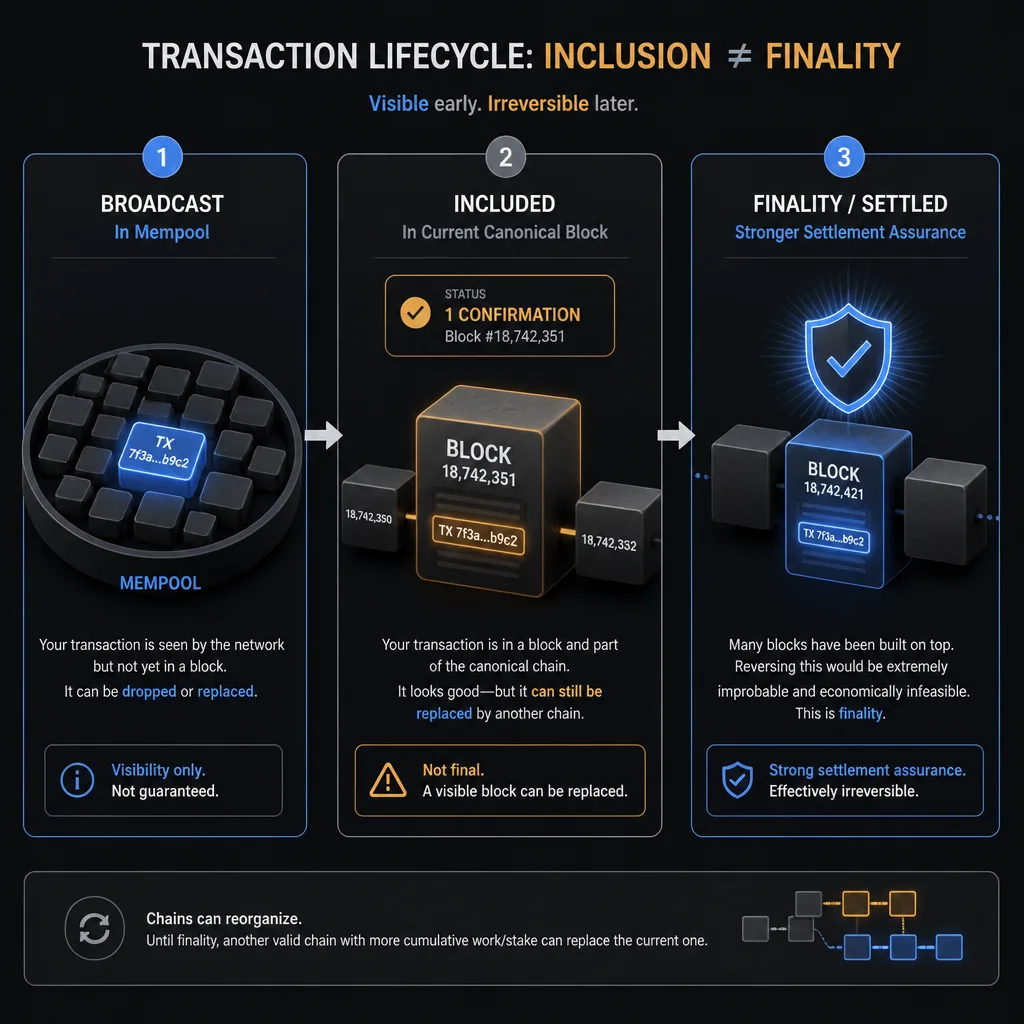
What “1 confirmation” usually means
On both chains, “1 confirmation” usually means the transaction is in a block on the current canonical chain tip.
That matters. It tells you the network currently recognizes that block as part of the best chain.
What it does not mean is that the block can never be displaced.
On Bitcoin, one confirmation means one mined block includes your transaction. On Ethereum, it usually means the transaction is in an execution block accepted by the current fork choice. In both cases, that is inclusion, not the strongest form of settlement.
Why this causes confusion
Wallets compress a messy consensus process into a clean status label. That is good product design, but it can create the wrong mental model.
If a transaction is visible, users tend to treat it as settled. But visibility is not irreversibility. Recent chain history can still change while the network resolves competing versions of the latest blocks. That is what a reorg is. Sometimes it reflects an attack. Often it is just the network converging on one branch.
For a self-transfer, that distinction may not matter much. For an exchange crediting a large deposit or a merchant shipping expensive goods, it matters a lot.
Bitcoin finality is probabilistic
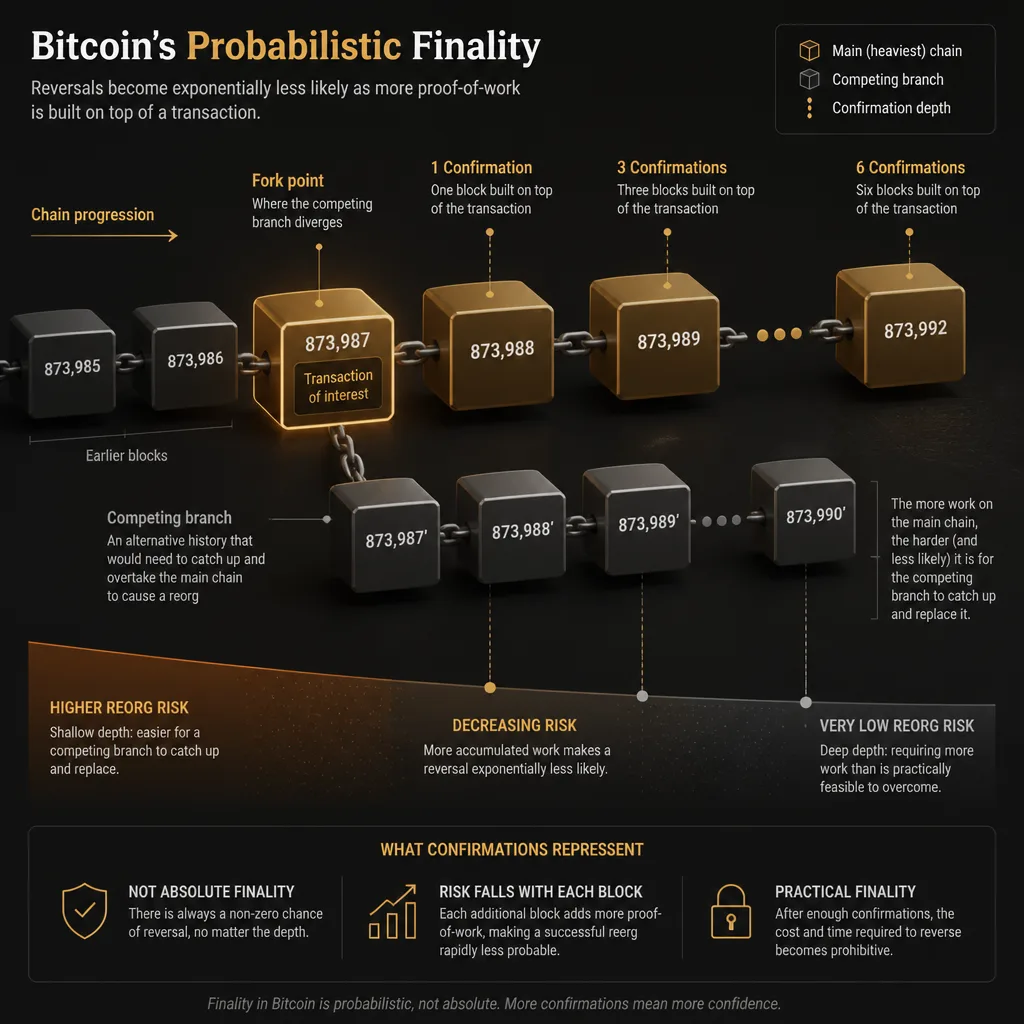
Why reversals become less likely over time
Bitcoin’s rule is conceptually simple: the accepted chain is the one with the most accumulated proof of work. To reverse a transaction, an attacker needs to build an alternative chain that overtakes the honest chain.[^1]
That is why additional confirmations help. They do not create absolute finality. They raise the cost of rewriting history and lower the odds of success, assuming the attacker does not control dominant hashpower.
A practical way to think about Bitcoin finality is as a confidence curve, not a checkpoint.
What 1, 3, and 6 confirmations actually tell you
These numbers are conventions, not protocol milestones.
1 confirmation means the transaction is in one accepted block. For low-stakes transfers, that may be enough. But one-block reorganizations can happen naturally when miners find competing blocks at nearly the same time.
3 confirmations usually means the chance of an ordinary accidental reorg affecting the transaction is much lower. For moderate-value payments, many operators see that as a reasonable level of assurance.
6 confirmations is the classic Bitcoin rule of thumb. It persists because it is often operationally sensible, not because the protocol treats six blocks as special.[^1] For many ordinary transfers, six confirmations is high confidence. For unusually large transfers or targeted attack scenarios, it may still be too little.
Bitcoin’s block interval averages about 10 minutes, but that is only an average.[^3] Sometimes blocks arrive quickly. Sometimes they do not. So six confirmations is often around an hour, not exactly an hour.
Why Bitcoin never reaches protocol-defined absolute finality
This is the part many explanations skip.
Bitcoin has no built-in finality checkpoint. No rule says that after a certain block depth, history is impossible to change. What the protocol gives you is increasing confidence.
That is why “Bitcoin finality” should almost always be described as probabilistic. The residual risk can become very small relative to the value at stake, but it does not become formally zero.
Ethereum finality is checkpoint-based and economic
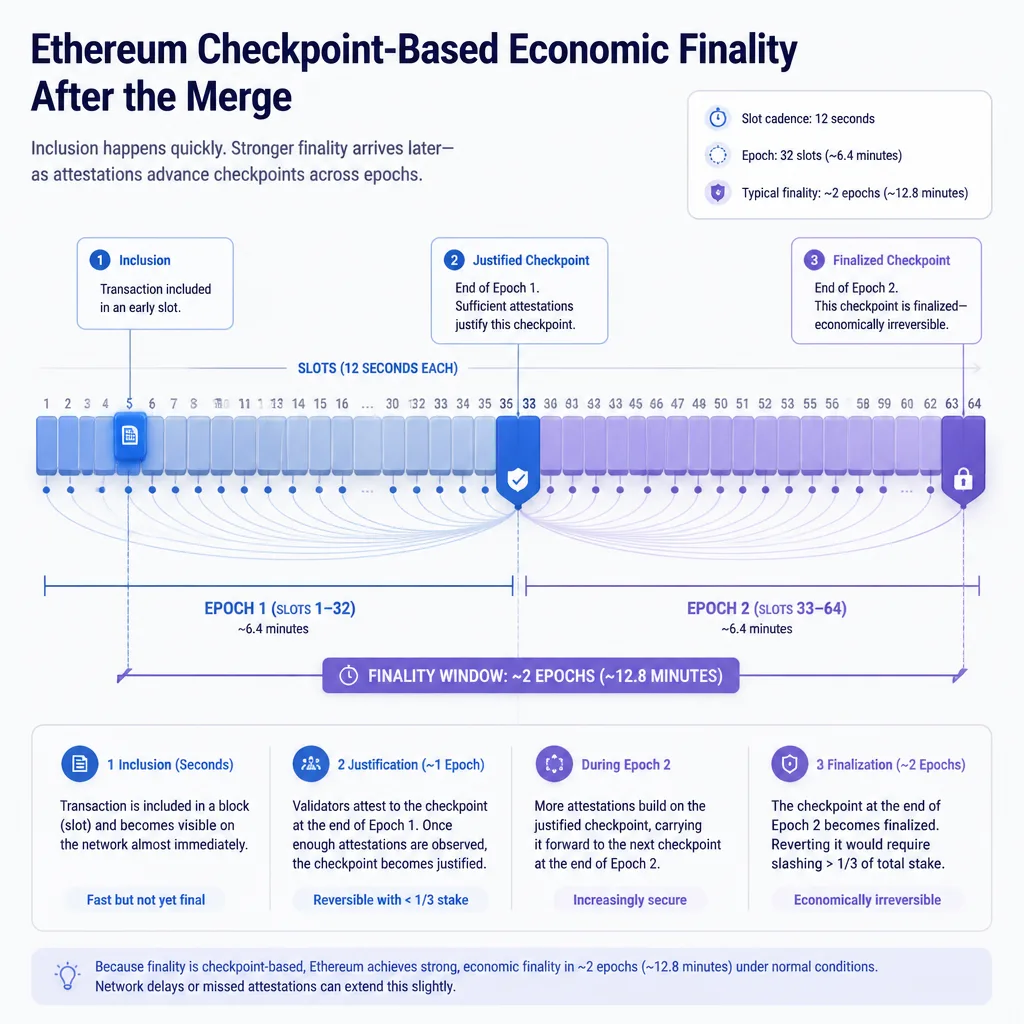
Inclusion, justification, and finalization
Ethereum after the Merge has a layered safety model.
First, a transaction is included in a block.
Then, through validator attestations, checkpoints at epoch boundaries can become justified.
Later, a justified checkpoint can become finalized. That is the stronger settlement milestone that matters for larger-value transfers.[^2][^4]
This finality comes from Ethereum’s consensus design, often described as Gasper. Reverting finalized history would require severe validator misbehavior, slashable stake, and likely broader coordination failure. That is why economic finality is the most precise term.
Some people call this deterministic finality, which makes sense from a user perspective because finalized checkpoints are much stronger than ordinary block inclusion. Still, “economic finality” is more careful, because extreme failures are not impossible.
Ethereum timing in practice
Ethereum’s timing is more structured than Bitcoin’s.
A slot is 12 seconds. An epoch is 32 slots, or about 6.4 minutes. Under normal conditions, finality usually arrives after about 2 epochs, so roughly 12.8 to 15 minutes, depending on where the transaction lands within the epoch.[^2][^4]
That creates an important split:
- inclusion can happen within seconds
- stronger finality comes later
Ethereum often feels fast before it is truly final.
Why fast inclusion is not the whole story
Most of the time, users see a transaction included and move on. In normal conditions, that works fine.
But Ethereum can keep producing blocks without reaching finality if enough validators are offline or attestations are missed.[^2] In that situation, a transaction may be visible on-chain while finality is delayed. For larger exposures, that is a different risk profile from finalized settlement.
That is why serious operators watch finalized status, not just inclusion.
When “confirmed” transactions can still change
Bitcoin reorgs
Bitcoin reorgs are part of normal distributed operation. Two miners can find valid blocks at nearly the same time. One branch wins, the other becomes stale. If your transaction was only in the stale branch, it may disappear temporarily until it is re-included.
That is a shallow, normal reorg.
A deeper Bitcoin reorg is much rarer and more serious. At that point, the questions change: was this bad luck, infrastructure failure, or an intentional double-spend attempt? For large-value payments, the cause matters less than the outcome: the payment you relied on may no longer exist.
Ethereum reorgs and delayed finality
Ethereum can also reorg before finality. A block may appear accepted at the head of the chain, then get displaced because of fork-choice updates, propagation differences, or validator timing effects.
Under healthy conditions, these reorgs are usually short and limited to pre-finality history. Once a checkpoint is finalized, reversal moves from a normal consensus event to an extraordinary failure scenario.
Ethereum also has another failure mode: the chain may keep producing blocks while failing to finalize because validator participation drops too far. That is another reason inclusion alone is not a sufficient settlement boundary for larger transfers.
Rare but important edge cases
Both chains have failure scenarios that matter mainly to large operators.
Software bugs can trigger consensus issues. Network partitions can split the chain. Severe implementation problems or validator coordination failures can create abnormal behavior. In extreme cases, social coordination rather than pure protocol rules may determine which chain the ecosystem accepts.
Rare does not mean irrelevant if you run an exchange, custodian, bridge, or payment platform.
A better risk model: ask what you are defending against
The most useful question is not, “What is the standard number of confirmations?”
It is: what kind of failure are you trying to survive?
If you are moving ETH between your own wallets and nothing irreversible happens after receipt, a low threshold may be fine. If you are shipping a $2,000 phone after receiving BTC, the threshold should be higher because the fraud incentive is real and the shipment cannot be reversed.
For exchanges, the risk is broader. Crediting a deposit may allow a customer to trade, withdraw a different asset, post collateral, or exploit timing elsewhere. That is why exchange confirmation policies are usually stricter than wallet displays suggest.
Three variables matter most.
Transaction size and business context
A café and a centralized exchange are solving different problems.
A café may accept a very low confirmation threshold because the amount is small, the customer is present, and the payoff from fraud is limited.
An exchange handling a six-figure deposit faces reversal risk, withdrawal risk, and internal operational risk. It should behave accordingly.
Incentives and attack surface
The more profitable a reversal would be, the more cautious you should be.
If the goods are digital, instantly transferable, or easily resold, attacker incentives rise. If your system auto-credits deposits and releases value before stronger settlement assurance arrives, operational speed becomes attack surface.
Why fixed confirmation rules are weak policy
A rule like “always wait six blocks” is folklore, not a complete risk policy.
Better policies scale with:
- transaction size
- how reversible the delivered value is
- attacker upside
- your ability to monitor chain health
- whether acting on the deposit creates second-order exposure
How many confirmations are enough?
These are heuristics, not guarantees. Actual policies vary by operator and may change with network conditions.
| Scenario | Bitcoin heuristic | Ethereum heuristic | Why |
|---|---|---|---|
| Self-transfer between your own wallets | 1–2 confirmations | 1 included block may be enough; finalized is safer if the next action is irreversible | Low fraud incentive, low external exposure |
| Low-value in-person merchant payment | 1 confirmation, sometimes less depending on policy | 1–2 blocks may be operationally acceptable | Limited downside if something goes wrong |
| Medium/high-value merchant order | 3–6+ confirmations | Wait for stronger depth or finalized status | Goods are costly and hard to recover |
| Exchange or custodian deposit | 3–6+ or more depending on value and asset policy | Finalized status is the cleaner boundary for larger deposits | Crediting creates secondary exposure |
For everyday users
If you control both wallets and do not need to act instantly, a little patience is usually enough. On Bitcoin, 1 to 2 confirmations is often fine operationally. On Ethereum, one included block may be acceptable for low-stakes actions, but waiting for finality is cleaner if the next step cannot be undone.
For merchants
A coffee shop, an apparel store, and a high-end electronics seller should not use the same threshold.
Low-ticket, in-person payments can tolerate more settlement risk. High-value shipped goods cannot. If the buyer can walk away with something valuable and you cannot claw it back, the confirmation threshold should rise sharply.
For exchanges and custodians
This is where weak policy becomes expensive.
Exchanges care less about what a wallet shows and more about what happens if the credited funds vanish after the customer has already traded or withdrawn. For Bitcoin, that often means requiring several confirmations, and sometimes more for larger deposits. For Ethereum, finalized checkpoints are usually the cleanest boundary for meaningful deposits because they align with the protocol’s stronger safety guarantee.
A simple mental model
Bitcoin: increasing statistical confidence
Bitcoin asks: how much work would an attacker need to replace this history?
Each block increases confidence. No block count creates absolute protocol finality.
Ethereum: fast inclusion, stronger finality later
Ethereum asks: has enough stake voted to finalize this checkpoint, and what would it cost to violate that finality?
Inclusion is fast. Finality comes later. For low-stakes use, inclusion may be enough. For serious settlement, finalized status is the better boundary.
Conclusion
“Confirmed” is useful wallet language, but weak risk language.
Bitcoin and Ethereum both let you see a transaction before the strongest settlement assurance has arrived. Bitcoin gives you a probability curve: more blocks mean more confidence, but not absolute protocol finality. Ethereum gives you fast inclusion first, then stronger checkpoint-based economic finality after validator votes.
So there is no universal answer to how many confirmations are enough. The right threshold depends on what you are protecting against, how much value is at risk, and what happens if you act too early.
The practical rule is simple: match your confirmation policy to the consequence of being wrong.
FAQ
What does 1 confirmation mean on Bitcoin?
It usually means the transaction has been included in one block on the current best chain. It does not mean the payment is irreversible. More blocks on top make reversal less likely by adding more proof of work.
Is a Bitcoin transaction final after 6 confirmations?
Not absolutely. Six confirmations is a long-standing rule of thumb, not a protocol guarantee. For many normal transactions, it is treated as high confidence, but Bitcoin finality remains probabilistic.
How long does Ethereum finality usually take?
Under normal conditions, Ethereum uses 12-second slots and 32-slot epochs, with finality typically arriving after about 2 epochs. In practice, that is usually around 12.8 to 15 minutes, depending on where the transaction lands in the epoch.
What is the difference between inclusion and finality on Ethereum?
Inclusion means the transaction appears in a block and is visible on-chain. Finality means the chain has reached a stronger checkpoint-based consensus state through validator votes. A transaction can be included quickly without being finalized.
Can confirmed Bitcoin transactions be reversed?
Yes, in principle. Short reorgs can happen naturally, and deeper reversals are possible in attack scenarios. The probability usually falls as more confirmations accumulate, but there is no protocol-defined point where reversal becomes impossible.
Can confirmed Ethereum transactions be reversed?
Before finality, yes. Short pre-finality reorgs can happen because of timing, attestations, or network conditions. After a checkpoint is finalized, reversal becomes an extraordinary event requiring severe validator failure or misbehavior, and likely broader coordination failure.
Why do exchanges require more confirmations than wallets show?
Wallets usually show inclusion status. Exchanges face a broader threat model that includes fraud, withdrawal racing, large deposits, and abnormal chain conditions. Their policies are built around operational exposure, not just wallet UX.
How many confirmations are enough for a merchant?
There is no universal number. For low-value in-person payments, some merchants may accept very low confirmation risk. For expensive or easily resold goods, waiting longer is more prudent. The right threshold depends on value, fraud incentive, and whether the goods can be recovered.
What is probabilistic finality?
Probabilistic finality means a transaction becomes less likely to be reversed as more blocks are added, but never reaches a protocol-defined point of absolute irreversibility. Bitcoin is the standard example.
What is economic finality?
Economic finality means reversing finalized history would require participants to absorb very large economic penalties or losses. Ethereum’s Proof-of-Stake finality is best described this way because it depends on validator voting, slashing risk, and checkpoint finalization.