If you buy something called a “tokenized Treasury,” it is easy to assume the setup is simple: a Treasury bill exists somewhere, a token represents it, and your wallet now holds government debt onchain.
Usually, it is not that simple.
In most cases, you do not own direct title to a specific T-bill. You own a claim built around Treasury exposure. That does not make the product flawed. Traditional finance uses wrappers all the time. But it does change where the real risk sits. It is not just the asset. It is the structure between you and the asset.
Tokenized Treasuries are not a single thing
“Tokenized Treasuries” is a market label, not a single legal structure.
One product may tokenize shares of a fund that holds short-dated government securities. Another may issue tokens through an SPV that owns the assets. Another may give you a note or contractual claim tied to a Treasury portfolio. Some products hold only Treasury bills; others may also hold repo, cash, or government money market instruments if the mandate allows it.[^1]
Why the label hides important legal differences
Marketing often compresses a lot of plumbing into one phrase: backed by Treasuries. That tells you something about the portfolio. It does not tell you what instrument you hold, who owes you what, or how you get your money back.
That matters because two products can hold similarly conservative assets while giving holders very different rights.
The core thesis: Treasury exposure may be safe, but the wrapper still matters
This is the useful mental split:
- Asset risk: What is in the portfolio?
- Wrapper risk: What do you actually own, who controls the records, how does it move, and what happens if a key party fails?
A short-duration Treasury portfolio can carry low credit risk. The token around it can still come with transfer restrictions, settlement frictions, redemption limits, and insolvency complexity.
What you actually own depends on the legal wrapper
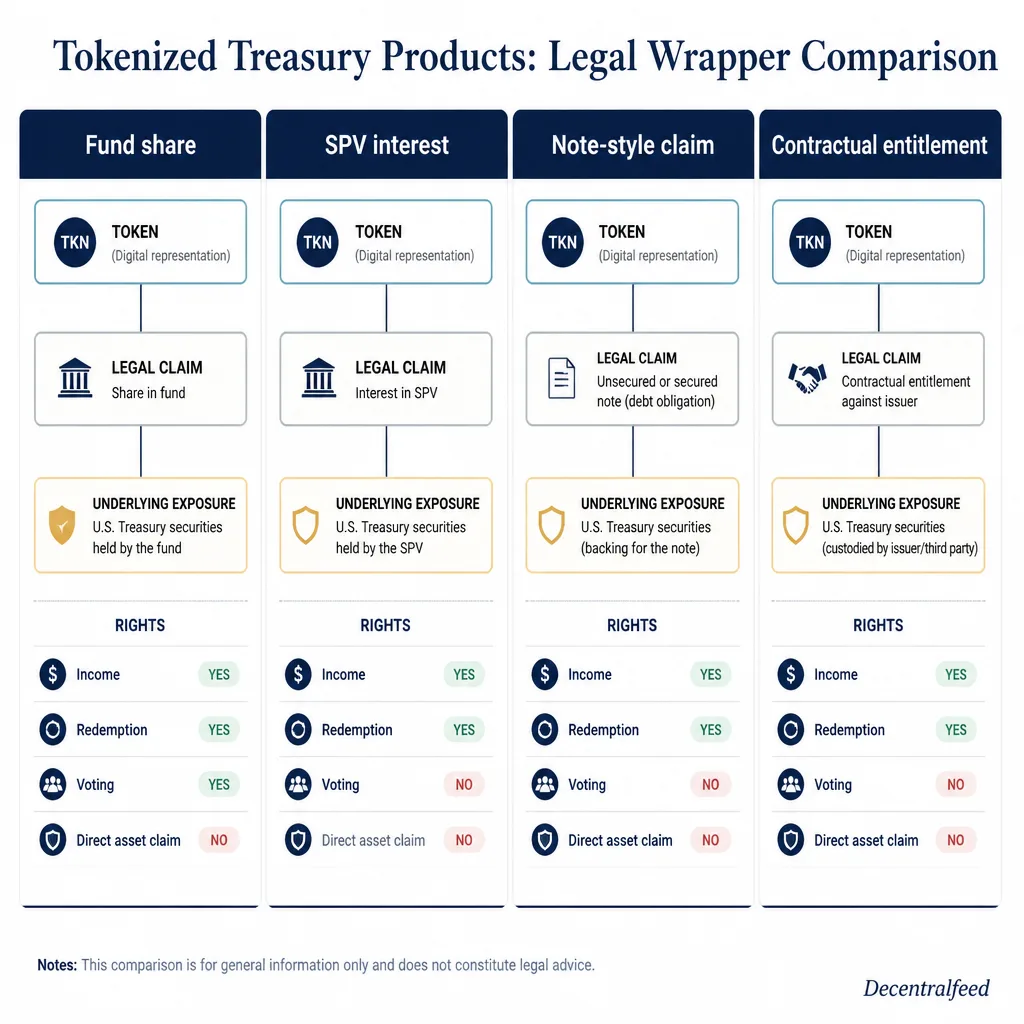
The first question to ask is blunt: what is the token, legally?
Direct claim vs fund share vs SPV interest vs note or receivable-style claim
At a high level, these products usually sit somewhere on this spectrum:
- Fund share: The token represents an interest in a fund that holds Treasuries or similar instruments.
- SPV interest: A special purpose vehicle owns the assets, and the token reflects a beneficial interest or entitlement tied to that vehicle.
- Note-style claim: The token is effectively a claim against an issuer that promises exposure to a Treasury-backed pool.
- Contractual entitlement: Your rights may exist mainly through platform terms, subscription documents, or offchain records.
The more layers between you and the underlying securities, the more the documentation matters.
Why “backed by Treasuries” is not the same as owning Treasuries
“Backed by Treasuries” describes the collateral or portfolio. It does not automatically mean you own those securities directly.
That distinction is common in traditional markets too. Most investors do not hold Treasury bills in direct registered form. They hold brokerage entitlements or fund shares. Tokenization did not invent intermediation. What it can do is hide more of it behind a clean wallet interface.
What rights usually come with each structure
Different wrappers can give you very different bundles of rights:
- a right to distributions
- a right to redeem, sometimes only above a minimum size
- information or notice rights
- limited or no voting rights
- no direct claim on specific underlying securities
Some products reflect yield through NAV appreciation rather than periodic payouts. Others distribute income on a schedule. The term sheet or offering documents should make that clear.[^2]
The custody chain is where operational risk hides
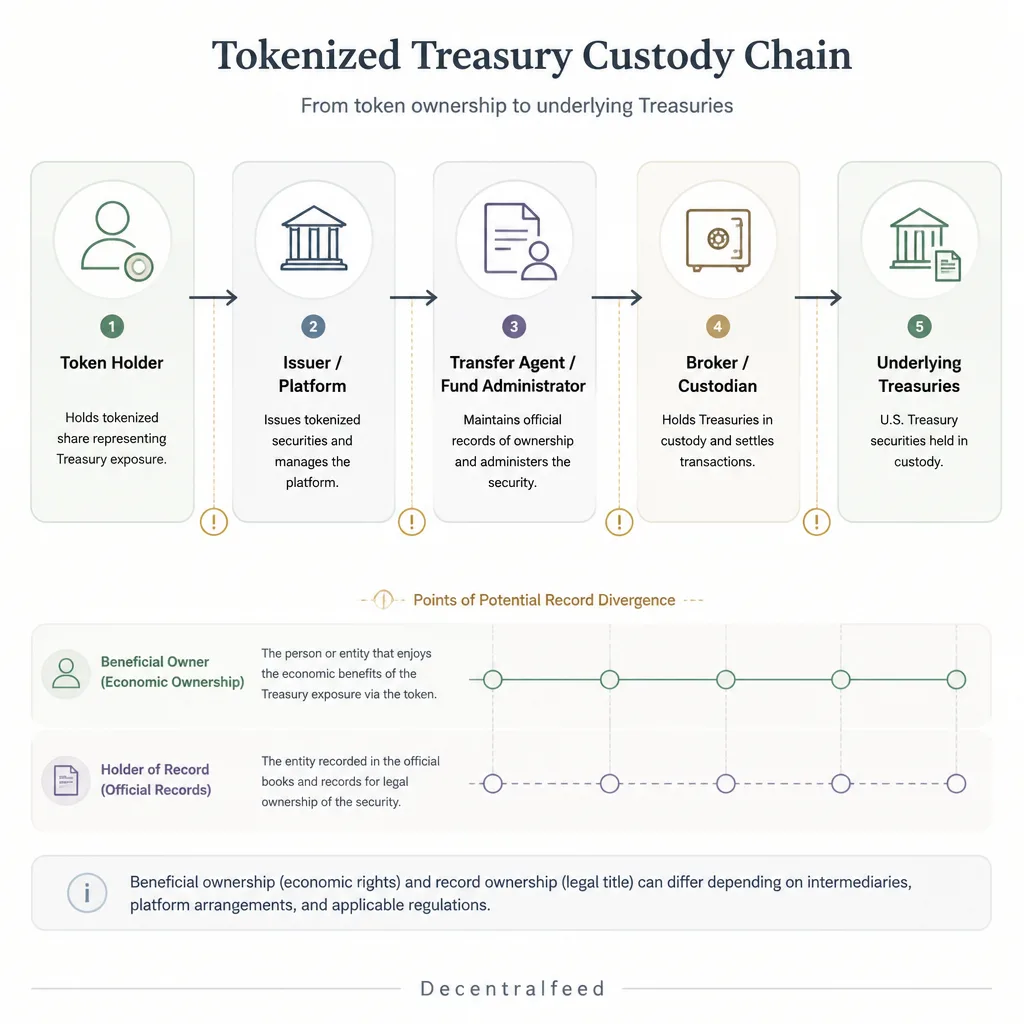
A useful way to read these products is as a chain.
A simple map
token holder -> issuer/platform -> transfer agent or fund administrator -> broker/custodian -> underlying Treasuries
That chain is often longer than buyers expect.
The Treasury instruments themselves usually remain inside conventional financial infrastructure, not on a public blockchain in native legal form. The token sits on top of offchain books, custody arrangements, administrator records, and compliance procedures.[^3]
Holder of record vs beneficial owner
This is one of the most important distinctions in the category.
The holder of record is the person or entity listed on the official books kept by the issuer, registrar, transfer agent, or fund administrator.
The beneficial owner is the party with the economic exposure.
Those may be the same person. They may not.
If you hold through a platform, omnibus structure, or intermediary wallet, the formal record may sit with that intermediary rather than with you personally. In normal conditions, that may not matter much. In a dispute, redemption event, voting process, or insolvency scenario, it matters a great deal.
Why multiple intermediaries matter in a stress event
Every extra layer creates another failure point:
- records can diverge
- processing can pause
- one service provider can block action even if others remain solvent
- legal claims can become slower to enforce
If the blockchain says you own the token but the administrator’s books do not match, you need to know which ledger controls. That answer should come from the documents, not assumptions about how tokens are supposed to work.
Transfer restrictions are often a feature, not a bug
Many of these products are securities, or are distributed under securities-law exemptions. That is why they are often permissioned.
Whitelists, KYC gating, jurisdiction blocks, and securities-law constraints
Common restrictions include:
- wallet whitelisting
- KYC and AML checks
- sanctions screening
- jurisdiction blocks
- investor eligibility limits
- holding periods or resale constraints under exemptions such as Regulation D, Regulation S, or Rule 144 where applicable[^4]
This is not usually poor design. It is a compliance choice.
Can tokens be frozen, clawed back, or force-transferred?
Often, yes.
Many tokenized securities use smart contract or administrator controls that allow transfers to be paused, blocked, reversed, or force-transferred in certain circumstances.[^5] The exact scope varies by product, and sometimes the legal authority sits offchain with the transfer agent rather than entirely in the contract.
That may sound jarring to crypto-native readers, but it is better understood as a tradeoff: more compliance control in exchange for broader lawful distribution.
Why a token can be technically movable but legally non-transferable
A token might move from wallet A to wallet B at the protocol level and still fail as a legally recognized transfer if B is not approved, not whitelisted, or sits in a blocked jurisdiction.
Technical movement and legal transfer are not the same thing.
That is the broader pattern across tokenized RWAs: code can move faster than the legal system that gives the code meaning.
Onchain settlement is not always final settlement
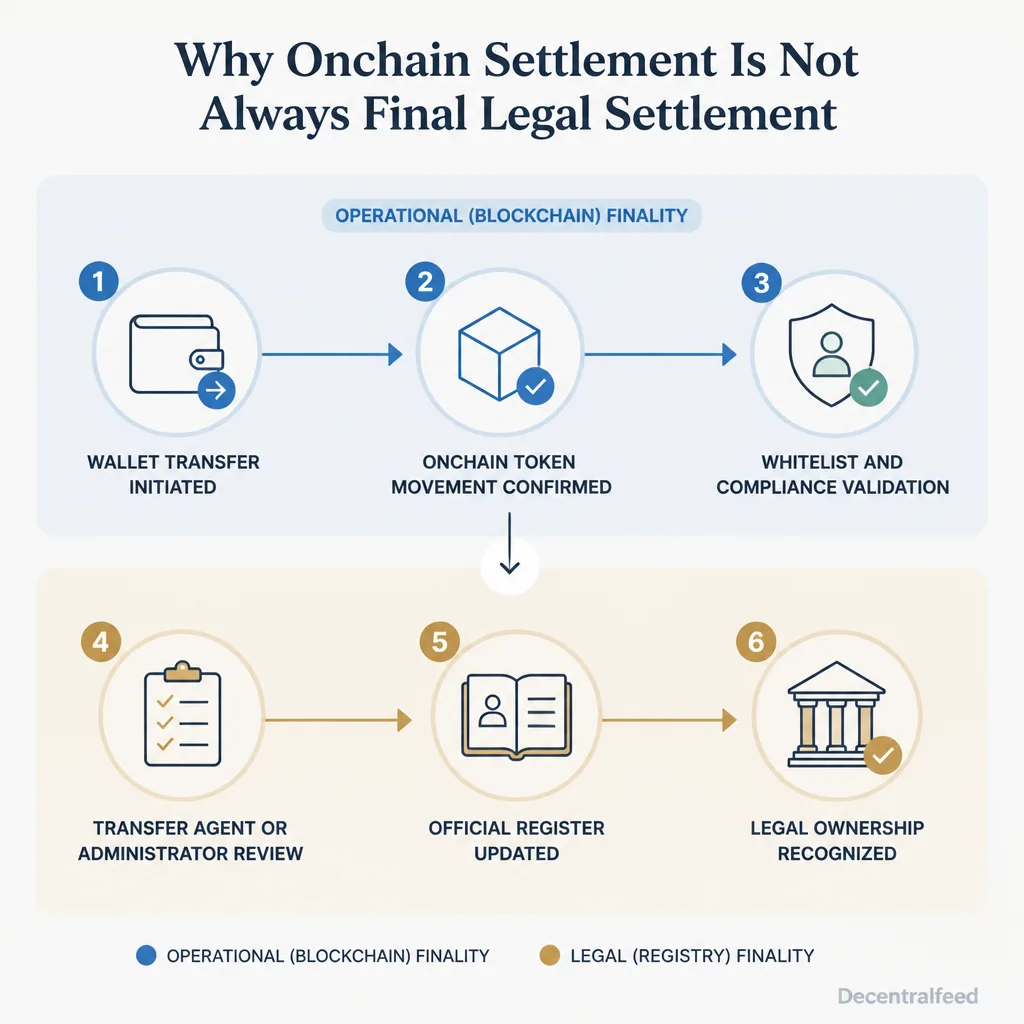
This is where many buyers overread the blockchain.
What settles onchain and what still settles in traditional records
The token transfer settles onchain. But the underlying rights may still depend on:
- an offchain register
- a transfer agent update
- administrator reconciliation
- business-day processing windows
- compliance approval
In some structures, the blockchain is tightly integrated with the official register. In others, it is a mirror or operational layer rather than the final legal source of truth.
When token transfer updates legal ownership and when it does not
You have to check the product terms.
If the documents say the issuer’s books or the registrar’s ledger are authoritative, then an onchain transfer alone may not complete legal settlement. It may become final only once the official record is updated.
How delays, cut-off times, and administrator processes affect finality
This is why “instant settlement” claims need careful reading.
A token may appear in your wallet immediately, while redemption rights, distribution recognition, or legal ownership status update later, sometimes subject to cut-off times or human review. In calm markets, that may feel like a minor detail. In stress, it can become the whole issue.
Liquidity and redemption are separate questions
A token that trades is not necessarily a token you can redeem.
DEX liquidity, OTC desks, brokered liquidity, and issuer-supported windows
Exit paths can come from several places:
- bilateral transfers
- OTC desks
- market makers
- brokered venues
- DEX pools
- direct issuer or platform redemption windows
These are not equivalent.
A DEX pool gives you tradability if someone is willing to take the other side. Direct redemption gives you a path back to the issuer, usually closer to NAV, but often only if you meet eligibility and minimum-size requirements.
Why secondary market liquidity can drift from NAV
If only certain parties can redeem, arbitrage is weaker.
That is one reason these products can trade above or below NAV despite conservative underlying assets. Other reasons include transfer restrictions, fragmented liquidity, administrator delays, or market stress.
A practical example: a small holder may see a tokenized Treasury product quoted on a secondary venue and assume the price will stay pinned to portfolio value. If that holder cannot redeem directly and liquidity thins out, the discount can persist longer than expected.
Who can redeem directly, in what size, and with what notice period
Not all holders can redeem directly.[^6]
Some products reserve direct redemption for approved institutions, authorized participants, or investors above a minimum block size. Others require prior onboarding, business-day notice, or specific cutoff times. Redemptions may also be suspended or delayed under the governing documents.
So your real exit route may be the secondary market even if the product is “redeemable” in theory.
What happens if the issuer fails or goes bankrupt
This is the uncomfortable question, and it does not have a one-line answer.
The uncomfortable question: are you insulated from issuer insolvency?
Sometimes partly. Sometimes not enough.
If the assets are properly segregated, the structure is genuinely bankruptcy-remote, and the records are clean, token holders may be better insulated from issuer insolvency. But “bankruptcy-remote” is not magic language. It depends on actual legal mechanics, not branding.[^7]
Bankruptcy remoteness, segregation, and where the assets legally sit
The key questions are:
- Who legally owns the underlying assets?
- Are they segregated from the issuer’s balance sheet?
- Are they held for the benefit of token holders?
- Are there independent governance features supporting the vehicle?
- What do the offering and custody documents actually say?
If your token is just a claim against an issuer, your position may look more like creditor exposure than ring-fenced asset ownership.
What can go wrong if records are messy, structures are weak, or service providers fail
Even with a sound structure, problems can still come from elsewhere:
- the custodian can suffer an outage or insolvency event
- the administrator can have bad records
- the transfer agent can fail to process transfers
- sanctions or compliance controls can freeze activity
- the onchain ledger and offchain books can diverge
So insolvency analysis should not stop at the issuer. Issuer failure, custodian failure, and administrator failure are different problems with different consequences.
This is educational, not legal advice. Actual outcomes depend heavily on governing law, entity structure, and court treatment.
A six-point checklist for reading a tokenized Treasury term sheet
Before buying or integrating one of these products, work through six questions.
Legal claim
What exactly do you hold: fund share, SPV interest, note, trust interest, or contractual claim? Whose obligation is it?
Custody chain
Who holds the underlying assets? Through which broker or custodian? Who keeps the official ownership records?
Transfer controls
Are addresses whitelisted? Can transfers be rejected, frozen, or force-executed? Are there jurisdiction or resale restrictions?
Settlement finality
When does legal ownership change: at token transfer, at registrar update, or after administrator recognition? Which ledger controls if records conflict?
Liquidity source
If you want out, who is expected to buy: another investor, market maker, OTC desk, brokered venue, or the issuer?
Redemption path
Can you redeem directly? At what minimum size, with what fees, notice period, and suspension rights?
The practical takeaway
The conservative nature of U.S. Treasuries does not eliminate structure risk.
That is the main mistake to avoid. A product can reference very safe underlying assets while still exposing holders to wrapper risk: transfer controls, offchain record dependence, redemption limits, and insolvency uncertainty.
Before buying, ignore the smoothest part of the user experience for a moment. Read the ugly parts instead:
- legal terms
- custody disclosures
- transfer restrictions
- redemption procedures
- risk factors
- who the holder of record is
- which ledger is authoritative
The token is the visible object. The real risk usually sits one or two layers below it.
FAQ
What do you actually own when you buy tokenized Treasuries?
Usually not a Treasury bill directly. In many products, the token represents a claim through a fund, SPV, note, trust, or another legal wrapper. That wrapper determines your rights to income, redemption, and enforcement.
Are tokenized Treasuries the same as owning U.S. Treasuries onchain?
Not necessarily. The underlying assets may be Treasury bills or other short-duration government instruments, but the token often sits on top of offchain custody, fund records, and contractual terms. That means asset quality and structure risk are separate questions.
What does holder of record mean in tokenized Treasury products?
The holder of record is the person or entity listed on the official books maintained by the issuer, transfer agent, registrar, or fund administrator. A beneficial owner has economic exposure but may not be the name that appears on the formal register.
Can tokenized Treasury tokens be frozen or transfer-restricted?
Yes, many can. Depending on the structure and smart contract controls, issuers may use whitelists, KYC gating, jurisdiction blocks, pause functions, freeze powers, or forced transfers to comply with securities and sanctions rules.
Does an onchain transfer always count as final legal settlement?
No. In some products, legal ownership changes only when the offchain register, transfer agent, or administrator updates the official records. A blockchain transfer can be operationally visible before it becomes legally recognized.
Can every token holder redeem directly with the issuer?
No. Some products limit direct redemption to approved investors, institutional counterparties, or holders above a minimum size. Smaller holders may need to exit through secondary market liquidity instead of redeeming at NAV.
Why can tokenized Treasury products trade away from NAV?
Because liquidity and redemption are separate. Prices can move away from NAV when redemption access is limited, transfers are restricted, liquidity is thin, or processing delays make arbitrage harder.
What happens if the issuer of a tokenized Treasury product goes bankrupt?
It depends on the structure. If assets are properly segregated and the vehicle is genuinely bankruptcy-remote, token holders may be better insulated. If records are weak or the claim is simply against the issuer, recovery can be slower, messier, and more uncertain.
Is bankruptcy remoteness guaranteed if a product says it is bankruptcy-remote?
No. That label is only as strong as the legal structure, segregation mechanics, governing documents, and how a court ultimately treats the arrangement. It should be verified in the actual offering and custody documents.
What should you check before buying a tokenized Treasury product?
Start with six things: what legal claim the token gives you, who holds the assets, who keeps the official record, what transfer restrictions apply, when settlement becomes final, and who can redeem under what terms.