A wallet can label your swap “MEV protected” and still give you a worse trade
That is the uncomfortable part. In DeFi, protection often gets marketed as if privacy and good execution are the same thing. They are not. Hiding your order from the public mempool may reduce one kind of predation, but it can also narrow competition, delay inclusion, or route your trade through a system you cannot easily inspect.[^1][^2]
The right question is not whether your transaction was “protected.” It is whether the route improved your net execution: price, slippage, revert risk, latency, and trust tradeoffs taken together. That is what matters. This article explains the mechanics in plain English, then shows how to judge whether protection actually helped.
MEV protection is not the same as better execution
Why DEX traders feel MEV as a hidden tax
Most traders never see MEV directly. They see the symptoms.
A swap lands noticeably worse than the quote. A trade uses almost all of the allowed slippage. A transaction fails and still burns gas. A swap executes a block or two later, after the market has moved.
That is why MEV feels like a hidden tax. The cost often shows up in execution quality rather than as an explicit fee. The broader pattern has been studied since Flash Boys 2.0, which showed how transparent transaction ordering on DEXs creates opportunities for frontrunning and reordering.[^1]
The thesis: protection only helps if it improves net execution
Keep this distinction in mind:
Reducing order visibility does not guarantee best execution.
A private route can help if it keeps your swap away from obvious predators while still delivering competitive pricing and reliable inclusion. But a “protected” route can also hurt if it quietly trades transparency and routing quality for exclusivity or delay.
It is better to think of MEV protection as an execution tool, not a moral label. Sometimes it helps. Sometimes it is just different plumbing with different failure modes.
The MEV that matters most for ordinary swaps
Sandwich attacks: the clearest form of user harm
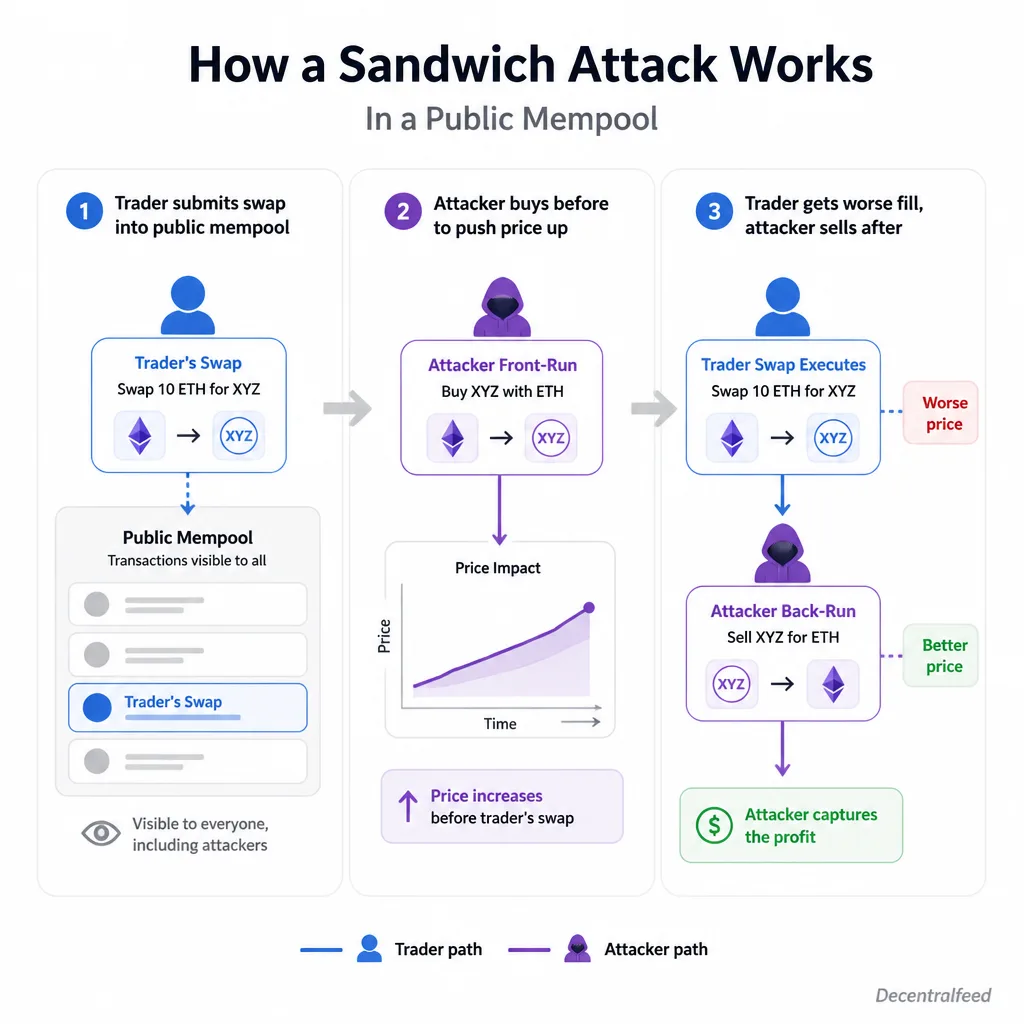
For normal DEX users, sandwiching is the easiest MEV pattern to understand and one of the clearest forms of harm.
In plain English:
- You submit a swap into a public mempool.
- A searcher sees it before it lands.
- They buy first, pushing the price against you.
- Your trade executes at a worse rate.
- They sell after your trade and keep the difference.
Your visible order becomes the thing being exploited.[^1][^2]
A realistic example helps. Suppose you swap a medium-sized amount of ETH into a smaller token in a thin pool. Your order is large enough to move the price, and your slippage tolerance is generous. That pending trade becomes a target. If someone can jump in front, they can worsen your fill and unwind the move right after.
Backrunning: not always harmful, but still relevant
Backrunning is more nuanced.
A backrun happens when someone trades after a known transaction, often to arbitrage the price move it created. That is not automatically bad for the original trader. In some cases, arbitrage after a swap helps restore the pool price toward the wider market.[^2]
The distinction matters: sandwiching exploits your order before and after to extract from you directly. Backrunning usually reacts after your trade. You may still get a poor fill, but the backrun itself is not always the main source of harm.
That nuance matters because some MEV marketing treats all searcher activity as equally hostile. It is not.
Why public mempool visibility changes the game
On chains with public mempools, pending swaps are visible before inclusion. That visibility creates optionality for searchers, builders, and other intermediaries in the transaction supply chain.[^2][^3]
Visibility does not guarantee predation. But it increases the opportunity for it, especially when:
- your trade is large relative to pool depth
- the pair is thinly traded
- volatility is high
- your slippage setting is wide
That is why many protection tools focus first on hiding or restructuring orderflow before it reaches the public market.
What “MEV protection” usually means in practice
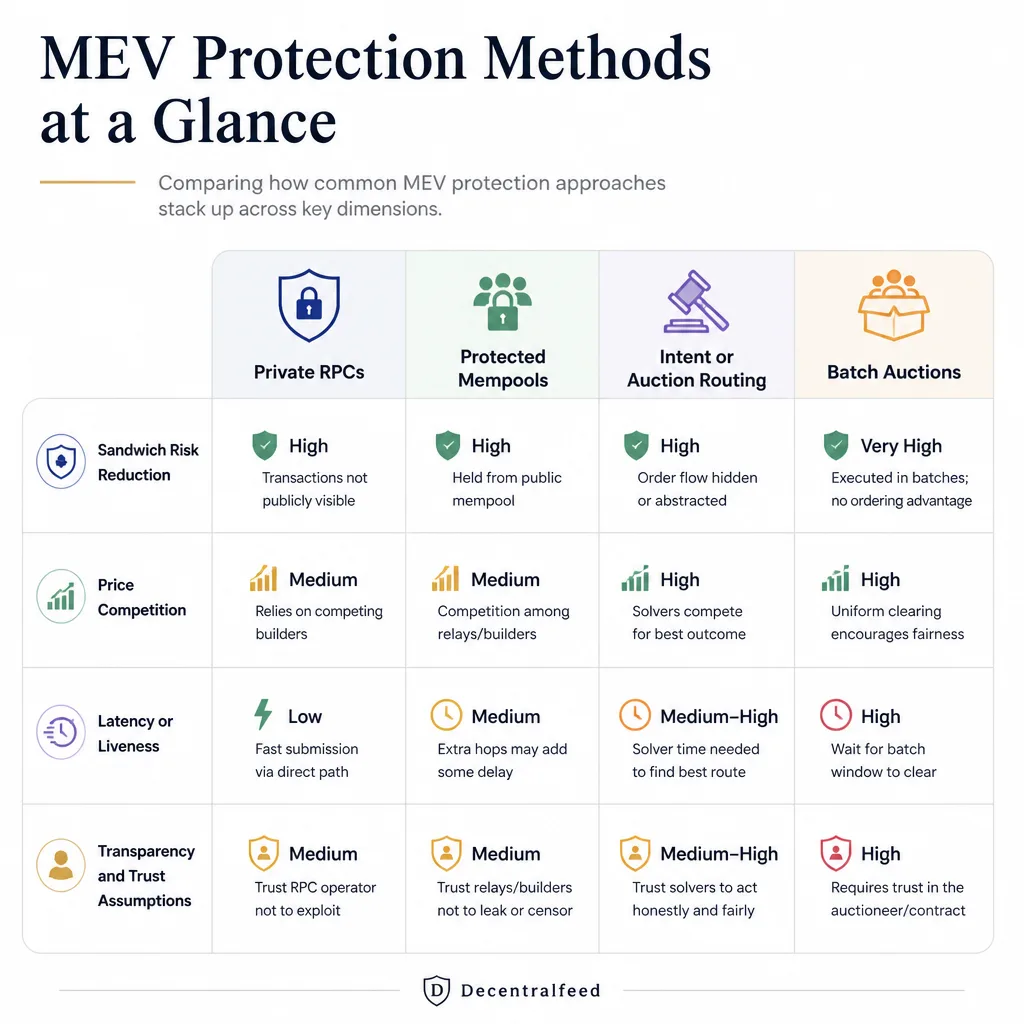
Private RPCs and private transaction relays
A private RPC or private relay sends your transaction somewhere other than the public mempool.[^3] The goal is simple: reduce pre-trade visibility.
In the cleanest case, this lowers sandwich risk. Your swap is not sitting in public view waiting to be picked apart.
But private routing introduces trust assumptions:
- Who sees the order?
- Is it shared with a broad enough set of builders for reliable inclusion?
- Does the operator internalize value that could have gone back to you?
- What happens if the transaction is not included quickly?
Private can be better. It can also just mean “visible to fewer people, under rules you do not control.”
Protected mempools and wallet-level shielding
Some wallets and interfaces offer “MEV protection” by shielding your transaction from public broadcast or routing it through preferred partners.
That can be useful. It can also be mostly branding.
The real question is whether the shield changes execution in your favor or simply changes where the order is visible. A route that avoids obvious public-mempool sandwiching but sends your order into a narrow, opaque pipeline may reduce one risk while increasing others.
Intent-based or auction routing
Intent-based systems change the instruction itself.
Instead of saying, “Execute this exact path on-chain,” you say, in effect, “Get me this outcome.” Solvers or fillers then compete to satisfy that intent. In theory, that competition can improve pricing and return more value to the user.[^4][^5]
Two live examples often discussed here are CoW Protocol and UniswapX, though their mechanics differ and should always be checked against current docs before relying on them heavily.[^4][^5]
This model can work very well when solver competition is real. It works less well when the auction is narrow, opaque, or preferential.
A good intent system can outperform direct AMM routing. A closed one may simply hide the decision-making.
Batch auctions and uniform clearing mechanisms
Batch auctions change the market structure more fundamentally.
Instead of first-seen, first-served ordering, orders are grouped and cleared together, often at a uniform price. That reduces some of the toxic speed race that makes sandwiching attractive in the first place.[^4]
This is one of the more interesting structural responses to harmful MEV because it does not just hide orders. It changes the game.
The tradeoff is latency. Batching usually means waiting for the batch. In calm markets that may be fine. In fast markets, delay can matter more than elegance.
When protection tends to help
Larger or more price-sensitive swaps
Protection matters more when your trade is large enough to be noticed.
If your swap is tiny relative to deep liquidity, there may be little to extract. But if you are moving a meaningful amount through a thinner pool, public visibility becomes more dangerous. In those cases, reducing exposure before inclusion can materially improve outcomes.
Thin pools, volatile markets, and high sandwich risk
Thin liquidity and volatility are where the marketing starts to sound plausible for a reason.
A medium-sized trade in a shallow pool with wide slippage is almost an invitation to adverse behavior. In that setup, a private or structured route may help by removing the easiest attack path.
A simple example: a trader swaps into a small-cap token through a public route and gets filled near the worst end of their slippage tolerance. The same-size trade, routed privately or through a competitive intent auction, lands much closer to the original quote. That is the kind of case where protection likely did real work.
Situations where reducing reverts matters as much as price
Not every trader is optimizing for the last few basis points.
If you trade during congestion or on expensive chains, failed transactions matter. A route that slightly underperforms on average output but meaningfully reduces reverts and wasted gas may still be better for your use case.
That tradeoff is easy to miss because many people judge execution only by tokens out. Reliability has value too.
When protection can hurt
Worse fills from restricted competition or poor routing
A protected route can reduce public competition as well as public predation.
That is the central tradeoff. If your transaction is shown only to a narrow set of fillers, builders, or partners, you may get less price competition. The swap may be “safe” from a visible sandwich and still execute worse than a more open route would have.
This matters most when a wallet or interface makes strong anti-MEV claims but says little about routing quality.
Latency, missed blocks, and reduced liveness
Liveness is one of the most underrated parts of execution quality.
If a protected route lands later, misses a block, or sometimes fails to be included, that can erase the benefit of reduced predation. In volatile markets, being two blocks late is not a footnote. It can be the whole trade.
A balanced example: a protected route avoids a sandwich, but the trade lands later during a fast price move and ends up worse than the public route likely would have. That does not mean the protection failed mechanically. It means the net outcome was worse.
Censorship, trust concentration, and opaque order handling
Private orderflow concentrates power. That is not just a philosophical objection. It has practical consequences for users.[^3]
When orders flow through a small set of RPC providers, relays, builders, or solver networks, you take on risks that are hard to observe directly:
- selective inclusion
- non-inclusion
- censorship
- hidden conflicts of interest
- unclear value-sharing
Opacity is not proof of abuse. But it does mean you are being asked to trust a black box.
The subtle trap: fewer obvious attacks, worse execution
This is the failure mode worth remembering.
A user checks the block explorer, sees no obvious sandwich pattern, and concludes the product worked. Meanwhile, the route may be delivering consistently weaker fills, slower inclusion, or both.
The absence of visible predation is not evidence of best execution.
How to tell if you actually got a better fill
Start with the right comparison
Do not judge a route by the final token amount alone.
You need a reference point. For most traders, the practical choices are:
- the quote shown at submission time
- the best route quote available when you signed
- a contemporaneous market reference such as an implied mid-price
None of these is perfect. Markets move, pools update, and no retail benchmark will isolate causality cleanly. But they are much better than asking only, “Did I get my swap?”
The real question is:
How far did realized execution deviate from a fair reference, and was that deviation worth the reliability and trust tradeoffs?
What to measure: slippage, reverts, latency, and transparency
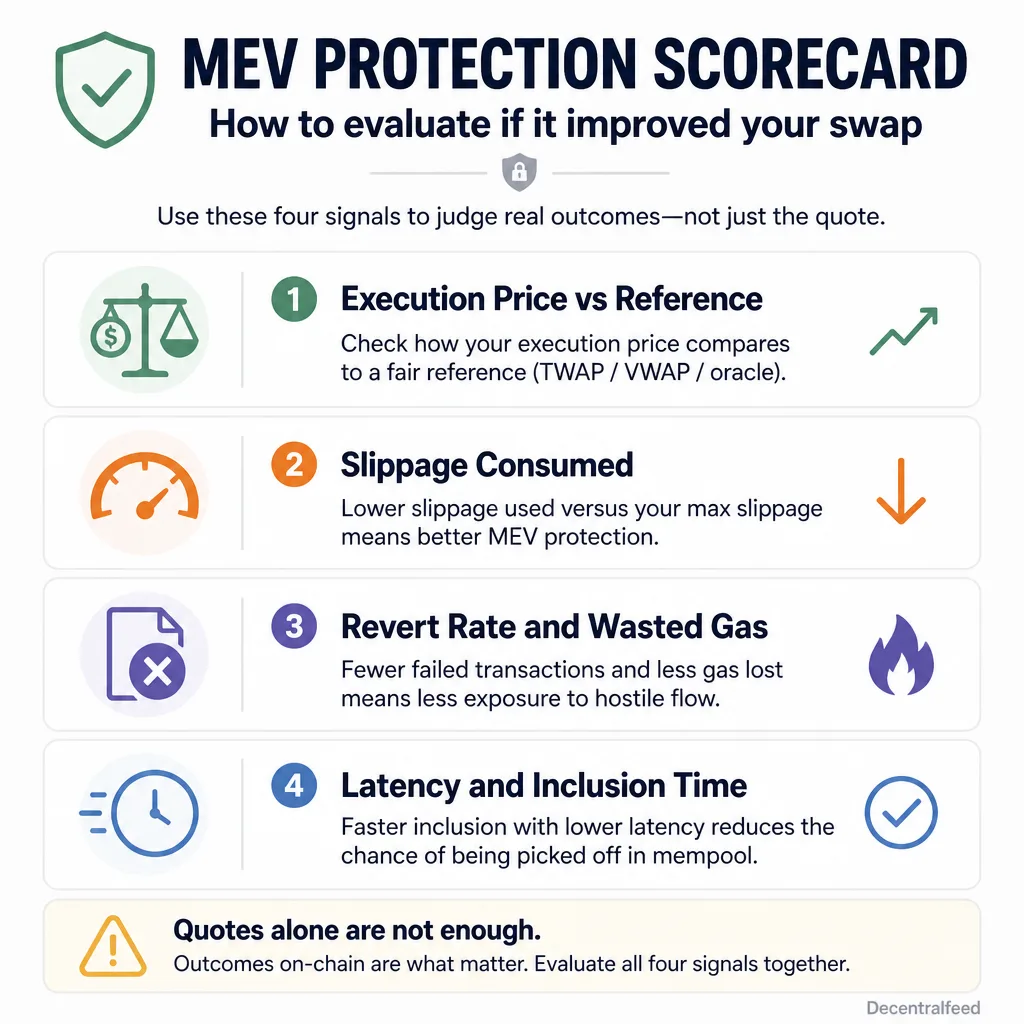
Use a simple Net Execution Test. For each route, track:
Realized execution versus reference
How close was the final fill to the submission-time quote or market reference?Slippage consumed
Did the trade use only a small fraction of allowed slippage, or did it push toward the limit?Revert rate and wasted gas
Did the route reduce failed transactions?Latency and inclusion quality
How long did the swap take to land? Did it miss obvious opportunities because it arrived late?Routing transparency
Can you tell who handled the orderflow and by what mechanism?
These metrics work better together than alone. A route with slightly worse average price but much lower failure risk may still be acceptable. A route with similar output but frequent delays may not be.
Why quotes alone are not enough
Quotes flatter execution.
They are snapshots, not outcomes. A route can show an attractive quote, then fill poorly, consume most of your slippage, or land late enough that the quote stops mattering.
Quoted output should be the start of the comparison, not the end.
A simple A/B test normal traders can run
Keep trade size, token pair, and timing as similar as possible
You do not need a quant desk to test this. You need discipline.
Run small swaps with:
- the same token pair
- similar trade size
- similar time of day or market conditions
- similar gas conditions when possible
- the same or very similar slippage settings
High volatility can drown the signal, so smaller repeated tests in calmer conditions are usually more informative.
Compare protected and unprotected routes across multiple trades
Alternate between protected and unprotected routes across multiple observations.
For each trade, record:
- quote at submission
- realized output
- effective execution price
- slippage tolerance set
- approximate slippage consumed
- submission-to-inclusion time
- whether the transaction reverted or stalled
You are not trying to build a lab-grade study. You are trying to avoid fooling yourself with one memorable swap.
What counts as meaningful
One lucky fill means almost nothing.
What matters is a repeated pattern:
- better median execution versus quote
- fewer bad outliers
- fewer reverts
- lower gas wasted on failures
- acceptable latency rather than chronic delay
If the difference is tiny and noisy over repeated tests, the protection may not matter much for your trade size. That is useful to know too.
Red flags that your protection may be costing you
Consistently worse execution without fewer failures
If your protected route gives worse fills in normal conditions and does not noticeably reduce reverts, you may be paying for a label rather than a benefit.
Frequent delays or unexplained non-inclusion
If trades routinely land late, stall, or disappear into a vague private pipeline, liveness is becoming the cost of protection.
No transparency on routing or who sees the orderflow
You do not need every builder-level detail. But you should get a credible explanation of the mechanism.
If a product says “protected” without clarifying whether it uses private relays, solver competition, batch execution, or something else, that is a warning sign.
Marketing claims without measurable outcomes
The clearest red flag is language that treats anti-MEV as self-evidently good while avoiding any discussion of:
- execution quality
- slippage
- revert reduction
- latency
- routing transparency
Good products explain tradeoffs. Weak ones hide behind slogans.
How to think about MEV protection going forward
Treat it as an execution tool, not a moral label
There is no universal answer here.
Private orderflow can materially reduce visible predation. Critics are also right that it can increase opacity and concentration. Both can be true at once.
The practical takeaway is simpler than the debate: judge the tool by outcome, not branding.
Use the venue that gives the best net outcome for your trade type
For a deep, liquid pair and a small order, protection may not matter much. For a larger swap in a thin pool, it might matter a lot. For a trader who hates failed transactions, a route with slightly lower average output but better reliability may be the right choice.
The right venue is the one that gives you the best net execution for the trades you actually place.
Conclusion
MEV protection is real, but so are its tradeoffs.
The cleanest case for it is straightforward: a visible order in a thin or volatile market becomes harder to exploit when it is hidden or executed through a better mechanism. The harder part is that protection can also reduce competition, slow inclusion, and push trust into places you cannot easily inspect.
So do not ask only whether your swap was protected. Ask whether it was better executed.
That means comparing fill quality against a fair reference, tracking slippage and reverts, watching latency, and refusing to confuse the absence of a visible sandwich with proof of a good deal. In DeFi, the best protection is not the loudest claim. It is the route that improves your outcomes when you measure them honestly.
FAQ
What is MEV protection on a DEX?
MEV protection usually means routing a swap in a way that reduces harmful exposure to public mempool observers. That can include private RPCs, protected relays, intent-based routing, or batch auctions. The goal is often to reduce sandwich risk or failed transactions, but it does not automatically guarantee the best execution.
Does MEV protection always give a better price?
No. It can improve outcomes when it reduces visible predation without weakening competition or delaying inclusion. But it can also lead to worse fills if routing is less competitive, execution lands later, or the protection layer adds opacity and trust costs.
What is a sandwich attack in plain English?
A sandwich attack happens when someone sees your pending swap, buys first to push the price against you, lets your trade execute at a worse rate, then sells after your trade and keeps the difference. It is one of the clearest ways MEV directly harms ordinary DEX traders.
Is backrunning always bad for the trader?
Not always. Backrunning means trading after a known transaction, often to arbitrage the price change it caused. In some cases, that arbitrage helps restore pool prices toward the wider market. The original user may still have had poor execution, but the harm is not always caused by the backrun itself.
How can I tell whether MEV protection improved my swap?
Do not judge by marketing claims or by the final token amount alone. Compare realized execution against a fair reference, such as the submission-time quote or a contemporaneous market price. Also track slippage used, revert rate, gas lost on failed transactions, and how long the trade took to land.
What metrics matter most when comparing protected and unprotected swaps?
The most useful metrics are realized output, effective execution price, quote-to-fill difference, slippage consumed, transaction revert rate, inclusion latency, and whether the route clearly explained who handled the orderflow. Looking at only one metric can hide important tradeoffs.
When is MEV protection most likely to help?
It tends to matter more for larger swaps relative to pool depth, thinner liquidity, wider slippage settings, and volatile conditions where visible orders are easier to exploit. It may also help when avoiding failed transactions is nearly as important as squeezing out the last bit of price improvement.
What are the red flags that MEV protection may be hurting me?
Watch for consistently worse fills, delayed or missing inclusion, no clear explanation of routing, vague anti-MEV marketing, and protection modes that reduce visible sandwiching but do not improve net execution. Fewer obvious attacks do not automatically mean better outcomes.