How to Read an On-Chain Token Transfer Like a Forensic Analyst
A familiar crypto story goes like this: a social account posts that a whale just moved $40 million in ETH to an exchange, and the comments jump straight to “dump incoming.” The transfer is real. The interpretation often isn’t.
That gap matters. On-chain data is transparent, but transparency is not the same as clarity. A token transfer tells you assets moved from one address to another. It does not tell you, by itself, whether someone is selling, rebalancing custody, settling an OTC trade, bridging to another chain, or just moving funds between wallets they already control.[^1]
The right way to read a large transfer is not as a price prediction. Treat it as a classification problem: identify the type of movement, trace the surrounding context, and then decide how confident you should be.
Less exciting than whale-alert theater, yes. Also much closer to how careful analysts actually work.
Why most whale alerts say less than they seem to
Observable movement is not the same as intent
A transfer on Etherscan, Arbiscan, or Basescan is an observable fact.[^1] “This whale is about to sell” is an inference.
Those are very different things.
If 15,000 ETH moves into a Binance-labeled wallet, one plausible read is that the owner now has easier access to sell. But other explanations still fit: internal routing, collateral movement, treasury operations, settlement, or a transfer within a larger service-provider cluster. The movement changes venue access. It does not prove execution.
That is the first discipline: separate what happened technically from what you think it means economically.
Why crypto overinterprets transfers
Crypto rewards dramatic stories. Big numbers attract attention. Fast takes spread faster than careful ones. On social media, confidence usually outperforms caution.
There is also a structural reason. Public blockchain data feels complete because it is visible. In practice, visibility is uneven. Some addresses are labeled; many are not. Some flows are easy to decode; others disappear into contracts, bridges, routers, or omnibus wallets. Centralized exchange and custodian internals remain partly opaque even when some wallets are labeled.[^2]
When the evidence is incomplete, people fill the gaps with narrative. That is where many false positives begin.
Start with the right question
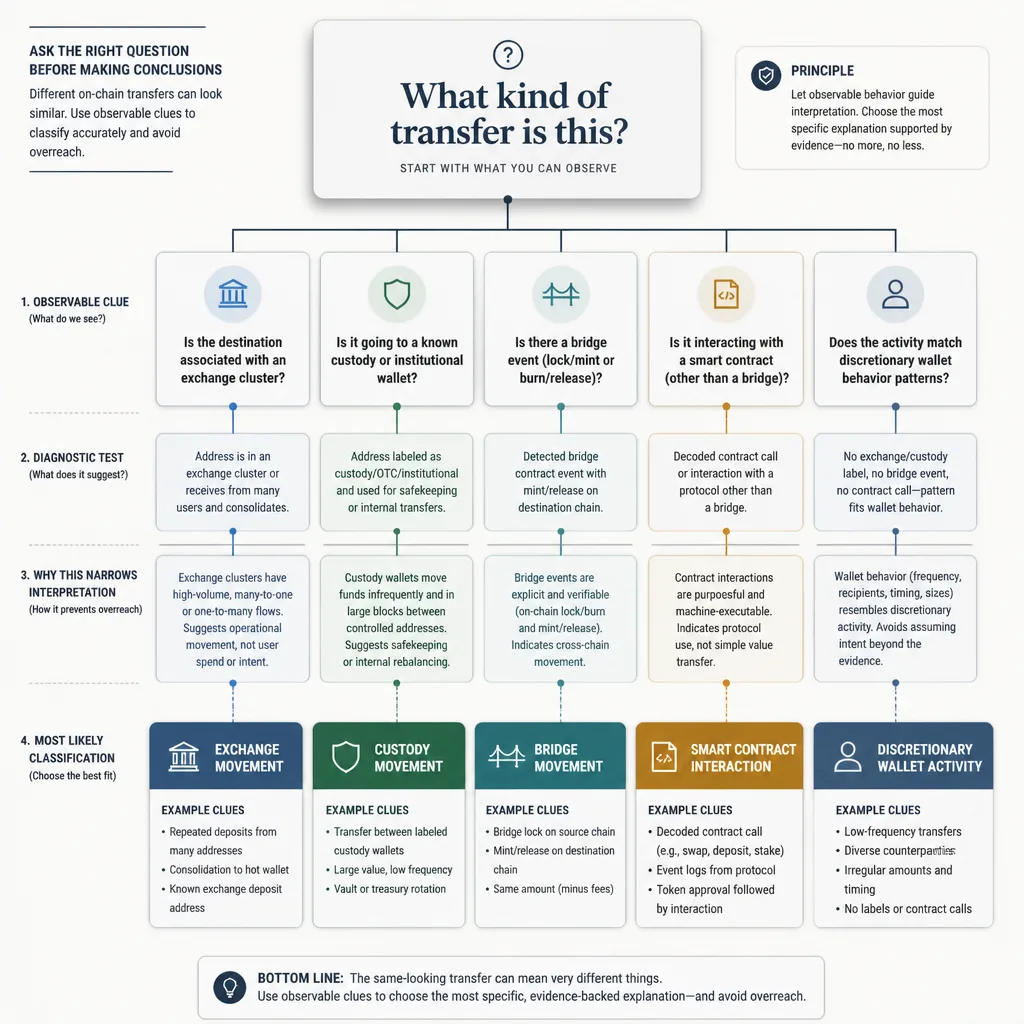
Before asking whether a transfer is bullish or bearish, ask something simpler: what kind of transfer is this?
That is the core framework here:
Classify -> Trace -> Corroborate -> Grade
You are not trying to read intent from a single line item. You are trying to identify the transfer type, trace nearby flows, test the explanation against other evidence, and then assign a confidence level.
That order matters. Bad analysis usually reverses it.
The five transfer categories that explain most cases
Most large token transfers fall into one of five buckets:
- Exchange movement: deposits, withdrawals, hot-wallet routing, cold-wallet shuffles
- Custody movement: vault rotation, safekeeping, client asset operations
- Bridge movement: moving funds between chains
- Smart contract interaction: staking, borrowing, collateral posting, liquidity provision, redemption
- Discretionary wallet activity: active choices by funds, treasuries, market makers, or individuals
A common mistake is assuming every large transfer belongs in the last group.
A practical workflow for reading a large transfer
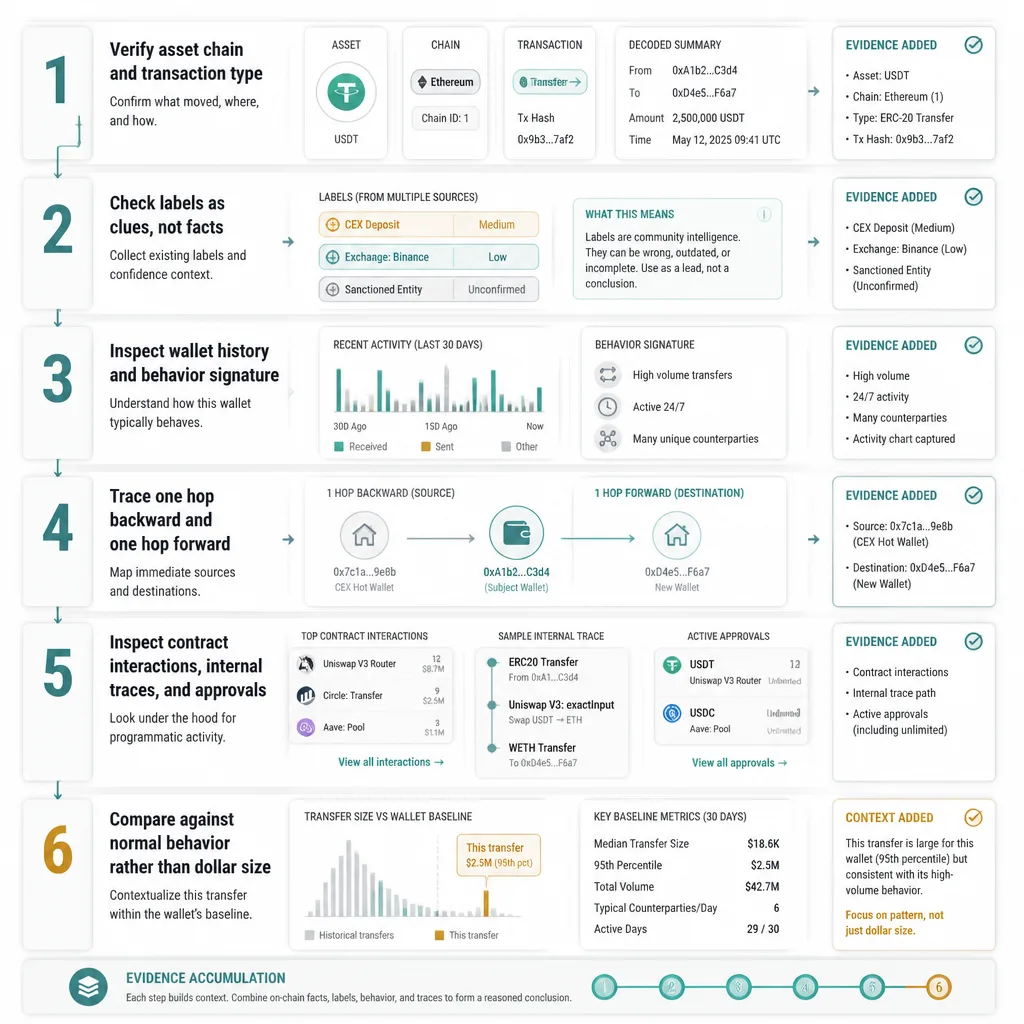
Step 1: Verify the asset, chain, and transaction type
Start with the basics.
Are you looking at native ETH, an ERC-20 transfer, a wrapped asset, a mint, a burn, or a bridge-related event? Was the asset sent directly between wallets, or did it move as part of a contract call? Explorer transfer tabs and decoded transaction views often show different slices of the same event.[^1]
A $25 million token movement into a contract is not automatically discretionary wallet activity. On Aave, Lido, or MakerDAO, it may represent collateral deposit, staking, wrapping, or redemption rather than trading intent.
Step 2: Check both wallet labels, but do not treat them as final proof
Labels help. They are not ground truth.
Etherscan’s label ecosystem and similar explorer systems can suggest whether an address belongs to an exchange, token contract, bridge, or protocol.[^2] But labels can be incomplete, outdated, or attached to only part of a wallet cluster.
A useful rule: labels increase confidence, but they do not end the investigation.
If both sides are clearly labeled and the labels fit the transaction story, confidence rises. If one side is unlabeled and the other is only vaguely tagged, confidence should stay modest.
Step 3: Read the wallet’s behavior, not just its balance
Addresses tend to have behavioral signatures.
Exchange-related wallets usually interact with many counterparties, receive repeated deposits, and route funds across other known exchange addresses. Custody wallets may move less often, in larger blocks, with fewer signs of active market interaction. A discretionary wallet often looks more idiosyncratic: fewer counterparties, more selective protocol use, and transfers tied to a particular strategy.
This is why transfer size alone is weak evidence. A $20 million move may be extraordinary for an individual and routine for a service provider.
Step 4: Trace one hop backward and one hop forward
This is often the fastest way to kill a bad narrative.
Suppose an address sends $40 million in ETH to a Binance-labeled wallet. At first glance, that looks bearish. Then you check one hop back and see the sender was funded by another Binance-associated address. The “whale depositing to sell” story becomes much weaker. Internal exchange routing is the simpler explanation.
Or imagine a wallet moving $18 million in USDC to a bridge contract on Ethereum. Social posts may frame it as fresh capital entering Base. But one hop forward might show the bridged funds arriving on Base and sitting idle, moving to a treasury wallet, or being deployed into a protocol. Until you see that next leg, “new demand” is too strong a claim.
Step 5: Check contract interactions and internal traces when relevant
Raw token transfers often hide the real action.
Explorer pages can show decoded method calls, event logs, and internal transactions derived from traces.[^1] These matter most when a transfer touches a contract. A token may appear to move into a contract, but the meaningful event could be a borrow, redeem, stake, lock, mint, burn, or liquidation-related action.
There is one caveat: internal transaction and trace visibility varies by chain and explorer. Missing trace data does not prove nothing else happened. Sometimes it just reflects tooling limits.
Step 6: Compare the transfer to normal behavior
The better question is not “Is this big?” It is “Is this unusual for this wallet?”
A $50 million transfer by a major exchange cluster may be operationally unremarkable. The same movement from a usually dormant wallet deserves attention.
Analysts who anchor on notional size tend to overreact. Analysts who anchor on behavioral baseline usually classify better.
The patterns people confuse most often
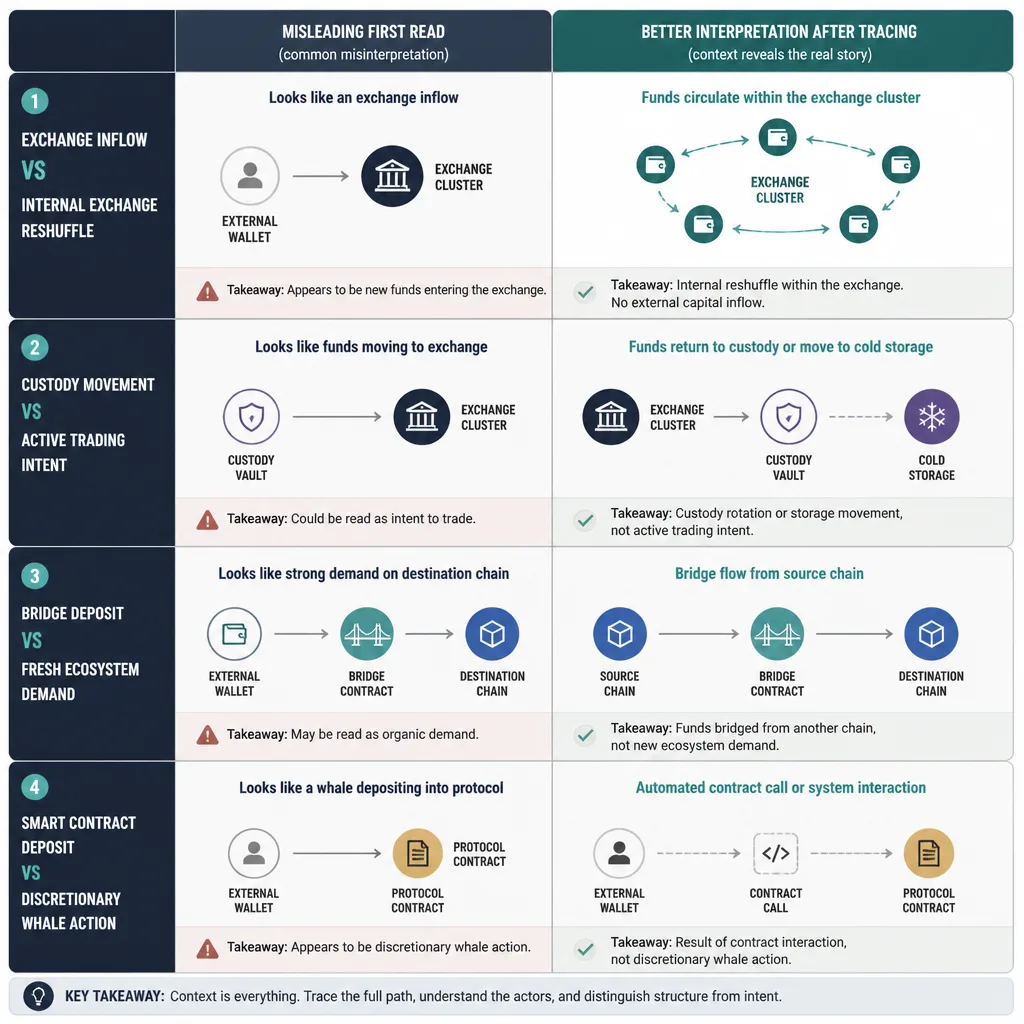
Exchange inflow vs internal exchange reshuffle
This is one of the most common misreads.
A transfer into a Binance, Coinbase, or Kraken wallet can be meaningful if it comes from an external wallet with no prior exchange-cluster behavior. But if the sender also appears to be part of the same exchange ecosystem, internal reshuffling is more likely.
Usually, one-hop tracing settles this quickly.
Custody movement vs trading intent
Custody flows often look dramatic because they are large and infrequent.
A vault rotation or client asset movement may pass near exchange infrastructure without implying an active sale. Custodians also optimize for operational security, not public interpretability, so outside observers can often see the movement without knowing the reason.
That uncertainty matters. Sometimes a custody explanation is simply the best fit, even if you cannot prove the exact purpose.
Bridge deposit vs fresh capital entering an ecosystem
Bridge flows are often overstated.
If funds move from Ethereum to Base or Arbitrum, the immediate fact is chain migration, not necessarily new capital formation. The right unit of analysis is the full bridge path: source lock or burn, destination mint or release, and then what happens after arrival.
If the bridged capital lands and is immediately deployed into a new protocol, that tells you more than the bridge deposit alone.
OTC settlement vs open-market pressure
Large wallet-to-wallet transfers can reflect bilateral settlement rather than exchange execution.
The problem is that public data usually cannot prove OTC intent on its own. You may only have clues: large direct transfers, little interaction with hot wallets, and no immediate DEX or CEX execution footprint. That can support a medium-confidence interpretation, not a definitive one.
This is one place where restraint matters.
Contract deposit vs discretionary whale action
A transfer headline can be technically correct and still analytically misleading.
A whale alert that says “$25 million moved” sounds like active positioning. But if the destination is a protocol contract and the decoded call shows collateral posting, staking, wrapping, or liquidity provision, the transfer should be interpreted through that protocol action, not through the raw token line.
Without contract context, you are often reading the shadow of the transaction rather than the transaction itself.
A simple confidence system
Low confidence: you can see the movement, but not the meaning
Low confidence means you can describe what moved, but not why with much reliability.
Typical signs:
- one or both wallets are unlabeled
- wallet history is sparse or contradictory
- contract context is unclear
- several explanations remain plausible
A fair low-confidence conclusion might be: “Large transfer into an exchange-linked address. Could indicate sale readiness, but internal routing and custody explanations remain plausible.”
That is not weak analysis. It is honest analysis.
Medium confidence: strong context, incomplete intent
Medium confidence means the wallet role is fairly clear, but the final purpose is still uncertain.
Example: funds move from a long-standing external wallet into a known exchange deposit path. That makes sale readiness more plausible. It still does not prove immediate selling, because collateral, conversion, or settlement remain possible.
This is where most useful public analysis lives.
High confidence: multiple signals line up
High confidence usually requires several things to align:
- credible labels on both sides
- wallet history consistent with the interpretation
- decoded contract actions that support the story
- adjacent hops that reinforce rather than contradict it
- repeated behavior over time
For example, repeated inflows from the same historically active seller into exchange deposit addresses, followed by known exchange-cluster dispersal, are much stronger evidence than a single isolated deposit.
What should raise or lower confidence
Confidence should rise when labels are consistent, wallet history is coherent, method calls are decoded, one-hop tracing is clear, and similar patterns repeat over time.
Confidence should fall when labels are partial, addresses are new, explorer traces are weak, behavior is inconsistent, or several alternative explanations still fit.
A useful habit is to say not only what you think happened, but also what would make you wrong.
When a large transfer actually matters
When it changes supply access, liquidity, or venue exposure
Transfers matter most when they change what can happen next.
A treasury unlock moving to a liquid venue matters because it changes market access. Repeated inflows from a historically active seller matter because they raise the chance of execution pressure. Large bridge flows matter when they are followed by deployment into ecosystem-specific opportunities.
The important thing is not the movement itself. It is the new options that movement creates.
When it fits a broader pattern
One transfer can be noise. A sequence can become signal.
If a wallet repeatedly sends assets to exchange deposit paths before periods of selling, that pattern is more informative than any single transfer. If bridged funds consistently arrive and then move into a specific DeFi protocol, that tells you more than the bridge transaction alone.
Time reduces ambiguity because repeated behavior narrows the set of plausible explanations.
Why clusters matter more than one-off alerts
Clusters are harder to fake and easier to interpret.
A single alert invites projection. Ten related alerts over a week start to reveal role, rhythm, and likely purpose. That is why serious analysts care more about recurring flows than viral screenshots.
The crowd’s edge is speed. The analyst’s edge is pattern recognition.
The practical rule: treat transfers as evidence, not verdicts
When a whale alert appears, use this sequence:
- Classify the transfer: exchange, custody, bridge, contract, or discretionary wallet?
- Verify the asset, chain, and transaction type.
- Check labels on both sides, knowing they may be incomplete.
- Trace one hop back and one hop forward.
- Inspect contract calls and internal traces if a protocol is involved.
- Compare against wallet history: is this normal or genuinely unusual?
- Grade confidence: low, medium, or high.
If you cannot get past steps three or four with coherent evidence, the professional answer is often simple: unclear, worth monitoring.
Conclusion
The main mistake people make with on-chain transfers is not reading the wrong data. It is asking too much from a single data point.
A large transfer rarely justifies a dramatic market story on its own. The better approach is slower, less theatrical, and more useful: classify the movement, trace nearby flows, check labels and contract context, and then grade your confidence. Sometimes that will support a strong interpretation. Often it will support a restrained one.
That restraint is not a weakness. It is the difference between watching on-chain activity and actually analyzing it.
The real edge is not spotting a whale alert first. It is interpreting it better than the crowd.
FAQ
Can a single on-chain transfer tell you whether a whale is about to sell?
Usually not with high confidence. A single transfer shows that assets moved, not why. An exchange inflow may increase the possibility of a sale, but it does not prove one.
How do you tell if a wallet belongs to an exchange or a custodian?
Start with explorer labels, then verify behavior. Exchange-related wallets often interact with many deposit addresses and other exchange-cluster wallets. Custody wallets may show lower-frequency, high-value operational movements with fewer signs of active trading.
Are wallet labels on Etherscan and similar explorers reliable?
Useful, yes. Perfect, no. Labels on tools like Etherscan, Arbiscan, and Basescan are best treated as clues rather than proof.[^2]
What is the fastest way to check whether a whale alert matters?
Classify the transfer, trace one hop backward and forward, check both wallet labels, inspect contract interaction if relevant, and then assign a confidence grade. In many cases, that is enough to separate noise from something worth tracking.
Does a transfer into an exchange always mean bearish pressure?
No. It may mean the holder now has easier access to sell, but that is not the same as a confirmed sale. It could also reflect collateral movement, treasury operations, internal routing, or settlement.
How can you distinguish an internal exchange reshuffle from an external deposit?
One-hop tracing is often enough. If the sending wallet also connects to known exchange-cluster addresses, or if the transfer moves between labeled wallets in the same exchange ecosystem, internal routing is usually the more likely explanation.
Why are bridge transfers often misread?
Because people treat one side of the bridge as the whole story. A bridge deposit usually means capital is moving between chains, not that fresh capital is entering the ecosystem. You need the end-to-end flow.
What makes a transfer interpretation high confidence?
High confidence usually requires several aligned signals: credible labels, wallet history that fits the interpretation, decoded contract activity that supports it, and follow-on transfers that reduce alternative explanations.
Can retail users do useful on-chain forensic analysis without expensive tools?
Yes, within limits. Public explorers, Blockscan, and protocol documentation are often enough to improve interpretation substantially. What retail users usually lack is deeper wallet clustering, attribution data, and off-chain context, so conclusions should remain probabilistic.
What is the most professional conclusion when the evidence is weak?
Unclear. That is often the right answer. Good on-chain analysis is less about forcing a narrative and more about knowing when the evidence does not justify one.