Crypto Profit Blueprints 2026: 7 Repeatable Strategies and When Each One Works
Most crypto profit guides make the same mistake: they list strategies without helping you choose between them. That matters because in 2026, two opportunities showing the same APY can come from very different risk sources. A 7% staking yield, a 7% stablecoin yield, and a 7% basis trade are not economically the same.
If you want repeatable crypto returns, the better question is not “What strategies exist?” It is “Which strategy fits my capital, time, risk tolerance, and ability to manage complexity?” That is how you avoid chasing headline yields and ending up in positions you cannot monitor when conditions turn.
This guide takes a decision-first approach. It gives you a practical framework, a quick fit matrix, and a clear view of when each strategy tends to work, where it breaks, and who it actually suits.
Start Here: The 4 Questions That Should Decide Your Strategy
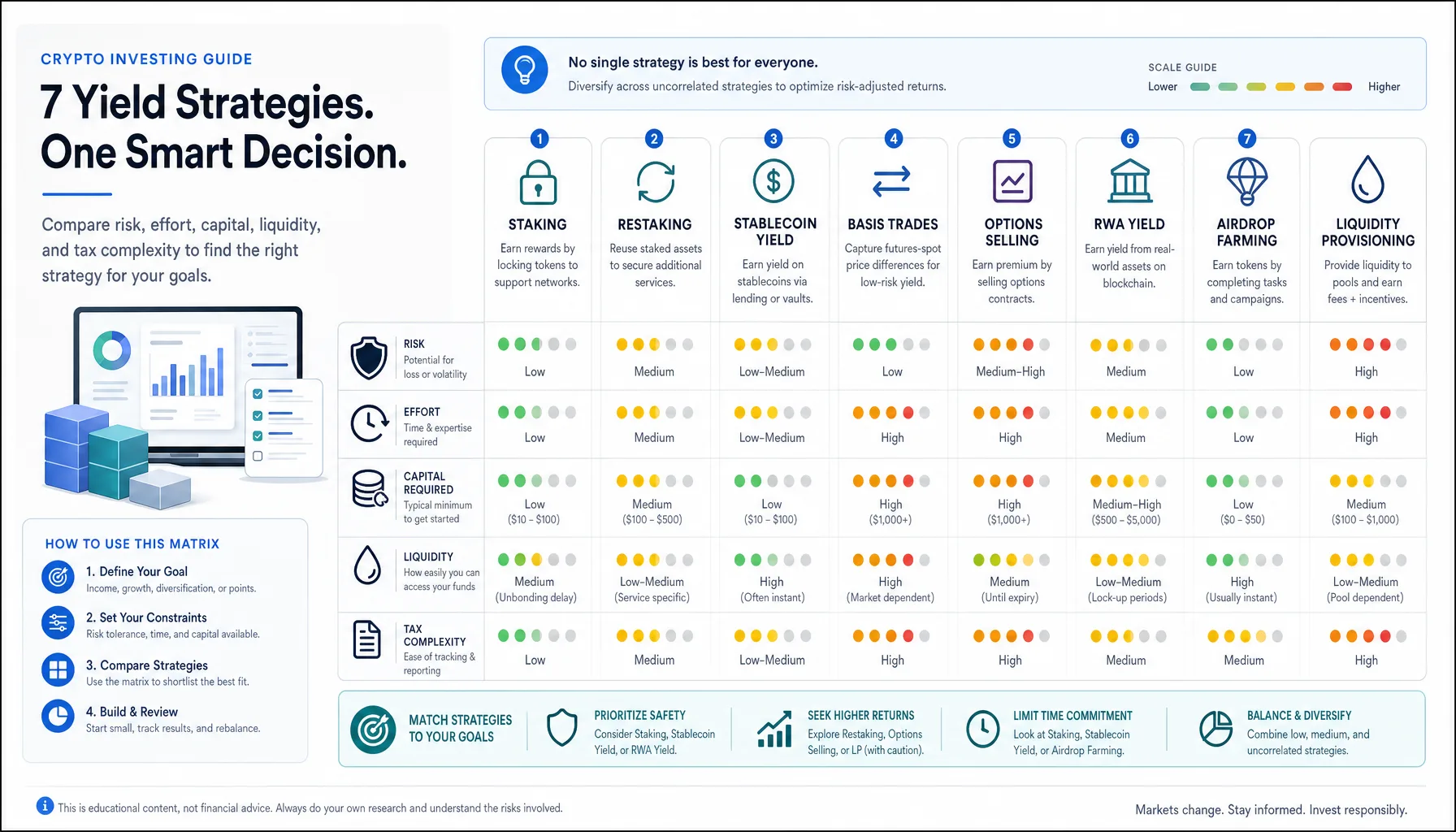
Before comparing yields, start with constraints. A strategy is only profitable if you can execute it consistently and survive its failure mode.
How much capital are you deploying?
Some strategies work at small size. Others do not.
Airdrop farming can make sense with modest capital because process matters more than account size. Basis trades and options selling usually work better with more capital, since fees, spreads, and collateral needs can absorb too much of the edge at smaller size.
How much time can you commit each week?
This is one of the most useful filters.
Simple staking or conservative stablecoin yield often needs limited oversight. Concentrated liquidity positions, basis trades, and active airdrop farming usually require more frequent checks, rebalancing, or tighter execution.
How much drawdown and smart-contract risk can you tolerate?
Every strategy pays you for taking some kind of risk. The key is knowing which one.
Staking pays you for holding token exposure and helping secure a network. Basis trades pay you for absorbing leverage demand and managing exchange risk. LPing pays you for holding inventory against trading flow. If you cannot explain the return source in one sentence, you should not be in the trade.
How much tax and reporting complexity can you handle?
A strategy can look attractive before taxes and become a burden afterward.
Frequent rewards, derivatives PnL, rebalances, swaps, and airdrops can create substantial record-keeping overhead. Tax treatment varies by jurisdiction, so this is not tax advice, but complexity itself is a real cost.
The FIT Matrix framework
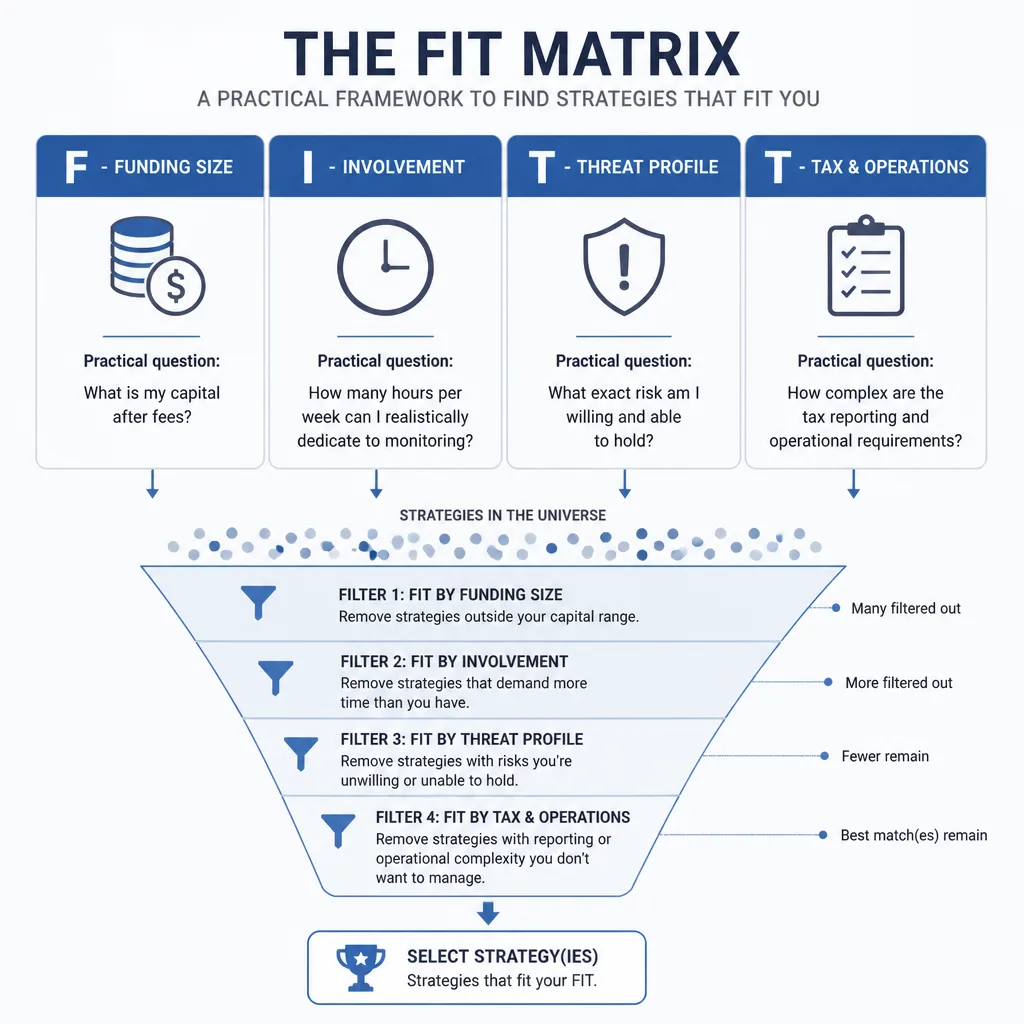
Use FIT as your first filter:
| Dimension | What to ask |
|---|---|
| F — Funding size | Is my capital large enough for this strategy to matter after fees, gas, and taxes? |
| I — Involvement | Can I realistically monitor and manage this each week? |
| T — Threat profile | Do I understand the exact risk I am being paid to hold? |
| T — Tax/operations | Can I track, report, and maintain this without errors? |
Decision Rule: Eliminate any strategy that fails even one hard constraint before comparing returns.
The 2026 Crypto Profit Fit Matrix
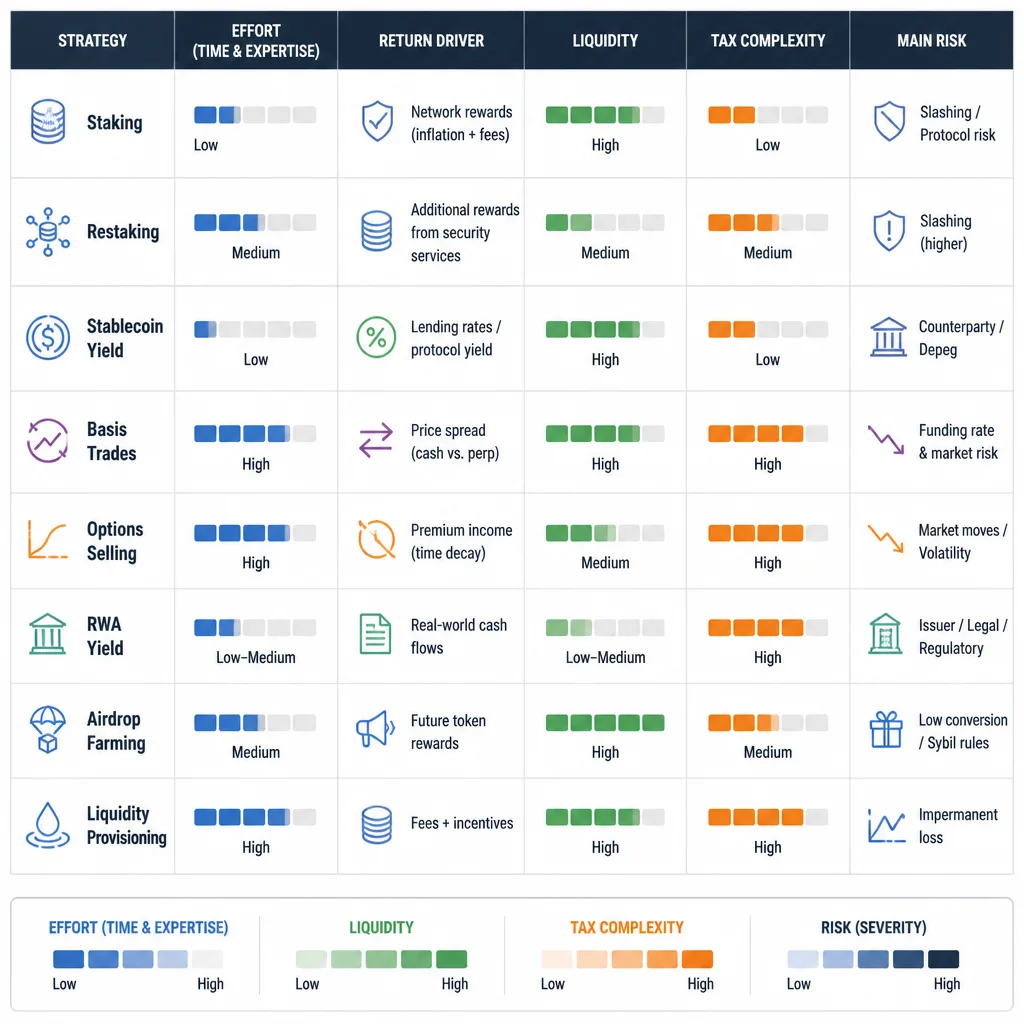
This is the fast orientation view.
| Strategy | Best for | Effort | Return driver | Main risks | Liquidity profile | Tax complexity | Works best when |
|---|---|---|---|---|---|---|---|
| Staking | Low-to-medium effort investors | Low | Validator rewards, fees, emissions | Token drawdown, slashing, lockups | Medium | Low to medium | You want simple native yield and accept token exposure |
| Restaking | Crypto-native yield seekers | Medium to high | Shared security demand, extra incentives | Layered slashing, smart contracts, wrappers | Medium | Medium to high | Extra yield persists and you understand the stack |
| Stablecoin yield | Capital-preservation-focused users | Low to medium | Borrow demand, credit spread, off-chain asset income | Depeg, issuer, platform, contract risk | Medium to high | Medium | You want lower volatility than spot crypto |
| Basis trades | Market-neutral operators | Medium to high | Funding payments, futures premium | Exchange failure, funding flips, collateral stress | High until stress hits | High | Leverage demand is healthy and carry is positive |
| Options selling | Risk managers, not yield chasers | Medium to high | Volatility premium | Tail losses, capped upside, liquidity gaps | Medium | High | Vol is rich and you accept the tradeoffs |
| RWA yield | Users seeking off-chain cash flow exposure | Low to medium | Treasury, money market, or credit income | Legal structure, redemption, issuer risk | Medium | Medium | You want less crypto-beta in the income source |
| Airdrop farming | Low-capital, high-time users | High | Protocol growth incentives | No drop, Sybil filtering, gas/time drag | High | High | You can run a disciplined multi-protocol process |
| Liquidity provisioning | Active DeFi users | Medium to high | Trading fees, incentives | Impermanent loss, volatility mismatch, exploits | Medium | High | Volume is strong relative to volatility |
Bottom Line: Similar APYs can hide very different business models, risk stacks, and monitoring demands.
1. Staking: Best When You Want Simpler Native Yield
How staking generates returns
Staking usually pays from a mix of protocol emissions and transaction fees, depending on the chain design.[^1] In simple terms, you lock or delegate tokens to help secure a network and receive rewards in return.
When staking works well
Staking works best when you already want long-term exposure to the token.
For example, if you plan to hold ETH anyway, staking can improve your token-denominated return without adding much structural complexity.
Where staking fails or disappoints
The biggest mistake is confusing token yield with fiat profit.
A token can pay 6% staking rewards and still fall 25% in USD terms over the year. The staking itself may have worked exactly as designed, while the investment still lost money in dollar terms.
Other weak points include:
- Unbonding or withdrawal delays
- Slashing risk
- Validator concentration
- Liquid staking wrapper risk if you use an LST instead of native staking
Who staking fits in 2026
Staking fits investors who want a relatively simple core strategy and are comfortable with the underlying asset’s price risk.
Common Mistake: Treating staking as “safe yield” instead of “yield on a volatile asset.”
2. Restaking: Best When Extra Yield Justifies Extra Risk
How restaking changes the staking equation
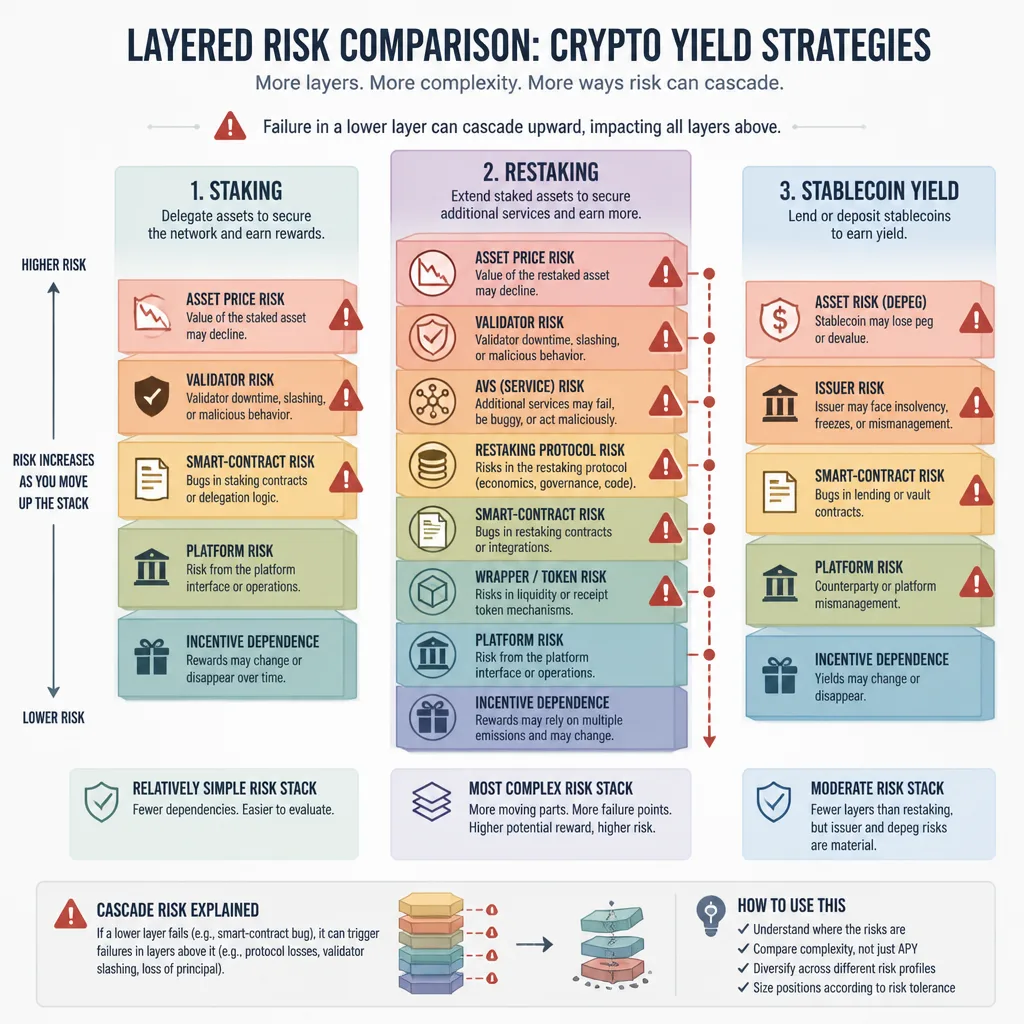
Restaking adds another monetization layer on top of staked collateral by extending economic security to additional services. A simple analogy: staking is renting out one house; restaking is renting the same house to multiple tenants under more complicated terms.
That can increase income, but it also increases the chance that one problem affects the whole structure.
When restaking can outperform basic staking
Restaking can outperform when there is real demand for shared security and incentives are not the only reason yields look attractive.
For crypto-native users who can evaluate liquid restaking tokens, slashing conditions, and protocol design, it may work as a higher-risk satellite strategy.
Failure modes
Restaking adds:
- Expanded slashing exposure
- Smart-contract dependency
- Wrapper and liquidity mismatch risk
- Incentive dependence
- More complex failure chains
If one layer breaks, the damage can spread faster than in plain staking.
Who should avoid restaking
Avoid restaking if you want simplicity, low monitoring, or limited operational complexity. It is not just better staking. It is a different risk stack.
Decision Rule: If you cannot explain where the extra yield comes from beyond “higher APY,” do not restake.
3. Stablecoin Yield: Best When Capital Preservation Matters More Than Upside
Where stablecoin yield comes from
Stablecoin yield can come from several very different places:
- DeFi lending markets such as Aave or Morpho, where borrowers pay to access capital[^2]
- Centralized lending or exchange earn programs
- Tokenized Treasury or money-market products that pass through off-chain asset income
When stablecoin strategies work
Stablecoin yield works best when your main goal is preserving nominal capital while keeping it productive.
For example, moving from volatile altcoins into USDC and deploying it into a transparent lending market reduces price volatility, but it replaces that risk with credit, platform, and contract exposure.
Depeg, issuer, and platform risks
Stablecoins are not riskless cash.
Failure modes include:
- Depegs
- Reserve or issuer weakness
- Banking and settlement frictions
- Smart-contract exploits
- Counterparty default
- Redemption bottlenecks
How to judge whether a yield is real or subsidized
Ask one question: Who is paying me, and why?
If the yield comes from borrower demand or underlying Treasury income, it may be more durable. If it comes mainly from token incentives or a promotional campaign, it may disappear quickly.
Decision Rule: If a stablecoin APY is far above cash-like benchmarks, identify the extra risk or assume the yield is partly subsidized.
4. Basis Trades: Best When You Want Market-Neutral Carry
How cash-and-carry works in crypto
A simple crypto basis trade is to buy spot BTC and short an equivalent BTC perpetual or futures position. If perp funding is positive or futures trade at a premium, you collect carry while reducing directional price exposure.
Why basis exists
Basis exists because traders want leverage, and someone has to take the other side. The arbitrageur gets paid for helping absorb that demand.
When basis trades are attractive
Basis trades work best when:
- Funding is consistently positive
- Exchange liquidity is deep
- Collateral management is efficient
- Carry exceeds fees and operational drag
Where basis trades break
They are not risk-free.
A realistic failure case: you long $10,000 spot BTC and short the equivalent perpetual exposure. Funding turns negative, the exchange raises margin requirements, and liquidity thins during stress. Even with the price mostly hedged, the trade can underperform or lose.
Main risks include:
- Funding flips
- Basis compression
- Exchange insolvency
- Collateral haircuts
- Forced deleveraging
Bottom Line: In crypto, market-neutral usually means reduced price risk, not zero risk.
5. Options Selling: Best When You Can Manage Risk, Not Just Collect Premium
Covered calls and cash-secured puts in crypto
The two simplest structures are:
- Covered calls: you hold the asset and sell upside beyond a strike
- Cash-secured puts: you sell downside insurance and are willing to buy the asset lower
When selling options works
Selling options works best when implied volatility is rich and the market stays within a manageable range.
Example: you hold 1 ETH and sell an out-of-the-money call. If ETH drifts sideways, you keep the premium and still hold the coin.
Tail risk, capped upside, and volatility regime shifts
The tradeoff is the whole point.
If ETH rallies hard, the covered call underperforms spot because your upside is capped. If the market crashes and you sold puts, you can be assigned into a falling asset. The premium is compensation for taking those risks.
Why premium income is often misunderstood
Premium can look like steady income in calm periods, but losses and missed upside often arrive in lumps.
Common Mistake: Thinking options premium is free yield. It is payment for taking volatility and convexity risk.
6. Real-World Asset (RWA) Yield: Best When You Want Off-Chain Cash Flow Exposure
What RWA yield actually represents
RWA yield is not created on-chain. It usually reflects income from off-chain assets such as Treasury bills, money-market instruments, repo, or private credit, wrapped in a tokenized structure.[^3]
When RWAs can improve a crypto portfolio
RWAs can help if you want income with less direct crypto-beta and a more legible cash-flow source.
For example, a tokenized Treasury product may appeal to someone who wants blockchain settlement rails but prefers short-duration government-backed income over DeFi borrower demand.
Key limitations
The hard questions are legal, not cosmetic:
- Who actually holds the underlying assets?
- What claim do token holders have?
- How do redemptions work?
- Are there KYC or jurisdiction limits?
- What happens if the issuer fails?
Who RWA exposure is suitable for
RWA yield fits users who care more about asset quality and legal structure than pure DeFi composability.
Decision Rule: With RWAs, focus less on the token wrapper and more on the legal rights behind it.
7. Airdrop Farming: Best When Time and Process Matter More Than Capital
How airdrop farming creates expected value
Airdrop farming is a workflow strategy. You interact early with credible protocols, meet likely activity heuristics, and spread effort across multiple ecosystems in hopes that a few successful launches outweigh many dead ends.
When it works
It works best when you have more time than capital and can stay organized.
A disciplined user might bridge, swap, test features, use governance, and maintain clean wallet behavior across a shortlist of serious projects over several months.
Why most users overestimate rewards
They remember the wins and ignore the drag:
- Gas costs
- Time spent
- Failed launches
- Low token valuations
- Disqualification
- Wallet clustering and Sybil filters
Sybil filtering, sunk cost, and execution drag
Teams have become stricter about filtering extractive behavior. That makes process quality more important and easy reward extraction less reliable.
Bottom Line: Airdrop farming is not passive yield. It is closer to speculative business-development work across protocols.
8. Liquidity Provisioning: Best When Fees Outweigh Impermanent Loss
How LP returns are generated
LP returns usually come from swap fees, token incentives, or both. In practice, you provide inventory so traders can transact.
When providing liquidity works
LPing works when fee income is strong relative to price volatility and when the asset pair and fee tier match actual market behavior.
Impermanent loss, pool design, and volatility mismatch
Consider an ETH/USDC pool. If ETH rises sharply, the pool continually sells some ETH into strength. The LP ends up with less ETH than a simple holder would have had. That inventory drag is impermanent loss.
If fees earned exceed that drag, LPing outperforms holding. If not, it underperforms.
How to think about LPing in concentrated liquidity environments
In concentrated liquidity systems such as Uniswap v3-style designs, capital efficiency improves, but the management burden rises.[^4] Narrow ranges can earn more fees when price stays inside them. But when price leaves the range, capital goes idle.
That makes LPing closer to active market making than passive income.
Common Mistake: Treating concentrated LPing like a set-and-forget strategy.
How to Choose: A Simple Strategy Selection Framework
Here is the practical version of the FIT Matrix.
If you have low time and want simplicity
Start with:
- Simple staking, if you want token exposure
- Conservative stablecoin or Treasury-linked yield, if you want lower volatility
If you want market-neutral exposure
Look at:
- Basis trades first
- Options only if you already understand assignment, strikes, and volatility regimes
If you want higher upside and accept operational risk
Consider:
- Restaking
- Active liquidity provisioning
These can work, but only if you can monitor them and understand the layered risks.
If you have more time than capital
Airdrop farming may be the best fit, especially if gas costs are controlled and your process is systematic.
If tax complexity is a hard constraint
Avoid high-turnover strategies like active LPing, heavy airdrop farming, and frequent derivatives trading unless you already have a tracking system.
Decision Rule: For most readers, one core strategy plus one satellite strategy is better than trying all seven.
Common Failure Modes Across All 7 Strategies
Depegs and collateral quality mismatches
This matters beyond stablecoins. Wrapped assets, LSTs, and derivative collateral can all break the assumption that one unit always equals one unit.
Smart-contract and bridge risk
Many strategies look diversified but sit on overlapping infrastructure. Different positions can fail for the same technical reason.
Liquidity crunches during stress
A position can appear liquid in normal conditions and become expensive to exit when you need liquidity most.
Counterparty and exchange failure
This matters especially for basis traders, centralized earn users, and some options traders. Venue concentration is often underestimated.
Tax surprises and record-keeping gaps
High-turnover activity can quietly erase much of a strategy’s practical value through admin burden, filing costs, or bad records.
Key Insight: Operational complexity is not just inconvenient. It is a risk factor.
Implementation Checklist for 2026
Implementation Checklist
- Define the goal in plain terms: capital preservation, market-neutral carry, token accumulation, or upside with income
- Choose one core strategy first
- Size small until execution is proven
- Identify the exact return source in one sentence
- Model the main downside scenario before deploying
- Check venue, protocol, issuer, or legal-structure risk
- Understand likely tax and reporting burden in your jurisdiction
- Track realized return, not just advertised APY
- Review the strategy quarterly and confirm that conditions still support it
Conclusion
The best crypto profit blueprint for 2026 is not the one with the highest APY. It is the one you can understand, monitor, survive, and repeat.
That is the difference between a strategy and a temptation. Staking, restaking, stablecoin yield, basis trades, options selling, RWA exposure, airdrop farming, and liquidity provisioning can all work in the right conditions. They can also all fail when the return driver weakens or the hidden risk finally shows up.
If you take one lesson from this guide, make it this: match the strategy to your constraints, not the narrative. Repeatability beats peak yield.
FAQ
What is the best crypto profit strategy for 2026?
There is no single best strategy. The right choice depends on your capital, time commitment, risk tolerance, and tax or operational complexity. Staking may suit lower-effort investors, while basis trades or liquidity provisioning fit users who can monitor positions more actively.
How do I choose between staking and restaking?
Choose staking if you want simpler native yield and can accept token price risk and lockups. Choose restaking only if you understand layered smart-contract and slashing risk and believe the extra yield is worth the added complexity. Restaking is not just higher-yield staking; it is a different risk stack.
Is stablecoin yield safer than staking?
Often, but not always. Stablecoin yield removes much of the price volatility that affects staking, but it introduces other risks such as depegs, issuer risk, counterparty exposure, and smart-contract risk. It can be safer in some conditions, but only if the yield source is credible and platform risk is acceptable.
Are basis trades really market-neutral?
Basis trades are designed to reduce directional price exposure, but they are not risk-free. They still carry exchange risk, collateral risk, funding-rate risk, liquidity stress risk, and execution risk. In crypto, market-neutral usually means reduced price risk, not zero risk.
Why can two crypto strategies show the same APY but have very different risk?
Because the return drivers are different. A 7% staking yield may come from protocol emissions and validator rewards, while a 7% stablecoin yield could come from borrower demand or off-chain assets, and a 7% basis trade could come from derivatives market structure. Similar APYs do not mean similar durability or risk.
Is options selling a good crypto income strategy?
It can be, but only if you understand what you are giving up or taking on. Covered calls can generate premium in range-bound markets but cap upside. Cash-secured puts can work if you are comfortable buying the asset lower. Premium is compensation for volatility and tail risk, not free yield.
What makes RWA yield different from DeFi yield?
RWA yield usually comes from off-chain assets such as Treasury bills, money-market instruments, or private credit. DeFi yield more often comes from borrower demand, trading fees, or protocol incentives. With RWAs, focus on legal structure, redemption rights, issuer quality, and jurisdictional limits.
Is airdrop farming worth it in 2026?
It can be worthwhile for users with more time than capital, but it should be treated as a workflow strategy rather than passive income. Results are uneven, Sybil filters are stricter, and many campaigns never produce meaningful rewards. It works best when approached systematically across multiple credible protocols.
When does liquidity provisioning work best?
Liquidity provisioning works best when trading fees and incentives outweigh impermanent loss and active management costs. It tends to perform better in markets with healthy volume, suitable fee tiers, and asset pairs that match volatility expectations. In concentrated liquidity systems, it is often closer to active market making than passive yield.
What are the biggest failure modes across crypto yield strategies?
The most common failure modes are depegs, smart-contract exploits, bridge failures, liquidity crunches, exchange or counterparty collapse, and tax-reporting complexity. A useful rule is to ask what specific risk you are being paid to hold before trusting any headline yield.