Centralized Exchange vs DEX vs Broker Apps: A Practical Guide to Choosing the Right Crypto Trading Venue
The same crypto purchase can turn out very differently depending on where you make it. A broker app may charge a wider spread. A centralized exchange may offer better execution. A DEX may be the only place a specific token is available. You may also end up with very different levels of control over the asset after you buy it.
That is why venue choice matters. It affects price, custody, privacy, token access, and what happens when something goes wrong. A platform that feels easiest at the start can become expensive or restrictive later. A platform that gives you full control can also make costly mistakes harder to undo.
This guide compares centralized exchanges, DEXs, and broker apps in practical terms. You will get a clear breakdown of how each one works, a decision framework you can reuse, shortcuts for common goals, and a safety checklist to avoid avoidable mistakes.
The short answer
If you only remember one thing, make it this:
Key Insight: There is no universal best crypto trading venue. The right choice depends on the tradeoffs that fit your goal.
Here is the quick version:
- Use a broker app if simplicity matters most and you are making a small first purchase.
- Use a CEX if you want better execution, deeper liquidity, or easier fiat on-ramps.
- Use a DEX if you want self-custody, access to long-tail tokens, or wallet-native trading.
If self-custody is non-negotiable
A DEX is often the most direct option because you trade from your own wallet instead of depositing funds with a platform. But that only works well if you understand wallet security, token approvals, contract verification, and network selection.
A beginner-friendly CEX can also work if your plan is to buy BTC or ETH and then withdraw to a hardware wallet. In that case, the exchange is just the entry point, not the place you keep funds long term.
Decision Rule: If you cannot withdraw to your own wallet, treat the product as exposure first and ownership second.
What each venue actually is
Many people compare features before they understand the underlying model. That is how they end up choosing the wrong tool.
Broker-style crypto apps
A broker app is the simplest way to buy crypto. The interface is usually clean, the buy flow is familiar, and there are few advanced settings.
The tradeoff is pricing transparency. Instead of showing a full order book, the app may quote a buy price that already includes a markup or wider spread. Some apps also limit withdrawals, supported networks, or order types.
A broker app can be fine for someone buying a small amount of BTC for the first time. It is less appealing if you care about precise execution or plan to move assets into self-custody later.
Centralized exchanges
A centralized exchange, or CEX, is a custodial platform that matches buyers and sellers. In simple terms, the platform holds your assets until you withdraw them.
CEXs usually offer stronger liquidity, clearer market pricing, and better trading tools than broker apps. That often means tighter spreads, visible fees, and features like market and limit orders.
The downside is trust. While your funds remain on the platform, you are relying on its systems, policies, and solvency.[^1]
Decentralized exchanges
A DEX lets you trade from your own wallet through smart contracts. You do not hand custody to the platform in the same way you do on a CEX.
That gives you more control and often broader access to niche tokens. It also means you are responsible for wallet security, approvals, slippage settings, and verifying that a token contract is legitimate.[^2]
A DEX removes intermediary custody risk, but it does not remove risk. It changes the type of risk.
The 6-Factor Venue Choice Framework
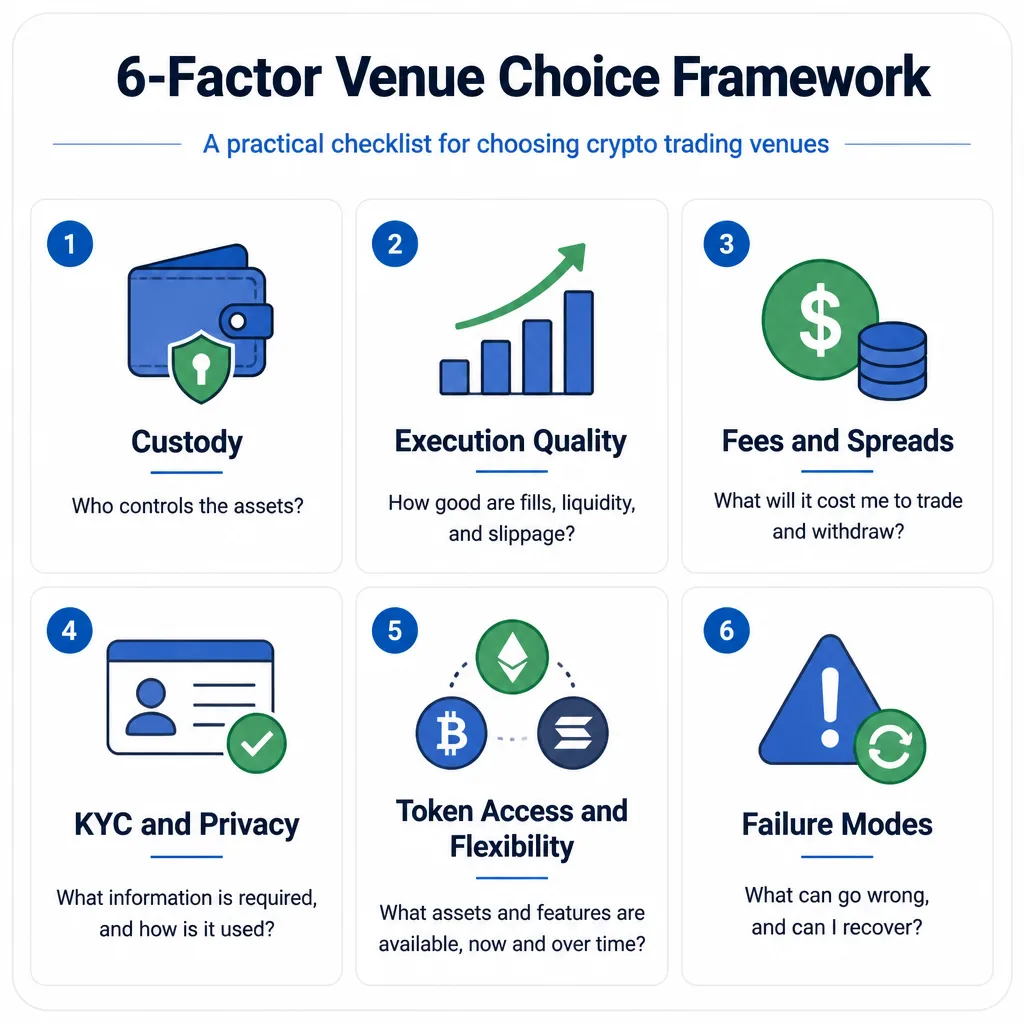
Use this framework to compare any broker app, CEX, or DEX.
| Factor | What to ask | Why it matters |
|---|---|---|
| Custody | Who controls the assets before and after the trade? | Determines ownership, freeze risk, and self-custody options |
| Execution quality | How close will I get to the expected price? | Affects how much crypto you actually receive |
| Fees and spreads | What is the all-in cost? | Visible fees can hide worse spreads, slippage, or gas |
| KYC and privacy | What personal data must I share, and what remains visible? | Affects compliance burden and traceability |
| Token access and flexibility | Can I buy the asset I want and move it where I want? | Determines asset choice and withdrawal freedom |
| Failure modes | What can go wrong, and can I recover? | Helps you choose risks you can realistically manage |
1. Custody
Custody means who controls the keys.
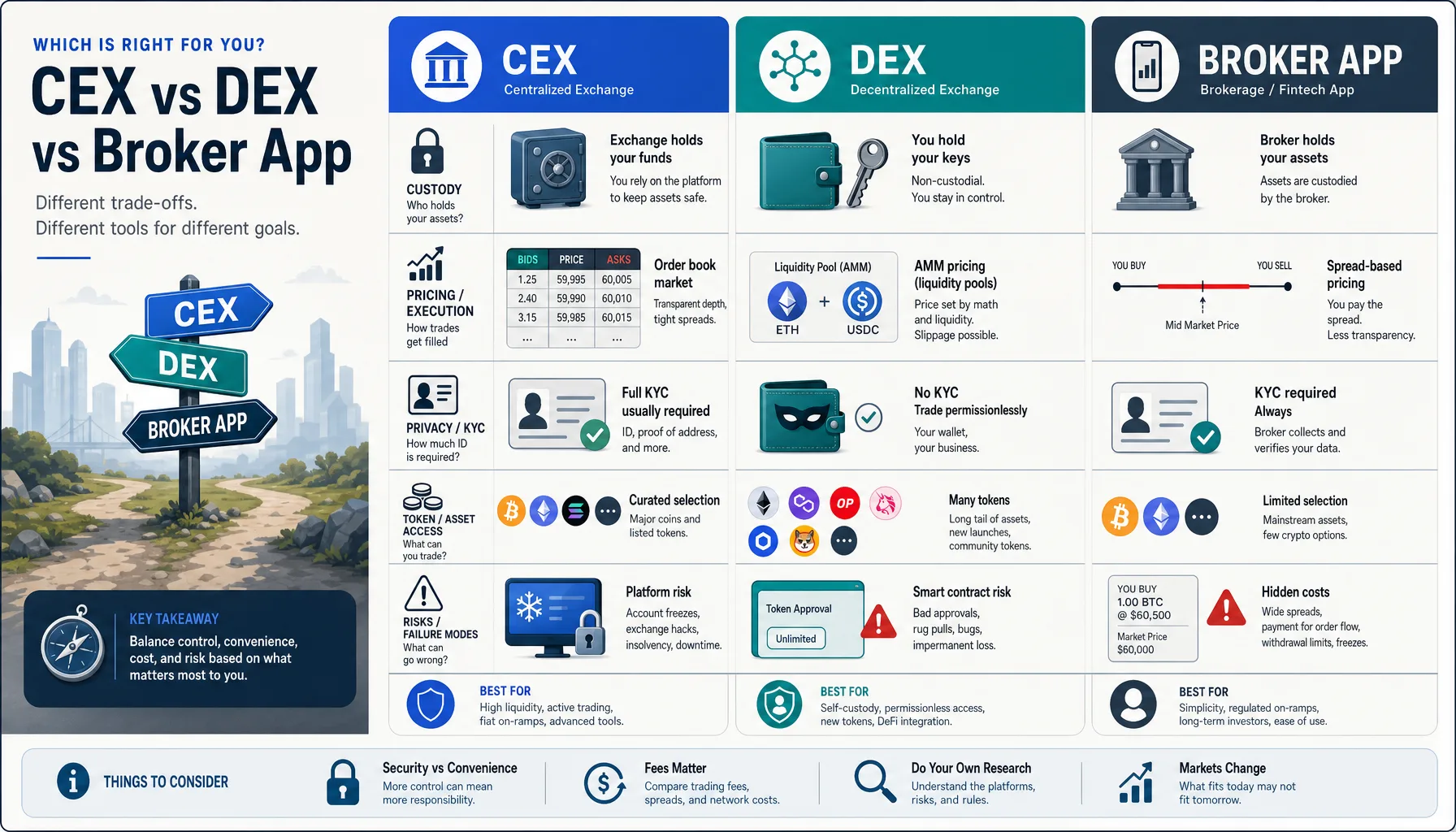
On a CEX, the platform controls the wallet keys until you withdraw. On a DEX, you sign transactions from your own wallet. On some broker apps, withdrawals may not be available at all.
If you plan to hold long term in a hardware wallet, check withdrawal support and network compatibility before you buy.
2. Execution quality
Execution quality is simply the quality of the price you actually get.
A broker app may advertise zero commission while giving you a wider spread. A CEX may offer an order book and limit orders. A DEX may show price impact and slippage directly.
Key Insight: Execution quality is the price you actually receive, not the headline fee.
3. Fees and spreads
Many beginners compare listed fees and stop there. That misses the real cost.
Your all-in cost may include:
- Trading fees
- Spread
- Slippage
- Gas fees
- Withdrawal fees
A broker app can show no explicit commission and still cost more overall if the spread is wide. A DEX trade can also look cheap until gas and slippage are included.
4. KYC and privacy
Most CEXs and many broker apps require identity verification under KYC/AML rules. DEXs usually do not require account-level identity submission.
But that does not mean DEX use is private in the everyday sense. Wallet activity is visible on public blockchains, and behavior can often be traced over time.[^3]
5. Token access and transfer flexibility
If you only want BTC or ETH, all three venue types may work. If you want a newly launched or niche token, a DEX may be the only practical option.
The tradeoff is quality control. DEXs list long-tail assets faster, but that also means more fake tokens, thinner liquidity, and greater contract risk.
Broker apps usually offer a curated selection. CEXs tend to sit in the middle: broader access than broker apps, but less than DEXs.
6. Failure modes
This is the factor most people ignore until something breaks.
- CEX risks: insolvency, hacks, withdrawal freezes, account lockouts, delistings
- DEX risks: wallet compromise, seed phrase loss, malicious approvals, fake contracts, phishing front ends, smart contract exploits
- Broker app risks: opaque spreads, no withdrawals, account restrictions, confusion between price exposure and true ownership
Recoverability is very different across these models. With a CEX, some outcomes depend on support and legal process. With a DEX, signing the wrong transaction is often final.
Bottom Line: Choose the failure mode you understand best, not the venue with the best marketing.
Side-by-side comparison
| Venue | Best for | Custody | Pricing transparency | Token access | Ease of use | KYC/privacy | Main risks |
|---|---|---|---|---|---|---|---|
| Broker app | First-time buyers, small simple purchases | Usually custodial; withdrawals may be limited | Often less transparent; spread may be embedded | Limited to curated assets | Easiest | Usually requires KYC | Hidden spread, transfer limits, limited control |
| CEX | Better execution, active trading, fiat on-ramp | Custodial until withdrawal | Usually stronger; visible fees and market pricing | Broad, but curated | Moderate | Usually requires KYC | Platform risk, freezes, lockouts |
| DEX | Self-custody, long-tail tokens, wallet-native trading | User-controlled wallet | Transparent on-chain, but slippage and gas matter | Broadest access | Hardest | No account KYC, but on-chain activity is visible | Wallet mistakes, scams, smart contract risk |
How to read the tradeoffs
Do not ask which venue is best in general. Ask which venue is best for the job you need done right now.
If you want convenience, you usually give up some control.
If you want control, you usually take on more responsibility.
If you want the broadest token access, you usually accept more verification work and more risk.
A practical decision path for common goals
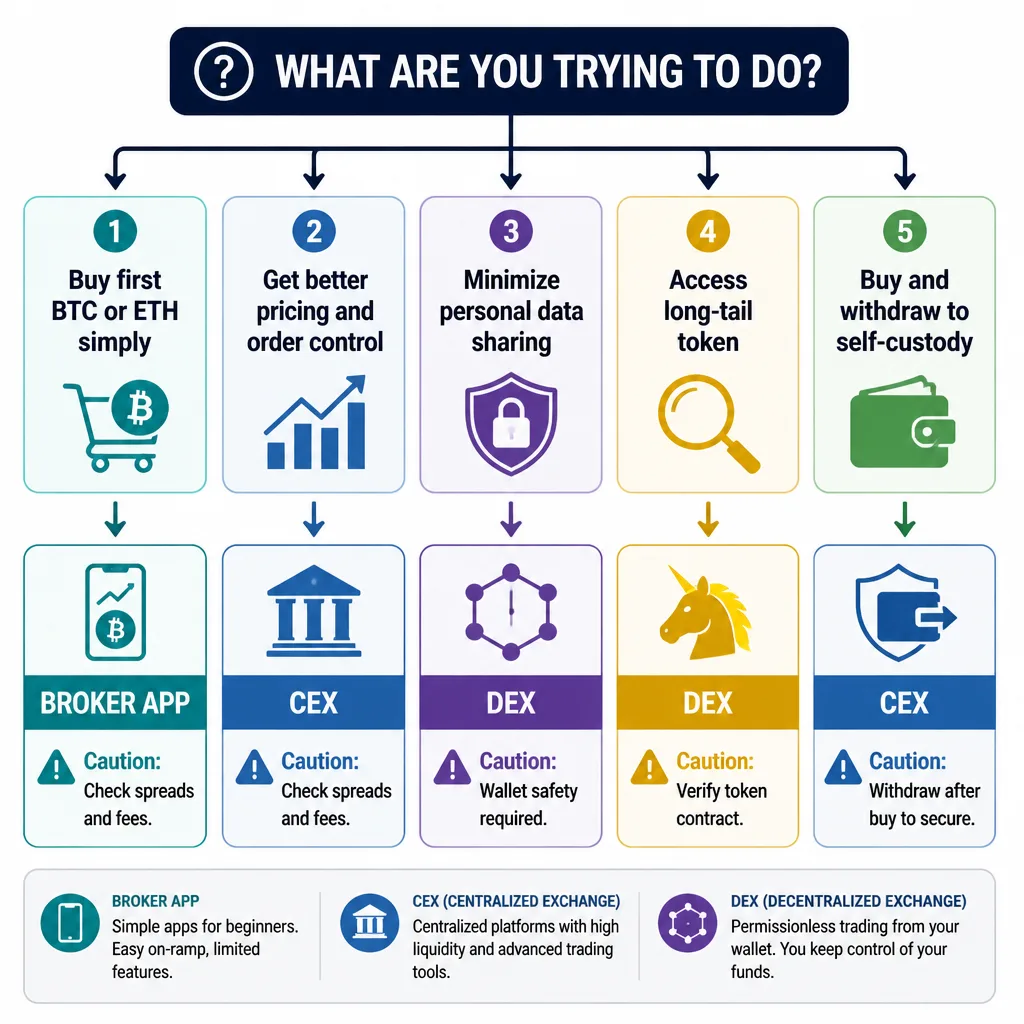
Use these shortcuts when the choice is not obvious.
Goal: buy your first BTC or ETH with minimal friction
Start with a reputable broker app or a beginner-friendly CEX. Then compare the all-in cost before you buy.
If the quoted price is noticeably worse than a market reference, or if withdrawals are limited, a CEX may be the better long-term choice.
Goal: get better pricing and order control
Use a liquid CEX. This is usually the default choice for larger buys, recurring buys followed by withdrawal, or active trading.
Goal: minimize personal data sharing
A DEX may fit if you already know how to use a wallet safely and the asset is available on-chain.
Be realistic, though. A DEX usually avoids account-level KYC, but your wallet activity is still publicly visible. That is lower identity submission, not guaranteed privacy.
Goal: access a long-tail or newly launched token
A DEX is often the only option. Verify the token contract through the project’s official channels, check liquidity, and account for gas and slippage before trading.
Goal: buy and hold for self-custody
A CEX is often the most practical bridge. Buy a major asset, then withdraw it to your own wallet once you are ready.
Decision Rule: For major assets and smoother onboarding, a CEX often works best. For niche token access and direct control, a DEX often works best.
Real-world examples
Example 1: a beginner buying a small amount of BTC
A new user wants to buy $200 of BTC. A broker app offers the easiest experience, but the quoted buy price includes a wider spread. A CEX charges a visible fee, yet the user ends up with slightly more BTC because the spread is tighter.
The broker app may still be worth it if convenience matters more than a few dollars. But the user should understand that tradeoff.
Example 2: a trader who cares about execution
A user wants to buy a larger amount of ETH and avoid a poor fill. A CEX with deep liquidity and limit orders is usually the better choice.
In this case, execution quality matters more than interface simplicity. A better fill can save more than the difference in listed fees.
Example 3: a user buying a long-tail token on a DEX
A token is not listed on major exchanges. The user connects a wallet to a DEX, checks the official token contract address, reviews liquidity, sets slippage carefully, and confirms the gas fee.
This is where a DEX is useful. But it is only safe if the user verifies the contract and understands token approvals. Buying the wrong token can be irreversible.
Example 4: a long-term holder moving to a hardware wallet
A long-term BTC holder buys on a CEX, then withdraws to a hardware wallet after sending a small test transaction. At that point, the main risk shifts from platform custody risk to personal key-management risk.
That is what self-custody really changes. You remove one dependency and accept another.
Common mistakes
Common Mistake: “Zero-fee” claims often distract from wider spreads.
Focusing only on listed fees
A venue can advertise zero commission and still give you a worse overall price. Compare the all-in cost, not just the published fee schedule.
Assuming “available” means “withdrawable”
Some broker apps offer price exposure without meaningful transfer freedom. If withdrawal matters to you, confirm that before funding the account.
Chasing token access without checking contract risk
On a DEX, access is easy. Verification is your responsibility. Check the token contract, liquidity depth, and official project links.
Moving to self-custody too early
Self-custody is powerful, but it is not beginner-proof. If you do not understand seed phrase security, device hygiene, and network selection, slow down.
Sending assets on the wrong network
This is one of the most common and most preventable mistakes. Confirm both the address and the network every time.
Ignoring approval hygiene on DEXs
Old token approvals can remain active long after a trade. Review and revoke approvals you no longer need.
Safety checklist before you trade
For broker app users
- Confirm whether on-chain withdrawals are supported
- Compare the quoted price against a reference market
- Check both buy and sell spread, not just the entry quote
- Verify whether you are buying spot crypto or synthetic exposure
- Enable strong account security and 2FA where available
- Use only the official app or website
For CEX users
- Verify the official domain or app before logging in
- Use a unique password and strong 2FA
- Review fee schedules and supported withdrawal networks[^1]
- Confirm withdrawal holds, limits, or restrictions
- Send a small test withdrawal before moving a larger amount
- Double-check address and network every time
For DEX users
- Use the official front end or trusted documentation[^2]
- Verify the token contract address from official project sources
- Check slippage, liquidity, and gas before confirming
- Review exactly what approval you are granting
- Revoke approvals you no longer need
- Consider hardware-wallet signing for larger amounts
- Avoid bridging or swapping funds you cannot afford to lose
Bottom Line: A small test transaction is much cheaper than a large irreversible mistake.
Conclusion
The best crypto trading venue is the one that fits your goal with the least dangerous tradeoff.
If you want the easiest start, a broker app or beginner-friendly CEX can make sense. If you care about execution quality, liquidity, and better order control, a CEX is usually the default. If you care most about self-custody, wallet-native trading, or long-tail token access, a DEX may be worth the extra complexity.
Many users move through these options in stages. They start with convenience, shift toward better execution, and later adopt self-custody or DEXs for specific use cases.
The practical rule is simple: match the venue to the job, and reassess as your needs change.
FAQ
What is the difference between a centralized exchange, a DEX, and a broker app?
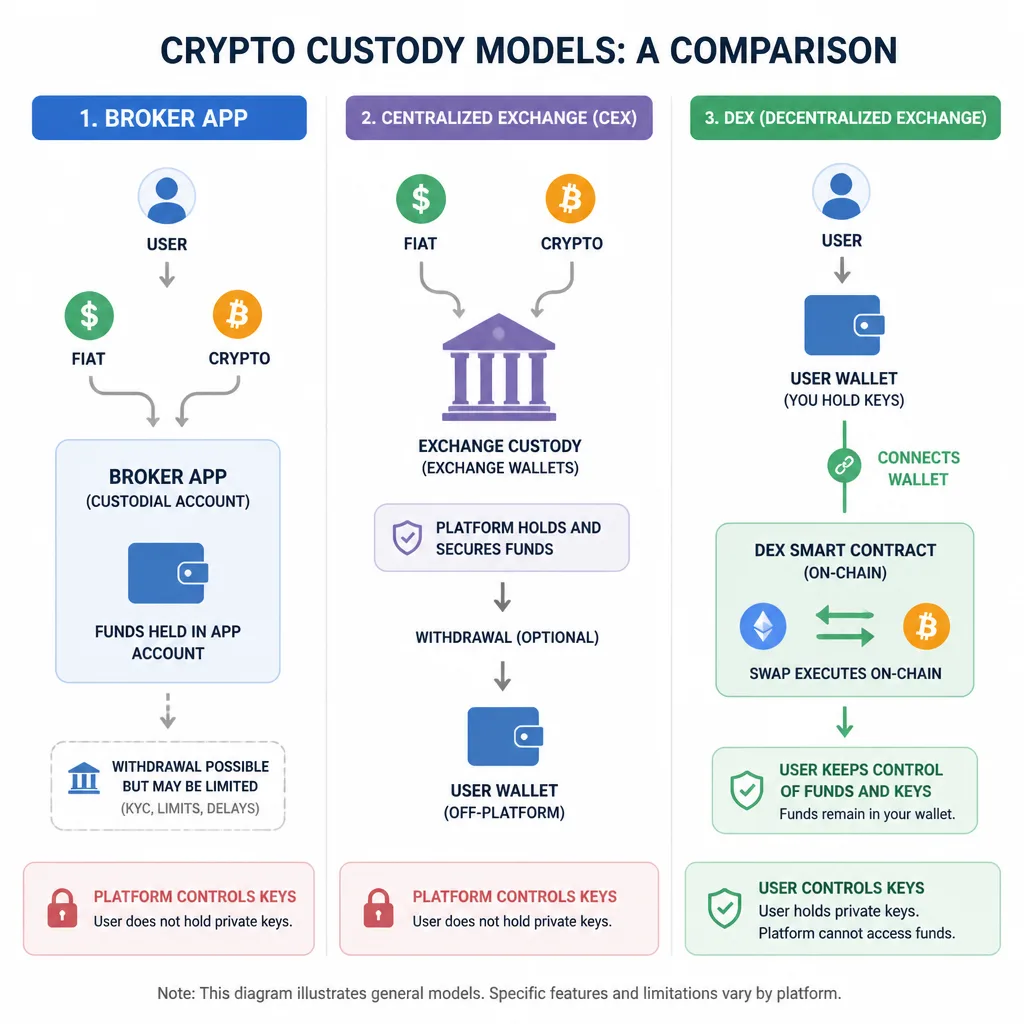
A centralized exchange (CEX) is a custodial platform that matches buyers and sellers and usually offers stronger liquidity and better order tools. A DEX lets you trade from your own wallet through smart contracts, which gives you more control but also more responsibility. A broker app simplifies buying and selling, often through an easier interface, but may offer less transparent pricing and limited withdrawal options.
Which option is best for beginners?
For many beginners, a reputable broker app or beginner-friendly CEX is the easiest place to start. The important part is comparing the all-in cost, not just the advertised fee, and confirming whether withdrawals to your own wallet are supported.
When is a CEX better than a broker app?
A CEX is usually the better choice when you care about execution quality, visible order books, lower spreads, advanced order types, or easier withdrawals to self-custody. Broker apps are simpler, but that convenience can come with wider spreads or less flexibility.
When is a DEX worth the extra complexity?
A DEX is often worth it when self-custody matters, when you want access to long-tail tokens, or when you want to trade directly from your wallet. It makes less sense if you are not comfortable with wallet security, token approvals, gas fees, and contract verification.
If I cannot withdraw to my own wallet, do I really own the crypto?
If a platform does not let you withdraw to your own wallet, treat it as crypto exposure first and full control second. You may benefit from price movement, but your practical ownership is limited because you cannot move the asset on-chain when you choose.
What matters more: fees or spread?
Both matter, but many users underestimate spread. A platform can advertise zero commission and still give you a worse overall price through a wider spread. What matters is the all-in cost: fees, spread, slippage, and any network or gas costs.
Is using a DEX private?
Not in the way many people assume. DEXs usually do not require account-level KYC, but wallet activity is still visible on public blockchains. That means behavior can often be traced or linked over time.
What are the main risks of using a CEX?
The main risks include platform insolvency, hacks, withdrawal freezes, account lockouts, delistings, and payment or banking disruptions. These are different from DEX risks because they depend on the platform’s operations and financial health.
What are the main risks of using a DEX?
The main risks include wallet compromise, seed phrase loss, malicious token approvals, fake token contracts, phishing front ends, bridge failures, and smart contract exploits. These mistakes are often harder to reverse because you control the wallet and sign the transactions yourself.
How should I choose the right venue?
Start with your goal. If you want simplicity, a broker app or beginner-friendly CEX may fit. If you want better execution and liquidity, a CEX is usually the default. If you want self-custody and broader token access, a DEX may be the right tool. The best choice comes down to which tradeoff matters most: convenience, control, pricing, privacy, or asset access.