Binance vs Coinbase vs Kraken vs OKX: Which Exchange Fits Your Trading Style?
Choosing between Binance, Coinbase, Kraken, and OKX is less about brand size and more about fit.
Many traders compare only headline fees, then run into the real costs later: wider spreads, thinner liquidity on their pair, awkward fiat withdrawals, or friction when markets get volatile. A low-fee exchange can still be expensive if execution is poor or getting funds out is difficult.
This guide compares the four platforms around what actually matters: total trading cost, fiat deposits and withdrawals, order control, and reliability under stress. It also includes a simple way to test an exchange with small amounts before committing more capital.
Key Insight: The best exchange is usually the one that fits your pair, region, funding method, and order style, not the one with the most aggressive fee table.
What Actually Matters When Comparing Exchanges
If your goal is cheap, frequent spot execution, your best option may be very different from someone who just wants easy bank deposits and simple cash-outs.
Headline fees are only part of the cost
Posted maker/taker fees matter, but they are only one layer.
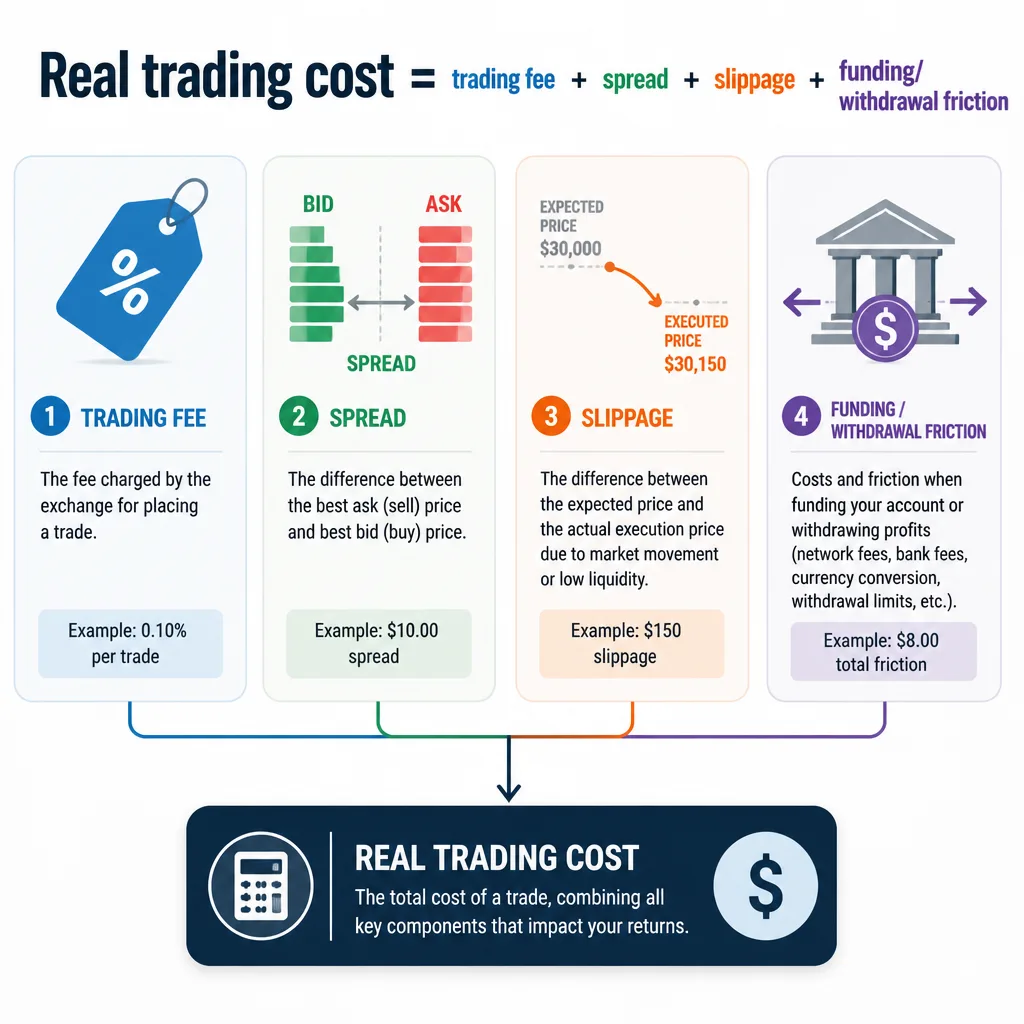
Real trading cost = trading fee + spread + slippage + funding/withdrawal friction
An exchange can show low fees and still cost more if:
- spreads are wider
- the order book is thinner
- card purchases add extra fees
- fiat withdrawals are slow or awkward
- local banking support is weak
Focus on four outcomes
A useful comparison comes down to four questions:
- Which platform gives you the lowest total trading cost?
- Which gives you the best fiat on-ramp and off-ramp?
- Which gives you the best order control?
- Which is more dependable during volatility?
Decision Rule: If you trade small amounts infrequently, convenience may matter more than shaving a few basis points. If you trade often or in larger size, execution quality matters much more.
Quick Decision Table
| Exchange | Best For | Main Strength | Main Limitation |
|---|---|---|---|
| Binance | Active traders seeking low visible fees and broad market access | Often strong liquidity and competitive fees where available[^1] | Regional access and product availability vary a lot |
| Coinbase | Beginners and convenience-first users | Simple fiat onboarding and familiar interface[^2] | Can be more expensive depending on route, spread, and payment method |
| Kraken | Users who value clearer structure and dependable fiat handling | Often seen as conservative, straightforward, and fiat-friendly in supported markets[^3] | May feel narrower than platforms built around broader trading breadth |
| OKX | Active traders who want advanced tools and competitive trading conditions | Strong trading functionality and often competitive pricing where accessible[^4] | Availability depends heavily on jurisdiction |
In broad terms
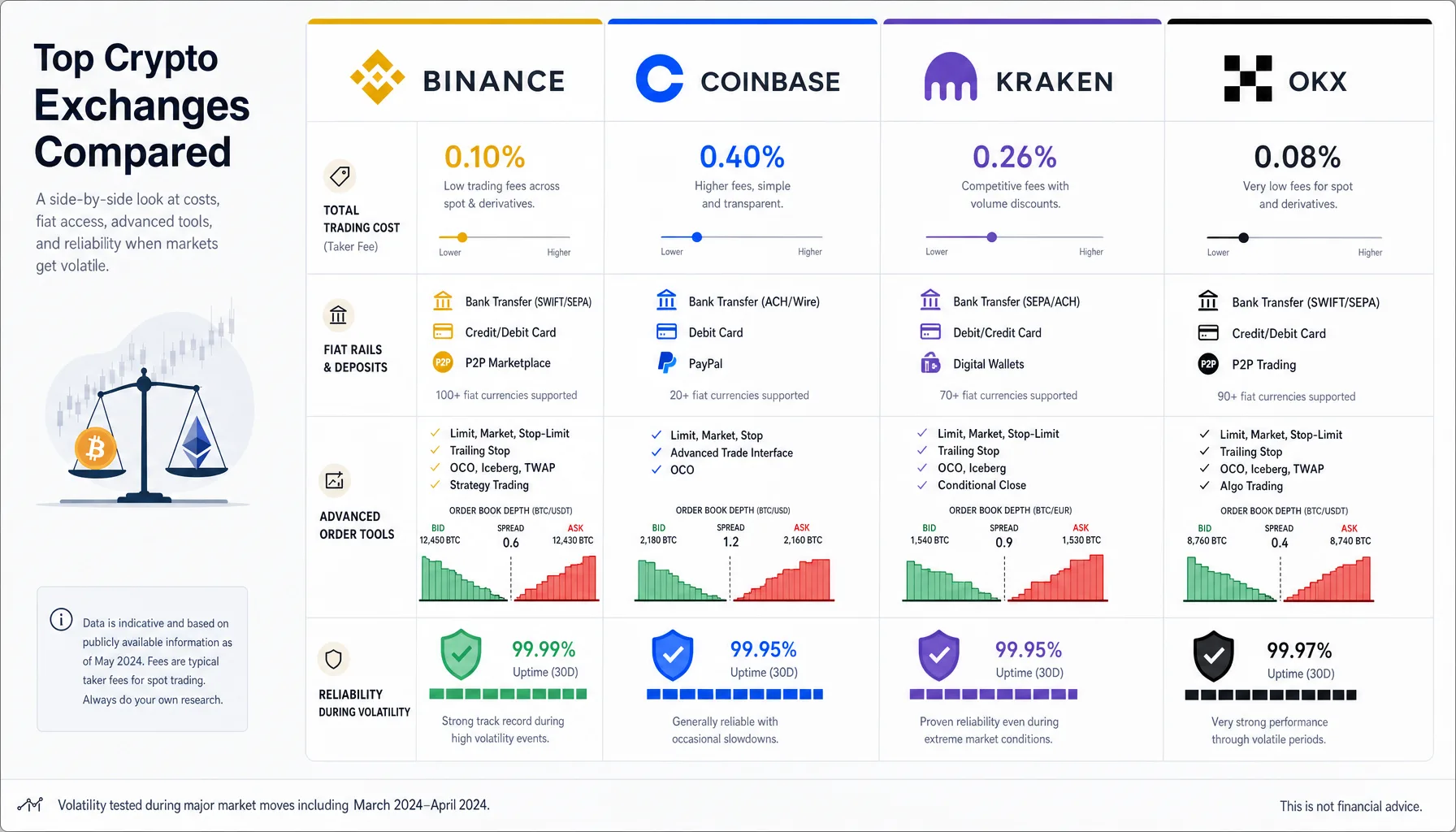
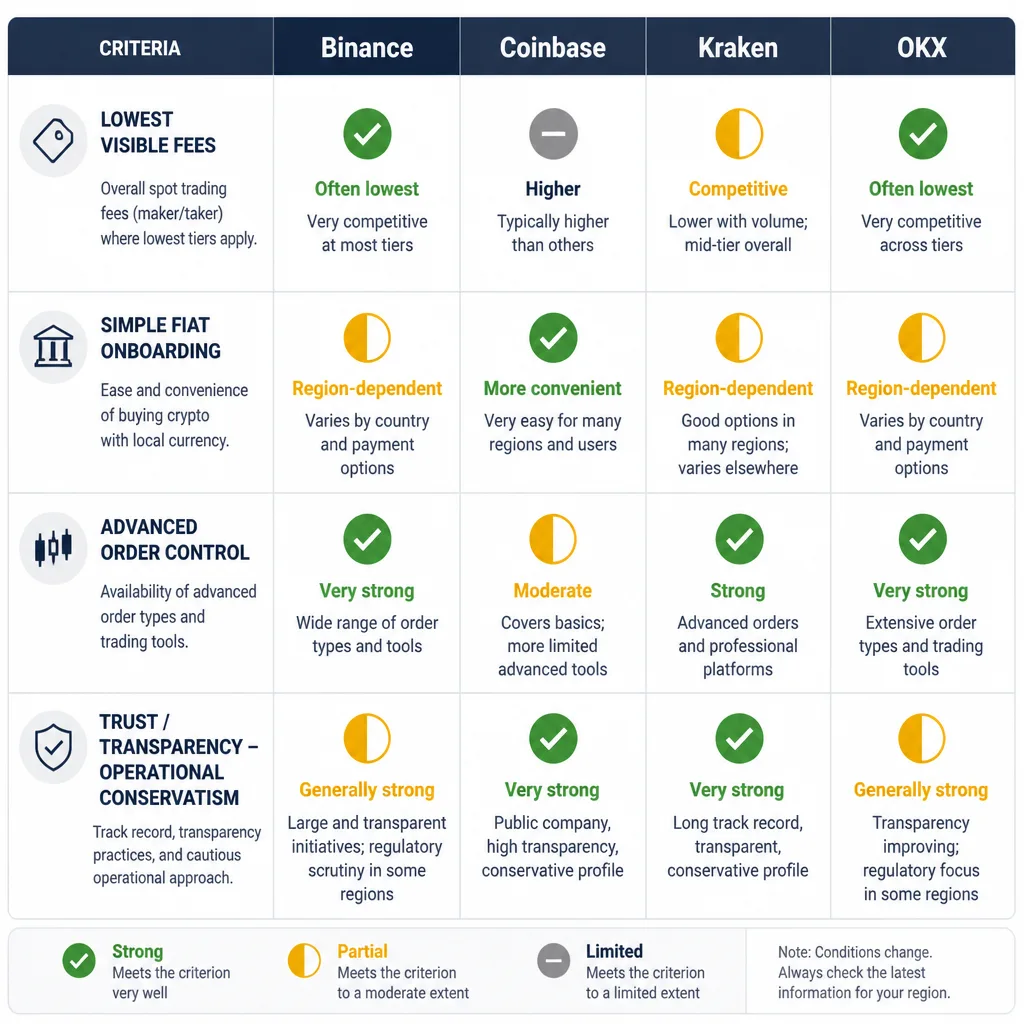
- Lowest visible fees: Binance and OKX often stand out
- Simplest fiat onboarding: Coinbase often leads
- Best advanced trading interface: Binance and OKX usually appeal most
- Most conservative operating profile: Kraken is often a common shortlist choice
Bottom Line: There is no universal winner. Each platform tends to fit a different kind of user.
Compare Total Cost, Not Just Trading Fees
Many exchange comparisons stop at fee pages. That is too shallow.
Maker/taker fees vs real execution cost
- Maker fees apply when your order adds liquidity, such as a limit order that sits on the book.
- Taker fees apply when your order removes liquidity, such as a market order or a limit order that fills immediately.
Those are explicit costs. They are not the full cost.
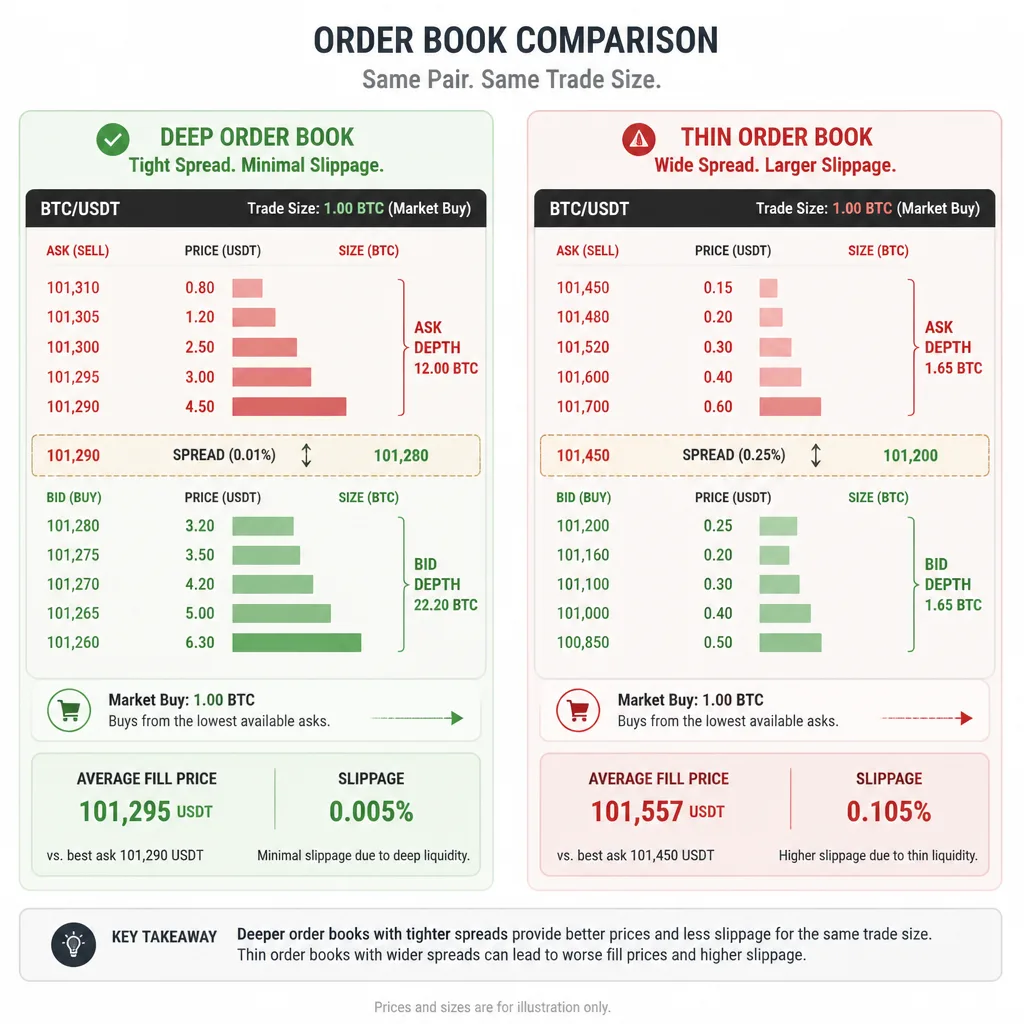
Spread and slippage can change the result
- Spread is the gap between the best bid and best ask.
- Slippage is the difference between the expected price and the actual fill, usually caused by order size or thin liquidity.
A simple example:
- Exchange A charges a 0.10% trading fee
- Exchange B charges a 0.25% trading fee
- But Exchange B has a tighter spread and deeper order book on your pair
For a small BTC buy, the difference may be negligible. On some pairs, Exchange B could even produce the better all-in result.
This matters even more for smaller-cap assets and fast markets.
Liquidity is pair-specific
Liquidity varies by:
- asset
- quote currency
- trade size
- time of day
- market conditions
A deep BTC/USDT book tells you very little about a thinner altcoin/EUR pair. What matters is depth on the exact pair you plan to trade.
Common Mistake: Comparing fee tables without checking whether you will trade through a tight order book, a convenience interface, or an expensive payment rail.
Bottom Line: Real execution cost matters more than advertised fees.
Exchange-by-Exchange Comparison
Binance
Binance often attracts active traders because it frequently offers competitive visible fees and strong liquidity on major pairs where its full offering is available[^1].
Its main limitation is often regional access. Depending on your jurisdiction, available products, banking methods, and supported services may differ significantly.
Coinbase
Coinbase usually stands out for simplicity. For many users, especially beginners, onboarding feels easier and more familiar than on trading-first platforms[^2].
The tradeoff is often cost. If you use convenience purchase routes or card funding, Coinbase can be materially more expensive than bank-transfer-based exchange trading. The gap is especially noticeable for active users.
Kraken
Kraken is often favored by users who want a more straightforward experience, especially around fiat handling in supported markets[^3]. It tends to appeal to traders who value operational clarity over maximum product breadth.
It may not always lead on visible fees, but it can still be competitive when fiat movement and off-ramping matter more.
OKX
OKX often appeals to active traders looking for competitive fee structures, strong trading functionality, and more advanced tools where available[^4].
Like Binance, the biggest caveat is jurisdiction. Product access, legal availability, and local support can vary sharply.
Decision Rule: If Binance or OKX looks best on paper, confirm that your local version supports the funding methods, products, and trading features you expect.
Which Exchange Tends to Offer the Lowest Total Trading Cost?
| Outcome | Binance | Coinbase | Kraken | OKX |
|---|---|---|---|---|
| Lowest total cost | Often strong on major pairs where access is good | Can be higher, especially via convenience flows | Can be competitive depending on pair and usage | Often strong for active traders where available |
| Fiat convenience | Varies by region | Often strong in supported markets | Often strong in key supported regions | Varies significantly by country |
| Advanced order tools | Usually strong | Good for many spot users, but may feel more limited to active traders | Solid, depending on product and region | Usually strong |
| Reliability tendency | Depends on region and market conditions | Strong brand trust, but not immune to stress | Often perceived as conservative and steady | Can be strong, but access and local conditions matter |
When Binance or OKX may win
Binance and OKX often look strongest for active spot traders because lower visible fees and stronger books can reduce all-in cost[^1][^4].
This matters most when you:
- trade frequently
- use limit or post-only orders
- trade major pairs with deep books
- care about basis-point-level differences
When Coinbase can still make sense
Coinbase can be the right choice for ease of use, but it may cost more if you:
- buy with cards instead of bank transfers
- use convenience flows instead of advanced trading
- trade actively rather than occasionally
That does not automatically make it a poor choice. It means you are paying partly for ease and simpler access.
When Kraken becomes competitive
Kraken becomes more appealing when your decision is not purely about the lowest posted fee. If fiat movement is smoother, exits feel more dependable, and your trading frequency is moderate, its overall value can be strong[^3].
Bottom Line: For active spot traders, Binance and OKX often lead on cost. For users who care more about banking and exits, Kraken or Coinbase may still be the better economic choice overall.
Which Exchange Has the Best Fiat Rails?
The best fiat experience is often local. The global brand matters less than the quality of the banking rails in your country.
Coinbase often stands out for easy onboarding in supported markets[^2]. Kraken also tends to perform well in key regions for straightforward fiat handling[^3]. Binance and OKX can work well too, but local method availability may vary more.
The core tradeoff
- Card purchases: faster, usually more expensive
- Bank transfers: slower, usually cheaper
- Local payment rails: potentially convenient, but country-specific
A beginner may value instant access more than cost. An active trader usually prefers cheaper funding even if it takes longer.
Why location matters so much
Jurisdiction affects:
- supported currencies
- deposit methods
- withdrawal rails
- verification requirements
- available products
That is why a comparison written for one country may be much less useful somewhere else.
Key Insight: Fiat experience is one of the most local parts of crypto trading. Always verify official deposit and withdrawal pages for your region before choosing.
Which Exchange Is Best for Order Control?
Active traders care about tools because tools affect both cost and risk.
Common order features that matter
- Post-only: helps avoid taking liquidity
- Stop-limit: gives more price control than a simple stop, though it may not fill in a fast move
- Reduce-only: useful in leveraged or derivatives contexts where available
- TWAP or similar tools: useful for splitting larger orders into smaller ones
What active traders need
If you buy occasionally and hold, almost any solid spot interface is probably enough.
If you trade actively, you may care more about:
- precise order control
- responsive order management
- API quality
- efficient entries and exits
- flexibility in fast markets
Which platforms usually feel more flexible
Binance and OKX usually feel more flexible for active traders. Coinbase may be enough for many spot users, but some traders find it less suited to deeper execution workflows. Kraken often sits between the two, with a cleaner structure that many users prefer.
Decision Rule: If your strategy depends on order placement precision, do not choose an exchange based only on brand familiarity or app design.
Which Exchange Is More Reliable During Volatility?
Reliability is not just whether the app opens. It includes:
- site and app responsiveness
- order placement speed
- order cancellation reliability
- chart and API stability
- continued withdrawals during stress
An exchange can feel excellent in calm markets and struggle when volatility spikes. That is when spreads widen, books move faster, market orders slip more, and support becomes less useful.
Kraken is often perceived as more conservative operationally. Coinbase benefits from mainstream familiarity and broad trust. Binance and OKX can be very strong in trading functionality where available. But none of that guarantees future performance.
Common Mistake: Treating reliability as a permanent label. It changes with market load, regulation, and regional operations.
Bottom Line: Judge reliability as a tendency, not a promise.
A Practical Framework: Match the Exchange to Your Trading Style
The COST Framework
| COST Factor | What to Check | Why It Matters |
|---|---|---|
| Cost | Fees, spread, slippage, deposit/withdrawal costs | Shows your true all-in result |
| On-ramp | Bank transfer support, card access, local currency options | Determines how easily you can move money in and out |
| Strategy tools | Order types, interface depth, API quality | Affects execution control and risk management |
| Tolerance for friction | Verification burden, regional restrictions, transfer complexity | Helps you avoid choosing a platform that is powerful but impractical |
Example profiles
Beginner buying with bank transfers
A beginner often benefits most from Coinbase if it is well supported locally, because simple onboarding and familiar banking flows reduce friction. Kraken can also be a strong option if local fiat handling is better.
Active spot trader optimizing execution
This user often compares Binance and OKX first, then checks actual pair liquidity and spread. For this profile, execution quality matters more than interface simplicity.
Trader who values stable fiat exits
This user often shortlists Kraken, and sometimes Coinbase, because getting money out cleanly matters as much as the trade itself.
International user seeking product breadth
This trader may prefer Binance or OKX where access is legally and operationally strong, but should verify country-specific limitations carefully.
Bottom Line: The COST framework helps prevent a common mistake: choosing the most famous exchange instead of the most suitable one.
How to Test an Exchange Before Committing Serious Capital
Most comparison articles skip this step. They should not.
What to test
- Check order book depth on your exact trading pair.
- Place a small market order and compare the expected price with the average fill.
- Place a small limit order to see how the interface and execution behave.
- Test a small fiat deposit and withdrawal if that matters for your workflow.
- Test a small crypto withdrawal on the network you plan to use.
- Repeat at least one test during a busy market period.
Low-risk exchange testing checklist
- Verify your exact pair and quote currency
- Check spread and visible order book depth
- Place a small market order
- Place a small limit order
- Test a small fiat deposit and withdrawal
- Test a small crypto withdrawal
- Review support responsiveness
- Repeat one test during higher volatility
Decision Rule: Never scale up on an exchange you have not tested end to end.
Common Mistakes When Comparing These Exchanges
Comparing posted fees without checking spread
This is the biggest error. Low posted fees do not guarantee low total cost.
Assuming the global experience is the same everywhere
It is not. Binance and OKX especially require careful regional verification, but Coinbase and Kraken also differ by jurisdiction.
Choosing based on interface alone
A polished app can still be a poor fit if liquidity, funding, or order control does not match your needs.
Ignoring withdrawal reliability
Many users only realize how important off-ramping is when they urgently need funds out.
Bottom Line: The best comparison is practical, local, and pair-specific.
Bottom Line: Which Exchange Should You Choose?
If you want the short version:
- Choose Coinbase if simple fiat onboarding and ease of use matter more than the absolute lowest cost.
- Choose Binance if you are an active trader focused on fees and liquidity, and your region gives you solid access.
- Choose Kraken if you value straightforward structure, stronger fiat confidence in supported markets, and a more conservative feel.
- Choose OKX if you want active-trader functionality and competitive trading conditions where available.
There is no single winner here. The best choice depends on your funding method, country, order style, and tolerance for friction.
In some cases, using more than one exchange makes sense: one for fiat on-ramping and another for better execution. The tradeoff is more transfers, more account management, and more complexity.
Exchange conditions also change. Fees, payment rails, supported assets, and product access should always be checked on official pages before you act[^1][^2][^3][^4].
FAQ
Which exchange is best for my trading style?
It depends on what you want to optimize. Coinbase often appeals to users who want simple fiat onboarding and a familiar interface. Binance and OKX often attract active traders looking for lower visible fees, deeper books, and broader trading tools where available. Kraken is often favored by users who value straightforward structure, strong fiat support in key regions, and a more conservative operating style.
Which one usually has the lowest total trading cost?
There is no universal winner. Total cost includes more than the maker or taker fee. You also need to account for spread, slippage, payment method costs, and withdrawal friction. Binance and OKX often look strong on visible fees, but the best result depends on the exact pair, your order size, and your region.
How should I compare them beyond headline fees?
Use an outcome-based comparison. Check four things: all-in cost, fiat deposit and withdrawal convenience, order tools, and reliability during volatile conditions. Then test your actual pair using small trades and a small withdrawal before moving larger capital.
What is the difference between posted trading fees and real execution cost?
Posted trading fees are only one part of the cost. Real execution cost also includes spread, slippage, and sometimes funding or withdrawal costs.
How much do spreads and slippage matter?
They can matter as much as, or more than, the fee table. A platform with slightly higher fees may still produce a better fill if the spread is tighter and the order book is deeper on your chosen pair.
Can Coinbase cost more even if it feels easier to use?
Yes. Coinbase can be convenient, especially for beginners or users prioritizing fiat access, but convenience flows and certain payment methods can be more expensive than lower-cost exchange routes.
When does Kraken become a better choice?
Kraken can be the better choice when you care more about operational clarity, fiat handling in supported markets, and a more conservative setup than chasing the lowest visible fee.
Is OKX better than Binance for active traders in some markets?
In some regions and for some users, yes. OKX can be very competitive for active traders looking for advanced tools and strong trading functionality. But access and product availability vary by jurisdiction.
Which exchange has the best fiat deposit and withdrawal experience?
That is heavily country-specific. Coinbase often stands out for easy onboarding in supported markets, while Kraken is also often strong for fiat support in key regions. Binance and OKX can work well in some countries but tend to vary more by local payment rails and product access.
Why does my country matter so much?
Because the experience is not the same globally. Supported payment methods, local banking relationships, trading products, withdrawal options, and even which entity serves you can differ by jurisdiction.
Which platform offers the best advanced order types?
Binance and OKX often appeal most to active traders who want more execution control and broader trading functionality where accessible. Kraken can also be strong depending on product and region. Coinbase may be sufficient for many spot traders, but some active users may find it more restrictive.
What should I look for during volatile market conditions?
Focus on practical reliability: site and app responsiveness, order placement and cancellation performance, chart and API stability, and whether deposits and withdrawals continue working smoothly during market stress.
How can I test an exchange safely before moving serious capital?
Start small. Verify your exact pair, inspect order book depth, place a small market order to observe slippage, test a small limit order, and run a small fiat or crypto withdrawal.
Should I use one exchange for fiat and another for execution?
For some users, yes. One platform may be better for fiat deposits and withdrawals, while another may offer better liquidity or lower all-in execution cost. The tradeoff is added complexity and more transfers.
What are the most common comparison mistakes?
The biggest mistakes are comparing only fee tables, ignoring spread and slippage, assuming the global version matches the local experience, choosing based only on interface design, and failing to test withdrawals before they matter.